Do your rings feel tight by the afternoon? Do your socks leave deep marks around your ankles? Do you wake up with a puffy face, or feel heavy and bloated, especially in hot weather or before your period? That’s fluid retention, and it’s one of the most common things I see in clinic.
The good news is that for many people, it responds beautifully to a few simple food changes. Two of the biggest are eating more fruit and getting the balance between potassium and salt right.
What is fluid retention?
Your body is about 60% water. Most of it sits inside your cells, and some flows around in your blood and in the spaces between your cells. Fluid retention (also called oedema) is when extra fluid builds up in those spaces, usually in your feet, ankles, legs, hands and face.
Your kidneys and your lymphatic system work together to keep this balanced. Remember our Uber Eats and rubbish trucks? Your blood is Uber Eats, delivering dinner packages (nutrients and oxygen) to every cell. Some fluid leaks out into the spaces between your cells along the way. Your lymphatic system is the rubbish trucks that come along to collect what’s left over. If the trucks are running slow, or there’s more fluid than they can carry, it pools, and you feel puffy.
Water follows salt
Here’s the most important idea in this article: water follows salt. Sodium, the main part of salt, acts like a sponge. Your body likes to keep sodium at a very steady concentration in your fluids, so when you eat a salty meal, you get thirsty and your kidneys hold on to water to dilute it. More salt, more water held.
That’s why you can wake up puffy and a kilo heavier after a salty takeaway meal. It isn’t fat. It’s water your body is holding to balance the salt.
The salt and potassium see-saw
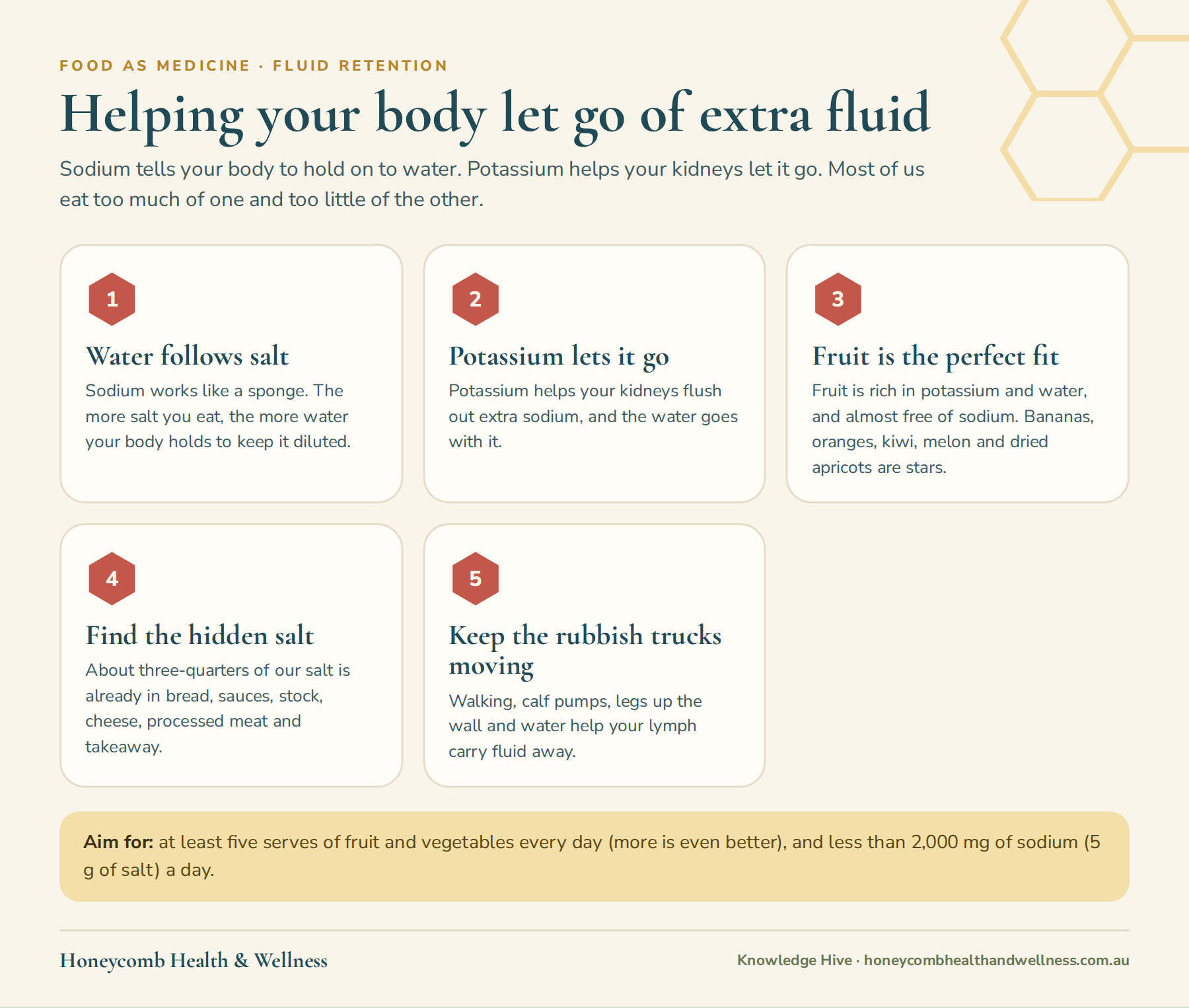
Sodium and potassium work like a see-saw. Sodium tells your body to hold on to water. Potassium helps your kidneys release sodium, and the water goes with it. Potassium also helps relax your blood vessel walls.
For most of human history, people ate several times more potassium than sodium, from fruit, vegetables, tubers and legumes. Today, the see-saw has tipped the other way. The World Health Organization recommends less than 2,000 mg of sodium a day (5 g of salt, about a level teaspoon) and at least 3,500 mg of potassium (WHO, 2012). Most Australians eat close to double the sodium and not enough potassium.
When researchers pooled the trials, eating more potassium lowered blood pressure in people with high blood pressure, with no harm to kidney function or blood fats in healthy people (Aburto et al., 2013). In the famous DASH-Sodium trial, a diet rich in fruit and vegetables combined with less salt lowered blood pressure more than either change on its own (Sacks et al., 2001). The same balance that helps your blood pressure helps your body let go of extra fluid. (Read Blood pressure and salt.)
Why fruit is so good for fluid retention
Fruit is almost perfectly designed for this job:
- Rich in potassium. It pushes the see-saw back towards letting go.
- Almost no sodium. A banana has about 1 mg of sodium. A slice of white bread has about 150 mg.
- Full of water. Watermelon, rockmelon, oranges and berries are around 85 to 90% water, so they hydrate you as well.
- Easy to eat more of. It’s a snack, a dessert and a breakfast that needs no cooking.
Potassium-rich foods
| Food | Potassium (approx.) |
|---|---|
| Potato, baked with skin (1 medium) | 900 mg |
| White beans or lentils (1 cup cooked) | 600 to 1,000 mg |
| Sweet potato (1 medium) | 450 mg |
| Banana (1 medium) | 400 mg |
| Dried apricots (10 halves) | 400 mg |
| Rockmelon (1 cup) | 400 mg |
| Spinach (1 cup cooked) | 800 mg |
| Orange (1 medium) | 250 mg |
| Kiwi fruit (2) | 400 mg |
| Tomato (1 large) | 400 mg |
Notice how many of these are the whole starches and legumes we already love at Honeycomb. A potato with its skin on is one of the richest potassium foods there is.
Where is all the salt coming from?
Most of our salt doesn’t come from the salt shaker. About three-quarters is already in the food we buy before it reaches the table. The biggest sources are:
- Bread, wraps and crackers (bread is the biggest single source for many Australians)
- Stock cubes, soy sauce, sauces, gravies and seasoning mixes
- Cheese, processed meats, ham and bacon
- Takeaway, restaurant meals and frozen meals
- Chips, salted nuts and savoury snacks
- Tinned soups and tinned vegetables with added salt
Label check: look at the sodium “per 100 g” column. Under 120 mg per 100 g is low salt and the best choice. Over 400 mg per 100 g is high.
What you can start today
- Eat fruit at least twice a day. A banana with breakfast and an orange or kiwi in the afternoon is a great start.
- Have a potato, sweet potato or legume every day for a big potassium boost.
- Swap to salt-reduced stock, tinned beans and sauces, and rinse tinned beans and vegetables.
- Flavour with herbs, garlic, lemon, lime, vinegar, chilli and spices instead of salt. Your taste buds adjust over a few weeks, and before long salty food starts to taste too salty. (Read Retraining your taste buds for less salt.)
- Drink water through the day. It sounds backwards, but when you’re under-hydrated, your body holds on to water more tightly.
- Keep the rubbish trucks moving. Walk, do calf raises at your desk, and put your legs up the wall for 10 minutes in the evening. (Read Move your lymph.)
Other things that can cause fluid retention
- Hormones: many women retain fluid in the week before their period, during pregnancy and in perimenopause.
- Heat: blood vessels widen in hot weather, so a Queensland summer often brings puffy ankles.
- Sitting or standing for long periods, including long flights and car trips.
- Some medications, including certain blood pressure medications, anti-inflammatories, steroids and the contraceptive pill.
- A sluggish lymphatic system, or swelling after surgery or injury.
When to get checked straight away
Most fluid retention is mild and responds to these changes. But please see a doctor promptly if you notice:
- Swelling in only one leg, especially if it’s painful, red or warm (this can be a blood clot)
- Swelling with breathlessness, chest pain, or trouble breathing when lying down
- Puffiness around the eyes with foamy urine, or passing much less urine than usual
- Swelling that comes on suddenly, or keeps getting worse
Important about potassium: if you have kidney disease, or take medications such as ACE inhibitors, ARBs, potassium-sparing diuretics or spironolactone, talk to your doctor or pharmacist before increasing potassium or using “low-sodium” salt substitutes, which are often made with potassium. Food sources are very different from supplements, and I don’t recommend potassium supplements without testing.
Recipes that help
- Strawberry Banana Oat Smoothie
- Fruity Kiwi Smoothie
- Lentil & Potato Soup
- Apple Cinnamon Stuffed Sweet Potato
- Spicy Cucumber Juice
In clinic, I look at the whole picture: your diet, hormones, lymph, kidney and liver function, and any medications, and build a plan to help your body find its balance again. Inside the Honeycomb Community, the Six-Week Nutrition Reset is naturally low in salt and rich in potassium from day one.
Water follows salt, and potassium shows it the way out. Tip the see-saw back with fruit, potatoes and beans, and your body can let go.
A note on medication: please don’t stop or change any prescribed medication on your own. When you change the way you eat, your numbers can move quickly, so keep your prescribing doctor informed so your doses can be reviewed as you improve. This is especially important for blood pressure medications and diuretics (fluid tablets), because your needs can change when you change the way you eat.
References
- World Health Organization. Guideline: Sodium intake for adults and children. Geneva: WHO; 2012.
- World Health Organization. Guideline: Potassium intake for adults and children. Geneva: WHO; 2012.
- Aburto NJ et al. Effect of increased potassium intake on cardiovascular risk factors and disease: systematic review and meta-analyses. BMJ. 2013;346:f1378.
- Sacks FM et al. Effects on blood pressure of reduced dietary sodium and the Dietary Approaches to Stop Hypertension (DASH) diet. New England Journal of Medicine. 2001;344(1):3-10.
- He FJ, MacGregor GA. A comprehensive review on salt and health and current experience of worldwide salt reduction programmes. Journal of Human Hypertension. 2009;23(6):363-384.
How Honeycomb can help
You don’t have to work this out alone
This information is general education and is not a substitute for individual advice. Please speak with your health practitioner before making changes, especially if you take prescribed medication.
Keep going
You’re not doing this alone
This information is general education and is not a substitute for individual advice. Please speak with your health practitioner before making changes, especially if you take prescribed medication.