

When people think of detox, they rarely think of their walking shoes. But in clinic, movement is one of the first things I talk about, because of a system most people have never been taught about: your lymphatic system.
Uber Eats and the rubbish trucks
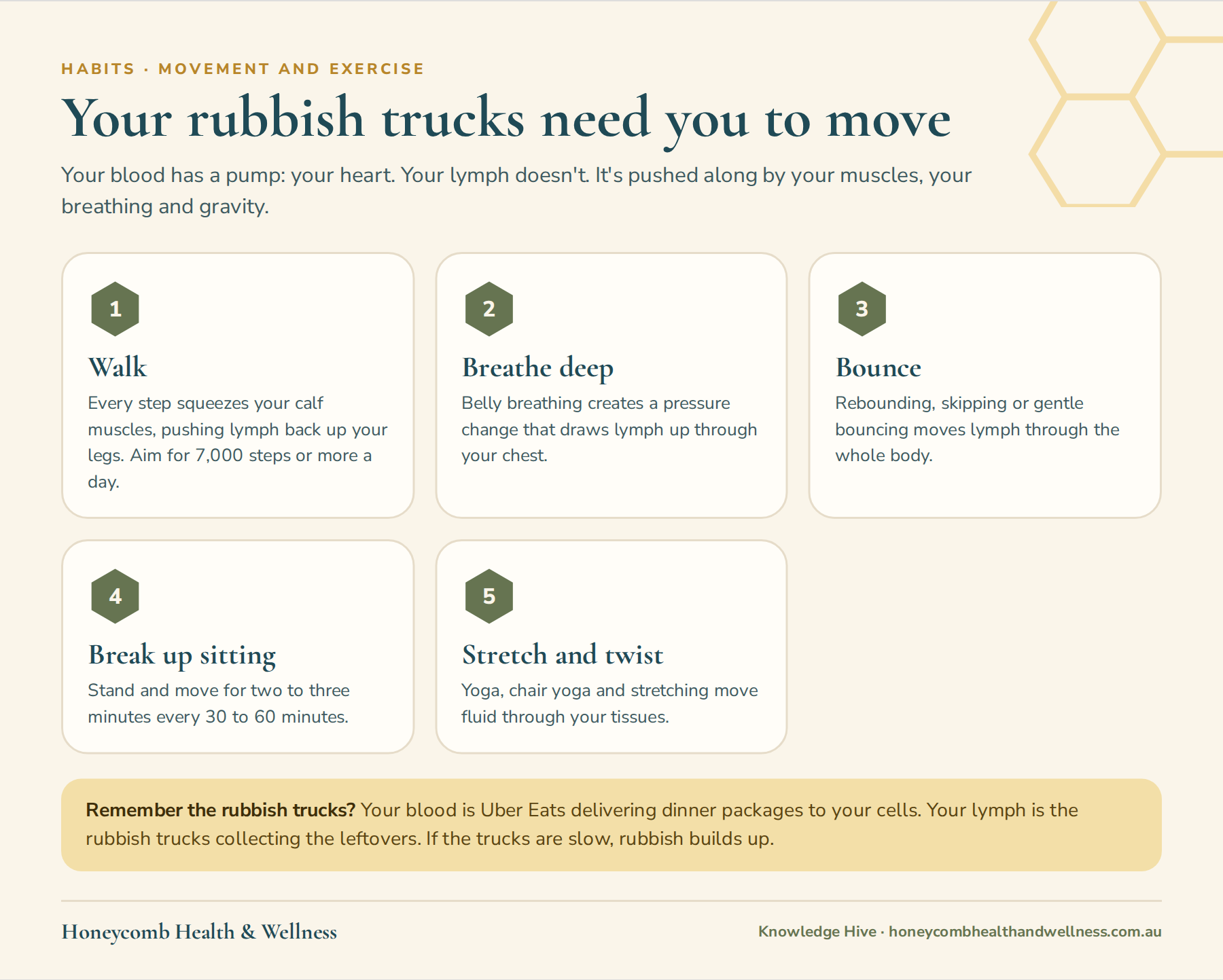
Here’s how I explain it. Your blood is like Uber Eats, delivering dinner packages (nutrients and oxygen) to every cell in your body. Your lymphatic system is the rubbish trucks that come along and collect what’s left over from the dinner packages: extra fluid, waste, proteins, dead cells and even bugs. If the rubbish trucks are running slow, and the garbage isn’t collected as often as the deliveries arrive, rubbish builds up in your system.
It’s not exactly like this scientifically, but it’s an easy way to understand it. And here’s the catch: Uber Eats has a fast car (your heart pumps your blood). The rubbish trucks don’t have an engine of their own.
How lymph actually moves
Lymph vessels have tiny one-way valves and some gentle squeezing of their own. But most of the push comes from outside: your muscles contracting as you move, the pressure changes as you breathe deeply, and gravity (Moore and Bertram, 2018). When you sit still for hours, lymph flow slows right down.
Signs your rubbish trucks are running slow
- Puffy ankles, fingers or eyes, especially after sitting or in the morning
- A heavy, sluggish feeling
- Frequent colds or swollen glands
- Brain fog
- Cellulite or fluid retention
- Stiffness that eases once you get moving
Movement that moves lymph
- Walking. The humble walk is perfect. Your calf muscles are sometimes called your “second heart” because they squeeze fluid back up your legs.
- Deep belly breathing. Your diaphragm acts like a pump for the large lymph vessels in your chest. Five slow belly breaths, several times a day.
- Rebounding. Gentle bouncing on a mini-trampoline is a favourite in many detox programs. Even a few minutes counts. Keep your feet on the mat if you’re new to it.
- Swimming and water walking. Water pressure gently compresses the tissues.
- Yoga and stretching, including chair yoga if you have limited mobility.
- Dry body brushing before a shower, with long strokes towards the heart.
- Legs up the wall for five to ten minutes at the end of the day.
Sitting is the new smoking (sort of)
A review of studies found that breaking up long periods of sitting with light walking or standing improved blood sugar and insulin after meals (Buffey et al., 2022). Set a timer to stand, stretch or walk for two to three minutes every 30 to 60 minutes. Walk while you’re on the phone. Have walking meetings or walking catch-ups with friends.
How much?
Australia’s Physical Activity Guidelines recommend 150 to 300 minutes of moderate activity a week (like brisk walking), plus muscle-strengthening activities on two days. But please don’t let the numbers put you off. If you’re starting from very little, ten minutes a day is a wonderful start. Any movement is better than none.
If you’re new to walking, our Beginner 1 Mile Walk and Walk 500 steps now videos are a great place to begin.
Fuel for moving
- Strawberry Banana Oat Smoothie before a morning walk
- Roasted Pumpkin Wedges
- Savoury Chickpea & Spinach Muffins for a post-walk snack
Motion is lotion, and it keeps the rubbish trucks running.
If you have a heart condition, are pregnant, have lymphoedema or haven’t exercised for a long time, check with your doctor before starting a new exercise program.
References
- Moore JE, Bertram CD. Lymphatic system flows. Annual Review of Fluid Mechanics. 2018;50:459-482.
- Buffey AJ et al. The acute effects of interrupting prolonged sitting time in adults with standing and light-intensity walking on biomarkers of cardiometabolic health: a systematic review and meta-analysis. Sports Medicine. 2022;52(8):1765-1787.
- Australian Government Department of Health and Aged Care. Physical activity and exercise guidelines for all Australians.
How Honeycomb can help
You don’t have to work this out alone
This information is general education and is not a substitute for individual advice. Please speak with your health practitioner before making changes, especially if you take prescribed medication.
Keep going
You’re not doing this alone
This information is general education and is not a substitute for individual advice. Please speak with your health practitioner before making changes, especially if you take prescribed medication.