You’ve just had a blood test and the result comes back: “Your cholesterol is a bit high.” Maybe a tablet has been mentioned. Maybe you’ve been told to “watch your diet” with no idea what that actually means. If you’re feeling a little worried and a lot confused, this article is for you.
Many of the clients I see in clinic first come to me in exactly that spot. The good news I always share first is this: cholesterol is one of the most food-responsive numbers in your whole body. What you put on your plate this week can show up in your blood test within a month or two.
First, what is cholesterol?
Cholesterol is a waxy substance your body uses to build cell walls, make hormones and produce vitamin D and bile. It isn’t the enemy. In fact, your liver makes all the cholesterol you need. That’s an important point, because it means we don’t need to eat any.
Because cholesterol is a fat, it can’t travel through your watery bloodstream on its own. It hitches a ride in little carriers called lipoproteins. Those carriers are what your blood test is really measuring.
Reading your results
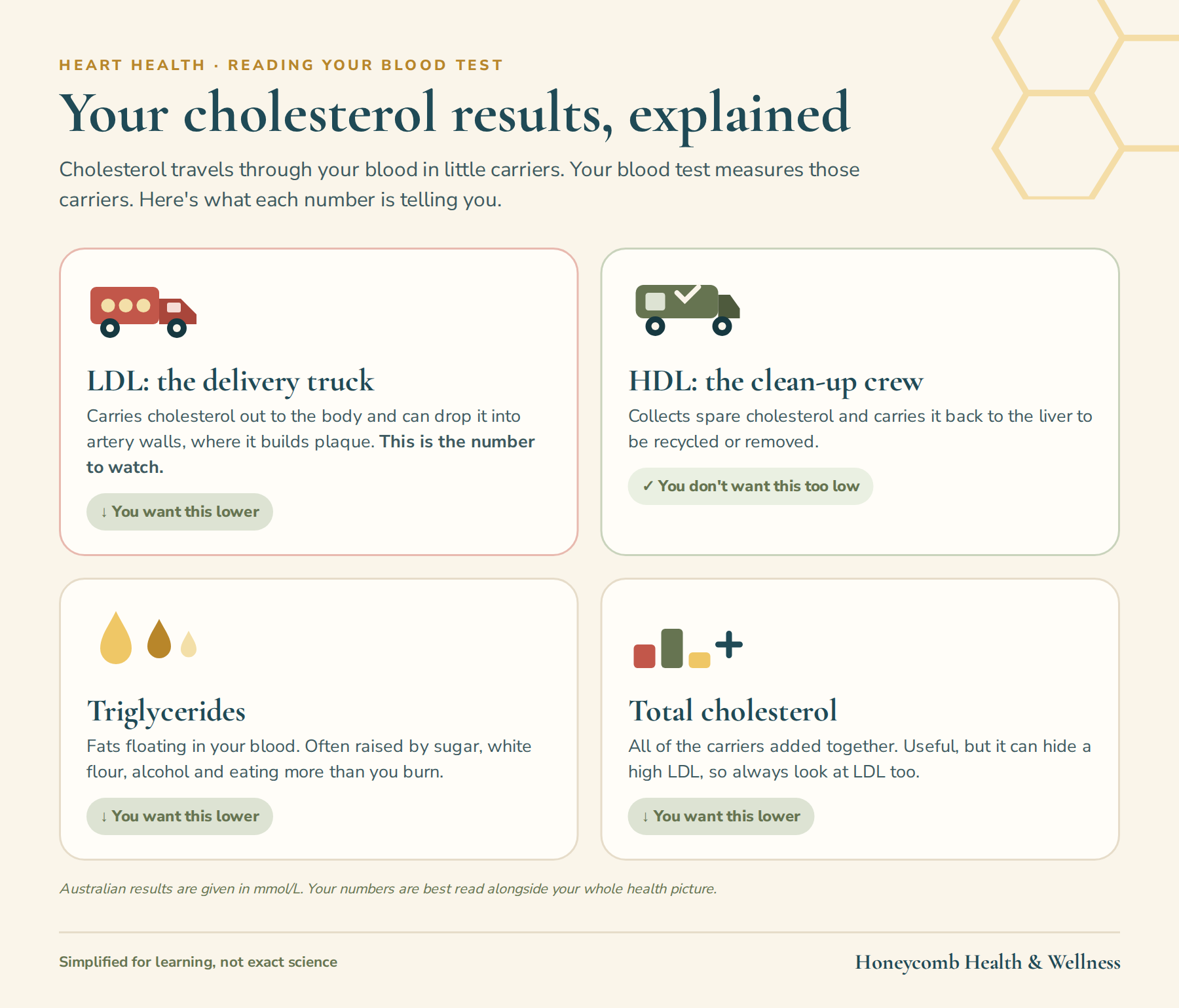
In Australia these are reported in mmol/L. Many labs flag an LDL above 3.5 mmol/L, but there isn’t one “right” number for everyone. Your numbers only make sense alongside your overall risk: your age, blood pressure, blood sugar, smoking, family history and whether you’ve had a heart event. People at higher risk need much lower targets.
Reading results like these is a big part of what I do in clinic. I look at your blood tests and functional tests together, and at the patterns behind the numbers, not just whether something is flagged. Then I create a personalised treatment plan with nutrition, herbal medicine formulas, targeted supplements and lifestyle support, and we retest to see how far you’ve come.
Of all these numbers, LDL is the one to watch. Decades of research show that the more LDL you carry, and the longer you carry it, the more plaque builds up in your arteries.
Why does cholesterol rise?
Genetics play a part, and some families make more LDL no matter what. For most of us, though, it comes back to the Honeycomb Four Pillars:
- Food: saturated fat (mostly from meat, dairy, butter, cheese and coconut) and trans fats tell the liver to keep more LDL in the blood. Cholesterol in the diet comes only from animal foods. At the same time, a low-fibre diet means less cholesterol is carried out of the body.
- Toxic load: your liver is your cholesterol factory and your detox powerhouse. When it’s overloaded by alcohol, a fatty liver or a heavy toxic burden, fat processing suffers.
- Stress and sleep: long-term stress hormones and poor sleep push blood fats and blood sugar in the wrong direction.
- Habits: sitting all day, smoking and carrying extra weight around the middle all raise heart risk.
What the research shows food can do
This is where I get excited. Some of the most striking studies in nutrition science have looked at cholesterol.
In the Portfolio Diet study, researchers in Toronto fed people a plant-based diet rich in oats, barley, beans, soy foods, nuts and plant sterols. After just four weeks, LDL dropped by about 29%, almost the same as the group taking a first-generation statin drug (Jenkins et al., 2003).
Dr Dean Ornish’s Lifestyle Heart Trial went further. People with heart disease ate a low-fat, whole food, plant-based diet, walked, managed stress and leaned on group support. After one year, many had less narrowing in their arteries, while the usual-care group got worse (Ornish et al., 1990).
Dr Caldwell Esselstyn followed almost 200 people with heart disease who adopted a whole food, plant-based, no-oil diet. Those who stuck with it had remarkably few further cardiac events over nearly four years (Esselstyn et al., 2014).
Food isn’t the only factor, but it’s the one you get to choose three times a day.
How fibre carries cholesterol out of your body
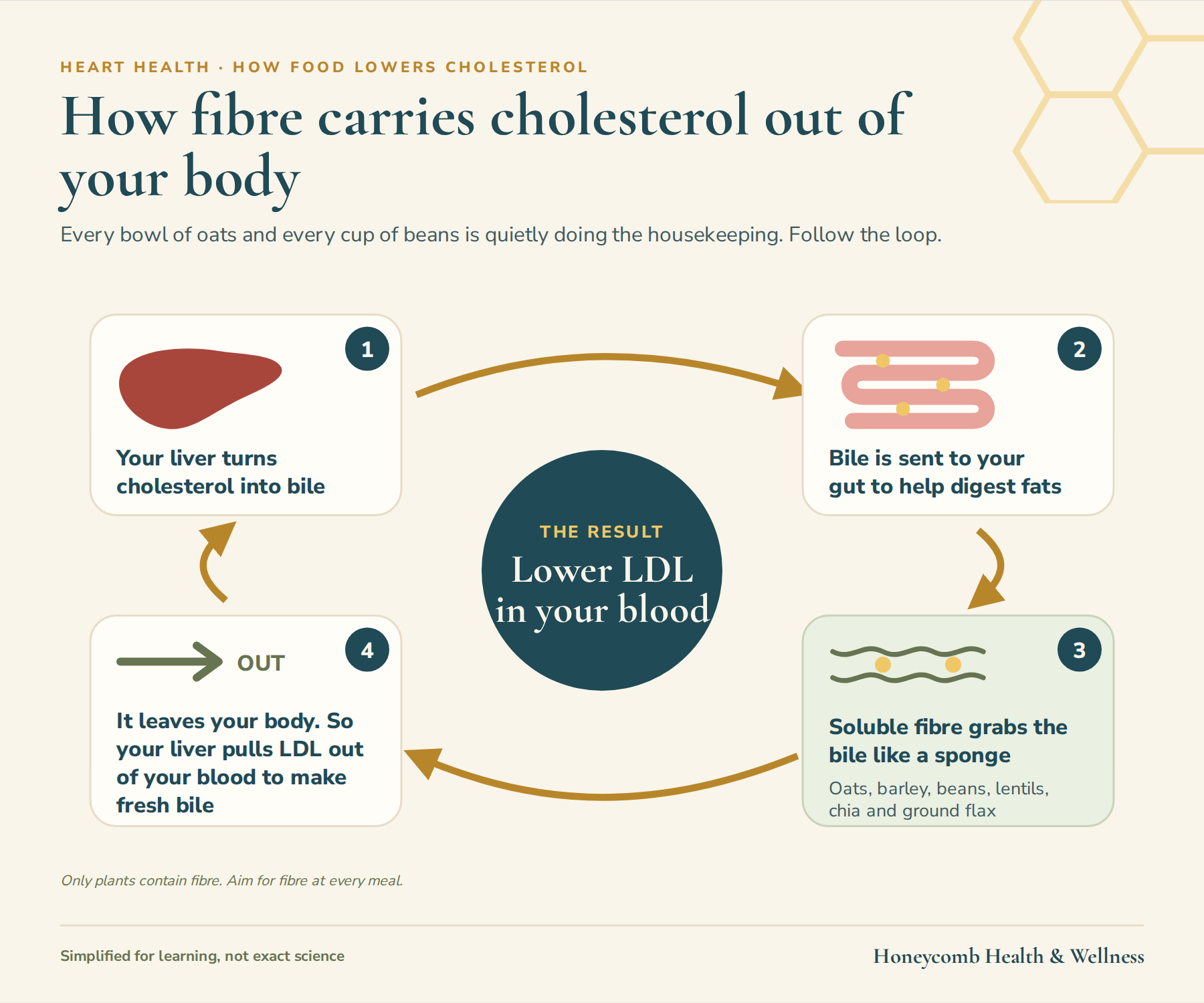
Your liver turns cholesterol into bile and sends it to the gut to help digest fats. Soluble fibre (the gel-like fibre in oats, barley, beans, lentils, chia and flax) binds that bile and carries it out with your bowel motion. Your liver then pulls more LDL from your blood to make fresh bile. Every bowl of porridge is quietly doing housekeeping.
Most Australians eat only around 20 to 25 grams of fibre a day. On a whole food, plant-based plate it’s easy to eat 40 grams or more, and only plants contain fibre.
What you can start today
- Start the day with oats or barley. About a cup of cooked oats provides the 3 grams of beta-glucan fibre shown to lower LDL. Try my Apple Pie Overnight Oats.
- Eat legumes once or twice a day. Beans, lentils, chickpeas, tofu, tempeh and soy milk are all heart-friendly protein.
- Add one to two tablespoons of ground flaxseed daily. In smoothies, oats or a chia pudding.
- Swap the saturated fats. Replace processed meats, cheese, butter and coconut cream with beans, mushrooms, silken tofu sauces and nutritional yeast.
- Leave out the oil. Even “good” oils are concentrated fat. Read why in Why oils aren’t heart food.
If you’re working on lowering a number, this is exactly what our Elimination phase in the Six-Week Nutrition Reset is designed for: no oils, no higher-fat foods for now, and plenty of fibre-rich whole foods, flax and chia.
Recipes that help
- Cinnamon Overnight Oats for a soluble-fibre breakfast
- Slow Cooker Kidney Bean & Barley Chili, with barley and kidney beans in one pot
- Chocolate Blueberry Chia & Flax Pudding, packed with omega-3s and fibre
A word on mindset
I often tell clients that a cholesterol result is not a verdict. It’s feedback. Your body is telling you something with love, and you get to answer. You don’t need to be perfect; you need to be consistent. Pick one change from the list above, do it every day this week, and notice how it feels to keep a promise to yourself.
A note on medication: please don’t stop or change any prescribed medication on your own. When you change the way you eat, your numbers can move quickly, so keep your prescribing doctor informed so your doses can be reviewed as you improve.
References
- Jenkins DJA et al. Effects of a dietary portfolio of cholesterol-lowering foods vs lovastatin on serum lipids and C-reactive protein. JAMA. 2003;290(4):502-510.
- Ornish D et al. Can lifestyle changes reverse coronary heart disease? The Lifestyle Heart Trial. Lancet. 1990;336(8708):129-133.
- Esselstyn CB Jr et al. A way to reverse CAD? Journal of Family Practice. 2014;63(7):356-364.
- Whitehead A et al. Cholesterol-lowering effects of oat β-glucan: a meta-analysis of randomized controlled trials. American Journal of Clinical Nutrition. 2014;100(6):1413-1421.
- Ference BA et al. Low-density lipoproteins cause atherosclerotic cardiovascular disease. European Heart Journal. 2017;38(32):2459-2472.
Members’ Toolkit
Lower your cholesterol
Ready to put this into practice? Members get these printables, plus the Six-Week Nutrition Reset, weekly lessons and the full recipe library.
How Honeycomb can help
You don’t have to work this out alone
This information is general education and is not a substitute for individual advice. Please speak with your health practitioner before making changes, especially if you take prescribed medication.
Keep going
You’re not doing this alone
This information is general education and is not a substitute for individual advice. Please speak with your health practitioner before making changes, especially if you take prescribed medication.