In this series, we’ve followed the fat from your plate into your cells: why it gets left behind (Part 1), how it throws a tantrum and causes insulin resistance (Part 2) and where it ends up (Part 3).
Now for the part I love most: what to do about it. And it starts with one simple idea. We need to drain the fat from the cells, so we need to stop putting it in in the first place.
Fats and your cells, a four-part series:
Part 1: Microwave energy and slow cooker energy
Part 2: How fat causes insulin resistance
Part 3: Where does the fat go?
Part 4: Draining the fat from your cells (you are here)
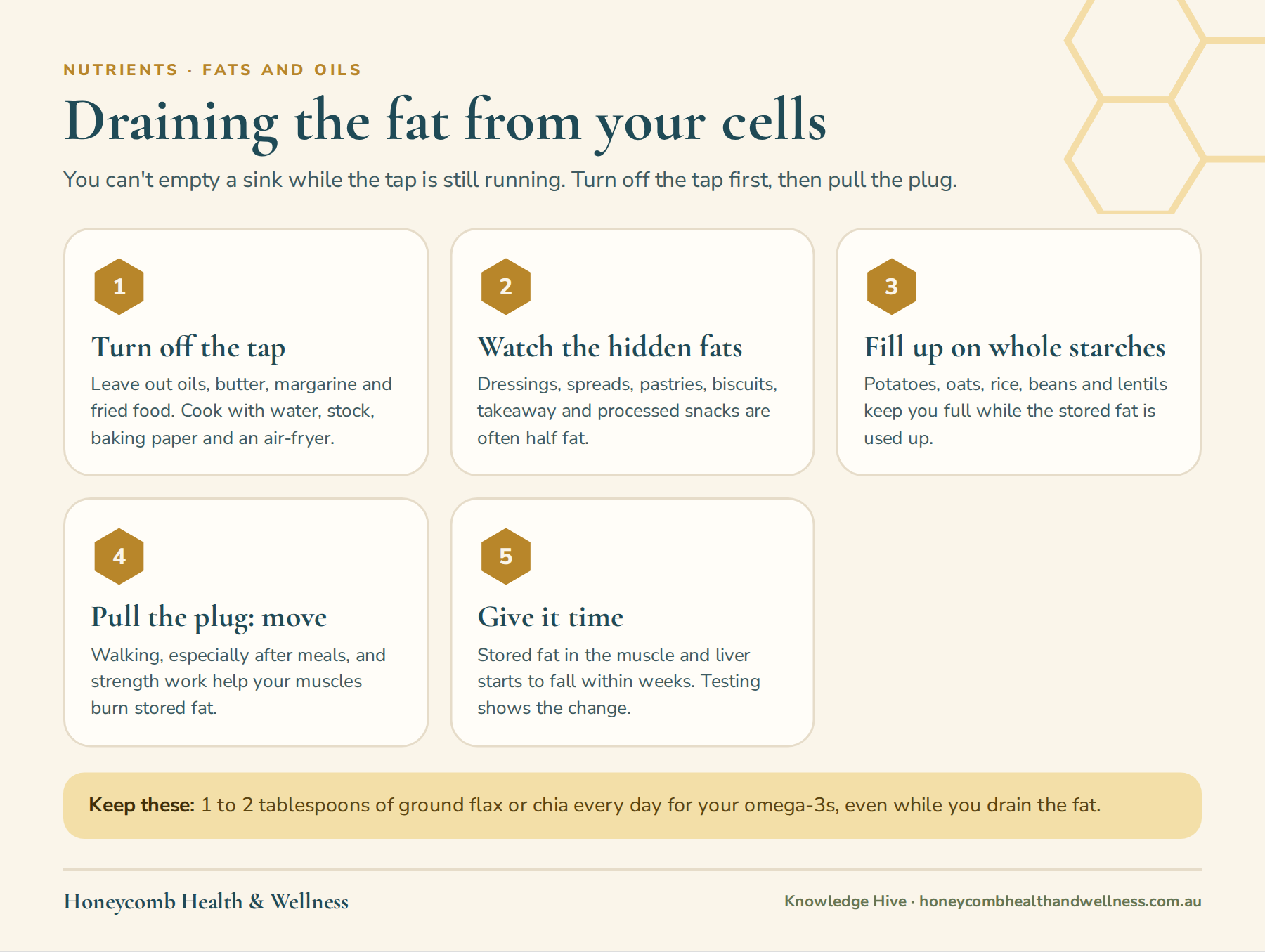
Turn off the tap
Imagine a sink that’s filling up. You could start bailing water out with a cup, but while the tap is still running, you’ll never get ahead. The first job is to turn off the tap. Then the plug can do its work. Your cells are the same. While fat keeps arriving at every meal, your body never gets the chance to burn what’s already stored. It’s not exactly like this scientifically, but it’s an easy way to understand it.
Step 1: leave out the oil
Oil is 100% fat. A single tablespoon has about 14 grams of fat and 500 kilojoules (120 calories), with almost no fibre or nutrients. It’s the fat without the packaging. (Read Why oils aren’t heart food.)
This includes olive oil, coconut oil and “healthy” oils. They may be better than some other fats in other ways, but they still add fat to your cells. Cooking without oil is much easier than most people expect:
- Sauté with water, stock, or a splash of soy sauce or vinegar. Add a little at a time as the pan dries.
- Roast and bake on baking paper or a silicone mat. Potatoes, pumpkin and vegetables crisp up beautifully.
- Use an air-fryer with no oil for chips, wedges and hash browns.
- Use a non-stick pan (ceramic is a good low-tox choice).
Step 2: find the hidden fats
Most of the fat we eat doesn’t come from the bottle in the cupboard. It’s already inside the foods we buy.
| Food | Where the fat hides |
|---|---|
| Salad dressings and mayonnaise | Mostly oil |
| Butter, margarine and spreads | About 80% fat |
| Pastries, croissants and pies | Butter or shortening in the dough |
| Biscuits, cakes and muffins | Butter or oil |
| Crackers, chips and snack bars | Oil, often palm oil |
| Takeaway and restaurant meals | Cooked in generous amounts of oil |
| Meat, cheese and eggs | Saturated fat, built in |
A simple label check: look at the “per 100 g” column. Under 3 g of fat per 100 g is low fat. Over 10 g per 100 g is high fat.
Step 3: whole-food fats, used wisely
Nuts, seeds, avocado, olives and coconut are whole foods that come with fibre and nutrients, and they’re much better choices than oil. But they’re still rich in fat.
In the Elimination phase of our Six-Week Nutrition Reset, when you’re actively working on blood sugar, weight, cholesterol or fatty liver, we leave out the higher-fat whole foods too. This gives your cells the best chance to empty. In the Relaxation phase, they come back in small amounts.
One fat we always keep: 1 to 2 tablespoons of ground flax or chia every day. They give you the essential omega-3 fats your body can’t make, plus lots of fibre. Tofu, tempeh and soy milk are always allowed too.
Step 4: fill up on whole starches
When you take the fat out, you need to put satisfying food in. Otherwise you’ll be hungry, and you won’t stick with it. This is where the microwave energy from Part 1 becomes your friend. Potatoes, sweet potatoes, oats, brown rice, pasta, corn, beans, lentils and chickpeas are filling, and they’re used for energy rather than stored.
Without the fat around, insulin can do its job again, and glucose moves into your cells the way it’s meant to.
Step 5: pull the plug with movement
Movement helps drain the stored fat. Your muscles burn the fat on their own “pantry shelf” during exercise, and active muscles can take in glucose even without much help from insulin.
- A 10 to 15-minute walk after meals helps your muscles soak up sugar.
- Strength work two or three times a week builds more muscle, which means more places for glucose to go.
- Find our walking and gentle strength videos in the Movement section of the Knowledge Hive.
How long does it take?
The fat stored in your muscle and liver cells can start to fall within weeks of turning off the tap. In a 16-week trial of a low-fat vegan diet, fat inside the liver and muscle cells fell by about a third, and insulin sensitivity improved (Kahleova et al., 2020). In a 74-week trial in people with type 2 diabetes, a low-fat vegan diet improved long-term blood sugar at least as well as a conventional diabetes diet (Barnard et al., 2009).
Many people notice they have more energy, fewer cravings and a smaller waist within the first few weeks. We track the changes with blood tests (fasting insulin, glucose, HbA1c, triglycerides and liver enzymes), so you can see what’s happening on the inside too.
A day of draining the fat
| Meal | Example |
|---|---|
| Breakfast | Oats cooked with soy milk, cinnamon, berries and ground flax |
| Lunch | Lentil and potato soup with a wholegrain roll (no butter) |
| Snack | Fruit, or carrot sticks with oil-free white bean dip |
| Dinner | Oven-baked potato wedges, chickpea curry and steamed greens |
| After dinner | A 15-minute walk |
Who are you becoming?
It can feel like a big change to cook without oil and leave out the butter. But think about who you’re becoming: someone whose cells are clear, whose energy is steady and whose body is working with them, not against them. Start with one meal a day, and celebrate every small win.
If you’re working on blood sugar, weight or fatty liver, the Six-Week Nutrition Reset inside the Honeycomb Community walks you through the Elimination phase week by week, with recipes for every meal.
Recipes that help
- Pressure Cooker Apple Cinnamon Oats
- Lentil & Potato Soup
- Creamy White Bean & Lemon Hummus Dip
- Sweet Potato Fries
- Nourish Your Body with Tomato Lentil Curry
To drain the fat from your cells, stop putting it in. Your body knows what to do with the rest.
A note on medication: please don’t stop or change any prescribed medication on your own. When you change the way you eat, your numbers can move quickly, so keep your prescribing doctor informed so your doses can be reviewed as you improve. This is especially important for blood sugar and blood pressure medications, because your numbers can change quickly when you change the way you eat.
References
- Kahleova H et al. Effect of a low-fat vegan diet on body weight, insulin sensitivity, postprandial metabolism, and intramyocellular and hepatocellular lipid levels in overweight adults: a randomized clinical trial. JAMA Network Open. 2020;3(11):e2025454.
- Barnard ND et al. A low-fat vegan diet and a conventional diabetes diet in the treatment of type 2 diabetes: a randomized, controlled, 74-wk clinical trial. American Journal of Clinical Nutrition. 2009;89(5):1588S-1596S.
- Goff LM et al. Veganism and its relationship with insulin resistance and intramyocellular lipid. European Journal of Clinical Nutrition. 2005;59(2):291-298.
How Honeycomb can help
You don’t have to work this out alone
This information is general education and is not a substitute for individual advice. Please speak with your health practitioner before making changes, especially if you take prescribed medication.
Keep going
You’re not doing this alone
This information is general education and is not a substitute for individual advice. Please speak with your health practitioner before making changes, especially if you take prescribed medication.