This is the question I’m asked more than any other: “But isn’t olive oil good for you?” It’s a fair question. Olive oil has been marketed as a health food for decades, and it’s at the heart of the Mediterranean diet.
So let’s look at it honestly, the way I’d explain it to a client sitting across from me. I’ll share what the research shows, where it’s mixed, and why Honeycomb chooses to cook without oil.
Oil is a processed food
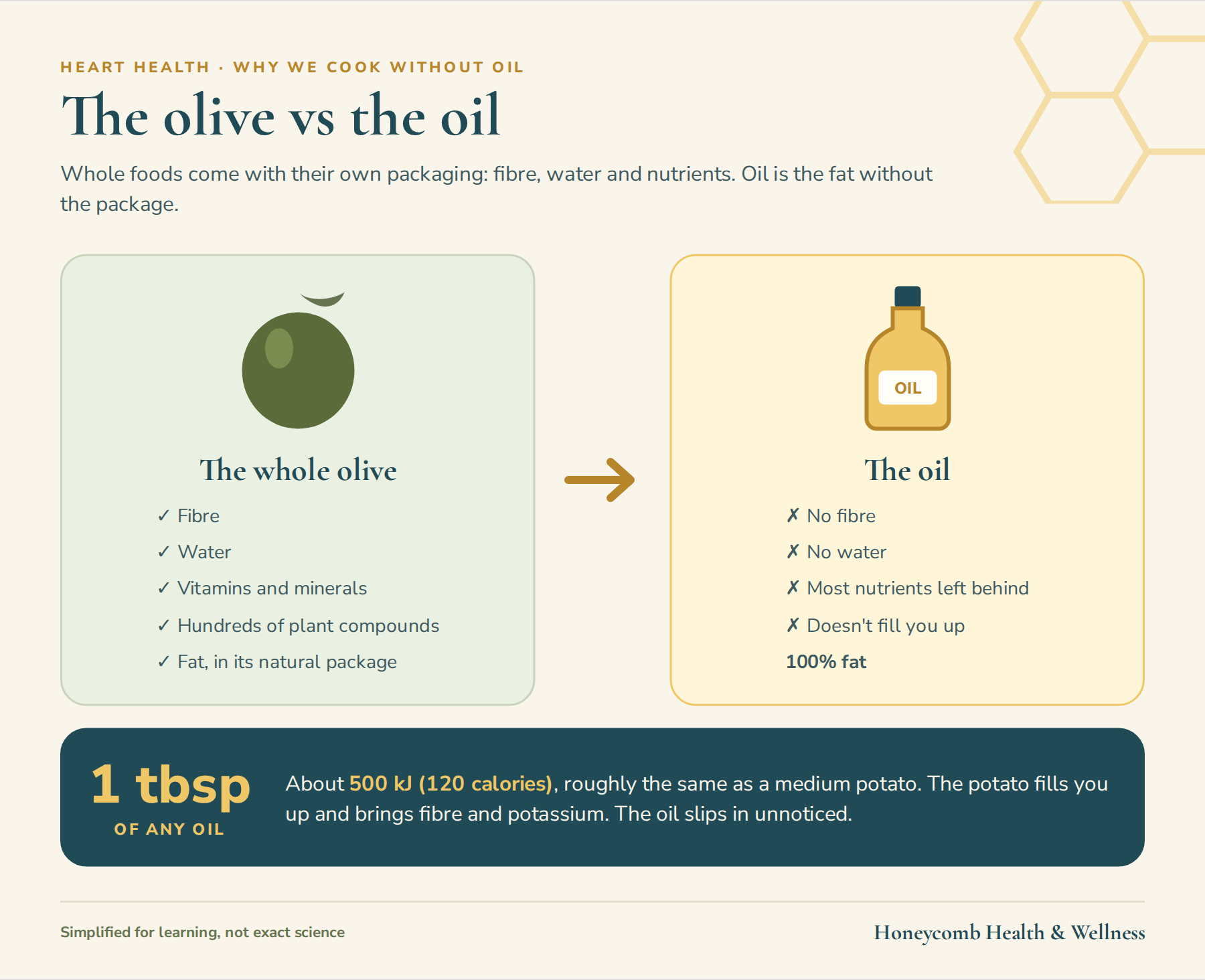
Picture an olive. It has fibre, water, a little protein, vitamins, minerals and hundreds of protective plant compounds. Now picture the oil pressed out of it. Almost everything except the fat has been left behind.
That makes oil the most calorie-dense food on the planet. One tablespoon contains about 500 kilojoules (around 120 calories) and no fibre, so it doesn’t fill you up. It’s easy to pour three or four tablespoons into a meal without noticing. We’d never eat that many olives in one sitting.
What happens inside your arteries
Your arteries are lined with a single, delicate layer of cells called the endothelium. When it’s healthy, it produces nitric oxide, which keeps blood vessels relaxed, smooth and flexible.
Researchers can measure this by checking how well an artery widens after a cuff is released (called flow-mediated dilation). In one study, a meal containing olive oil temporarily reduced this widening by around 30%, much like a fast-food meal did. Interestingly, adding vegetables and vinegar softened the effect (Vogel et al., 2000). It’s one small study, but it fits with what we see in practice.
The honest part: the research is mixed
I want to be fair here, because you deserve the whole picture, not just the parts that suit my argument.
The large Spanish PREDIMED trial found that people eating a Mediterranean diet with extra-virgin olive oil or nuts had fewer heart attacks and strokes than a control group told to cut their fat (Estruch et al., 2018). That’s a real finding, and it shows that olive oil is better than butter, lard or a typical Western diet.
But there’s a key point. The control group in PREDIMED was advised to eat less fat, yet in practice changed their diet very little. The question was never “olive oil versus no oil on a whole food, plant-based diet”.
When we look at the programs that have actually improved heart disease, such as Dr Ornish’s Lifestyle Heart Trial and Dr Esselstyn’s work, both used very low-fat, whole food, plant-based diets with no added oils. Dr McDougall’s Starch Solution takes the same approach. That’s the standard we’re aiming for.
What about coconut oil?
Coconut oil had a moment as a “superfood”, but it’s around 80 to 90% saturated fat. A review of 16 trials found it raised LDL cholesterol significantly compared with other plant oils (Neelakantan et al., 2020). It’s best kept for very occasional use, if at all.
Where do my healthy fats come from?
You absolutely need some fat, especially essential omega-3 fats. The difference is that we get them from whole foods, not bottles.
- Elimination phase (when you have a goal to reach, such as lowering cholesterol, blood pressure or weight): no oils, and no higher-fat whole foods like nuts, avocado and coconut for now. Your fats come from ground flaxseed and chia seeds every day (our best omega-3 sources), plus tofu, tempeh, soy milk, whole grains and greens, which naturally contain small amounts of fat.
- Relaxation phase: nuts, seeds, avocado and olives come back in moderation. Still no oil.
This isn’t about fearing fat. It’s about choosing fat in the form your body knows how to handle.
How to cook without oil (it’s easier than you think)
- Sauté with water or stock. Add a few tablespoons to a hot pan and keep adding a splash as it evaporates. Onions still go golden, just more slowly.
- Roast on baking paper. Vegetables caramelise beautifully at 200°C on a lined tray. A sprinkle of spices and a squeeze of lemon afterwards is all they need.
- Use an air fryer. Crispy potatoes, chickpeas and tofu with no oil at all.
- Use non-stick or well-seasoned pans. Ceramic-coated pans work well.
- Make creamy dressings without oil. Blend silken tofu, white beans or cooked potato with mustard, garlic, lemon and herbs.
- Bake with flax eggs and fruit. Mashed banana, apple sauce or pumpkin replace oil in muffins and loaves.
Recipes that help
- Creamy Mustard & Thyme Dressing: creamy, rich and oil-free
- Mushroom & Edamame Stir Fry: a water-sautéed stir fry
- Chocolate Blueberry Chia & Flax Pudding: your daily omega-3s
Be gentle with yourself
Changing how you cook is a skill, and skills take practice. When I was teaching, I’d tell parents that children don’t learn to walk by being told off for falling. The same goes for us. If you burn the first batch of onions, laugh, add a splash of water and try again. Every meal you cook without oil is a vote for the person you’re becoming.
A note on medication: please don’t stop or change any prescribed medication on your own. When you change the way you eat, your numbers can move quickly, so keep your prescribing doctor informed so your doses can be reviewed as you improve.
References
- Vogel RA, Corretti MC, Plotnick GD. The postprandial effect of components of the Mediterranean diet on endothelial function. Journal of the American College of Cardiology. 2000;36(5):1455-1460.
- Estruch R et al. Primary prevention of cardiovascular disease with a Mediterranean diet supplemented with extra-virgin olive oil or nuts. New England Journal of Medicine. 2018;378(25):e34.
- Ornish D et al. Intensive lifestyle changes for reversal of coronary heart disease. JAMA. 1998;280(23):2001-2007.
- Esselstyn CB Jr et al. A way to reverse CAD? Journal of Family Practice. 2014;63(7):356-364.
- Neelakantan N, Seah JYH, van Dam RM. The effect of coconut oil consumption on cardiovascular risk factors: a systematic review and meta-analysis of clinical trials. Circulation. 2020;141(10):803-814.
Members’ Toolkit
Cook without oil
Ready to put this into practice? Members get these printables, plus the Six-Week Nutrition Reset, weekly lessons and the full recipe library.
How Honeycomb can help
You don’t have to work this out alone
This information is general education and is not a substitute for individual advice. Please speak with your health practitioner before making changes, especially if you take prescribed medication.
Keep going
You’re not doing this alone
This information is general education and is not a substitute for individual advice. Please speak with your health practitioner before making changes, especially if you take prescribed medication.