Of everything I explain in clinic, fats are one of the hardest ideas for people to get their heads around. We’ve been told for years that carbs make us fat and fat is harmless, or even good for us. So when I explain how fat builds up in your cells, it can turn everything people thought they knew upside down.
So let’s start at the very beginning: what your body actually does with the food on your plate.
Fats and your cells, a four-part series:
Part 1: Microwave energy and slow cooker energy (you are here)
Part 2: How fat causes insulin resistance
Part 3: Where does the fat go?
Part 4: Draining the fat from your cells
Meet the hash brown
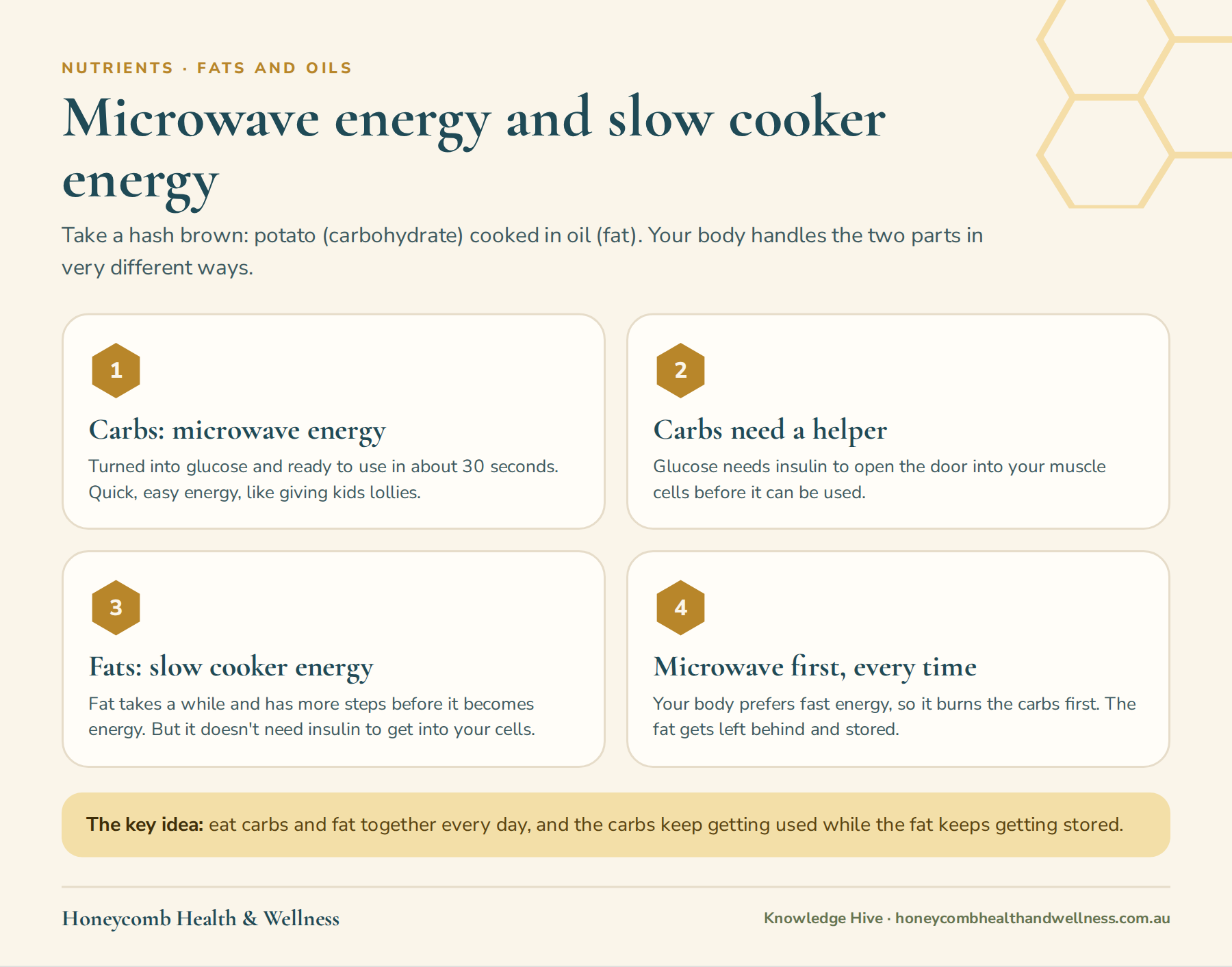
A hash brown is a great example, because it’s roughly half carbohydrate and half fat. The potato is the carbohydrate. The oil it’s cooked in is the fat. Once you’ve eaten it, your body sends those two parts down two very different roads.
Carbs: microwave energy
I call carbohydrates microwave energy. Pop them in, and 30 seconds later the energy is there. Your body breaks carbohydrates down into glucose, a simple sugar, and glucose can be turned into energy in just a few quick steps.
It’s just like giving kids lollies at a party. Within minutes they’re bouncing off the walls with an instant sugar high. That’s how fast glucose energy is.
But glucose has one catch. To get from your blood into your muscle cells, it needs a helper: insulin. Insulin is a hormone made by your pancreas. It knocks on the cell’s door and tells a little gatekeeper, called a glucose transporter, to open up and let the glucose in.
Fats: slow cooker energy
Fats are slow cooker energy. They’re full of energy, but they take a while to get there. Before fat can be burned, it has to be broken down into fatty acids, carried into the cell’s power stations (the mitochondria) and taken apart piece by piece. There are a few more steps, so it’s slow.
Here’s the part most people don’t know: fat doesn’t need insulin to get into your cells. It moves into your muscle and liver cells without asking anyone’s permission.
It’s not exactly like this scientifically, but it’s an easy way to understand it: carbs are the microwave dinner you can eat now, and fat is the stew you put on this morning that won’t be ready until tonight.
Why your body always chooses the microwave
If you were starving and had a choice between a 30-second microwave meal and a slow-cooked stew that takes eight hours, which would you eat first? Your body thinks the same way. It prefers fast energy, so when carbs and fat arrive together, it burns the carbs first, every time.
There’s a second reason. When insulin rises after a meal to move the glucose in, it also sends a message: “we’ve got plenty of fast fuel, so switch off fat burning and store the fat for later”. Scientists have known about this tug-of-war between glucose and fat since the 1960s, when it was named the glucose-fatty acid cycle (Randle et al., 1963).
So the fat from your hash brown gets left behind. It’s tucked away in storage, in your fat cells and inside your muscle and liver cells, to be used later.
And if later never comes?
That’s the important question. If you eat this way once in a while, the stored fat gets used between meals and overnight, and there’s no harm done. But most of us eat carbs and fat together at almost every meal: toast with butter, pasta with oil, chips, pastries, biscuits, takeaway and even “healthy” salads drowning in dressing.
When the microwave always gets used first and the slow cooker never gets a turn, the fat keeps arriving and very little leaves. Day after day, it builds up. That build-up is where the trouble starts, and it’s what we’ll look at in Part 2: how fat causes insulin resistance.
This isn’t a reason to fear carbs
Please don’t take this as “carbs are the problem”. Whole carbohydrates like potatoes, oats, brown rice, beans and fruit come packed with fibre, water and nutrients, and they’re the foundation of the way we eat at Honeycomb. (Read Foods that steady your blood sugar.)
The problem is the combination of carbs and fat, eaten together day after day, and especially fat that’s been added to food, like oil, butter and margarine.
| Food | The carbs | The added fat |
|---|---|---|
| Hash brown | Potato | Frying oil |
| Hot chips | Potato | Frying oil |
| Toast with butter | Bread | Butter or margarine |
| Pasta with pesto | Pasta | Oil, cheese and pine nuts |
| Croissant or pastry | Flour | Butter |
| Biscuits and cake | Flour and sugar | Butter or oil |
What you can start today
- Keep the potato, lose the oil. Oven-bake or air-fry potatoes, wedges and hash browns on baking paper, with no oil.
- Swap the spread. Try oil-free hummus, mashed avocado (in the Relaxation phase), or jam with no butter underneath.
- Dress salads without oil. Balsamic, lemon juice, mustard, or a blended white bean dressing.
- Notice your plates. For one day, look at each meal and ask: where’s the carb, and where’s the added fat?
Recipes that help
Carbs are microwave energy and fats are slow cooker energy. When you eat them together, your body uses the microwave and stores the stew.
References
- Randle PJ, Garland PB, Hales CN, Newsholme EA. The glucose fatty-acid cycle: its role in insulin sensitivity and the metabolic disturbances of diabetes mellitus. Lancet. 1963;1(7285):785-789.
- Frayn KN. The glucose-fatty acid cycle: a physiological perspective. Biochemical Society Transactions. 2003;31(6):1115-1119.
- Reynolds A et al. Carbohydrate quality and human health: a series of systematic reviews and meta-analyses. Lancet. 2019;393(10170):434-445.
How Honeycomb can help
You don’t have to work this out alone
This information is general education and is not a substitute for individual advice. Please speak with your health practitioner before making changes, especially if you take prescribed medication.
Keep going
You’re not doing this alone
This information is general education and is not a substitute for individual advice. Please speak with your health practitioner before making changes, especially if you take prescribed medication.