In Part 1, we saw that carbs are microwave energy and fats are slow cooker energy. When you eat them together, your body burns the fast carbs first, and the fat gets left behind in storage.
Now let’s look at what happens when that goes on, meal after meal, for months and years. This is the story I tell almost every day in clinic, and it’s the one that makes people say, “Oh! Now I get it.”
Fats and your cells, a four-part series:
Part 1: Microwave energy and slow cooker energy
Part 2: How fat causes insulin resistance (you are here)
Part 3: Where does the fat go?
Part 4: Draining the fat from your cells
The fat gets cranky
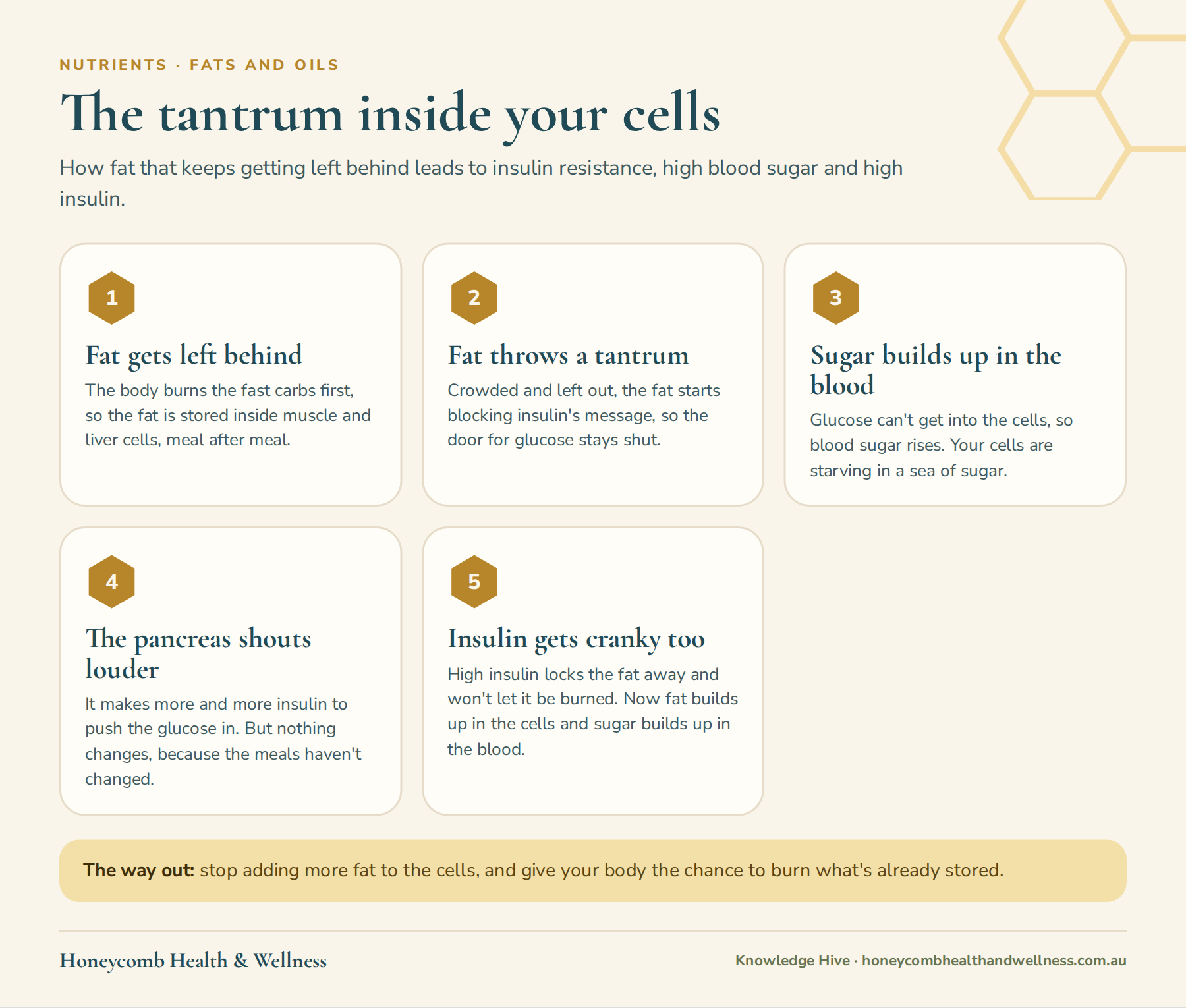
Picture the fat sitting inside your muscle and liver cells. Every meal, more fat arrives. And every meal, the carbs get chosen first and the fat gets left out. It’s like the child at the party who never gets picked for the team.
Eventually, the fat gets cranky. It’s been left out one too many times, so it has a bit of a tantrum. And a tantrum inside your cells looks like this: the fat stops letting insulin talk to the glucose transporter, the gatekeeper that brings glucose into the cell.
Insulin knocks on the door, but the gatekeeper doesn’t hear the message. The door stays shut, and glucose is left waiting outside in the blood. This is insulin resistance.
What’s happening scientifically
The tantrum is my way of explaining it, but the science behind it is well established. When fat builds up inside muscle and liver cells, some of it is turned into fat by-products (with names like diacylglycerols and ceramides). These by-products interfere with the chain of signals that runs from insulin, at the surface of the cell, down to the glucose transporters inside it. The transporters never get the message to move to the surface and let glucose in (Samuel and Shulman, 2012).
Researchers have shown this directly. When healthy volunteers are given a drip of fat into their blood, fat builds up in their muscle cells and their muscles become insulin resistant within hours (Roden et al., 1996). The fat comes first, and the insulin resistance follows.
A cell starving in a sea of sugar
Now there’s a strange situation. Your blood is full of glucose, but your muscle cells can’t get to it. Your cells are hungry, so you may feel tired, foggy and craving sugar, even though there’s plenty of sugar in your blood.
Your pancreas notices the high blood sugar and does the only thing it knows how to do: it makes more insulin to try to push the glucose in. For a while, this works. Shouting louder gets the message through, and your blood sugar may still look normal on a test. But the meals haven’t changed, so the fat keeps arriving, and the pancreas has to keep shouting louder and louder.
Then insulin gets cranky too
Here’s the twist that keeps the whole cycle going. Insulin isn’t only the key for glucose. It also tells your body to store fat and not burn it. When insulin is high all day, it blocks the fat from being turned into energy.
So now insulin is cranky too, and it won’t let the fat out. You end up with a build-up of fat inside the cells and a build-up of glucose in the blood. Both problems feed each other, and they’ll keep going for as long as the way of eating stays the same.
Signs this might be happening to you
- Tired or sleepy after meals, especially carb-and-fat meals
- Craving sweets, or feeling “hangry” between meals
- Weight gain around the middle that’s hard to shift
- Skin tags, or darker patches of skin on the neck or underarms
- High triglycerides, fatty liver, or blood sugar creeping up
- Irregular cycles or PCOS, which is closely linked to insulin resistance
Insulin resistance can be present for ten years or more before blood sugar rises enough to be called prediabetes or type 2 diabetes. That’s why I like to test fasting insulin, not just glucose.
The good news: this can turn around
Because the fat comes first, taking the fat away is one of the most powerful things you can do. In a 16-week randomised trial, overweight adults who ate a low-fat vegan diet reduced the fat stored inside their liver and muscle cells by about a third, and their insulin sensitivity improved, with no calorie counting (Kahleova et al., 2020).
We’ll look at where all that fat is stored in Part 3, and exactly how to drain it in Part 4.
Recipes that help
- Nourish Your Body with Tomato Lentil Curry
- Slow Cooker Kidney Bean & Barley Chili
- Coriander Lime Black Bean Nourish Bowl
- Cinnamon Overnight Oats
Insulin resistance isn’t a carb problem or a willpower problem. It’s a fat build-up problem, and that’s something you can change.
A note on medication: please don’t stop or change any prescribed medication on your own. When you change the way you eat, your numbers can move quickly, so keep your prescribing doctor informed so your doses can be reviewed as you improve. This is especially important for blood sugar medications and insulin, because your levels can fall quickly when you change the way you eat.
References
- Roden M et al. Mechanism of free fatty acid-induced insulin resistance in humans. Journal of Clinical Investigation. 1996;97(12):2859-2865.
- Samuel VT, Shulman GI. Mechanisms for insulin resistance: common threads and missing links. Cell. 2012;148(5):852-871.
- Kahleova H et al. Effect of a low-fat vegan diet on body weight, insulin sensitivity, postprandial metabolism, and intramyocellular and hepatocellular lipid levels in overweight adults: a randomized clinical trial. JAMA Network Open. 2020;3(11):e2025454.
How Honeycomb can help
You don’t have to work this out alone
This information is general education and is not a substitute for individual advice. Please speak with your health practitioner before making changes, especially if you take prescribed medication.
Keep going
You’re not doing this alone
This information is general education and is not a substitute for individual advice. Please speak with your health practitioner before making changes, especially if you take prescribed medication.