So far in this series, we’ve seen why fat gets left behind when you eat carbs and fat together (Part 1), and how that fat throws a tantrum and causes insulin resistance (Part 2).
Now let’s follow the fat, and see where it ends up.
Fats and your cells, a four-part series:
Part 1: Microwave energy and slow cooker energy
Part 2: How fat causes insulin resistance
Part 3: Where does the fat go? (you are here)
Part 4: Draining the fat from your cells
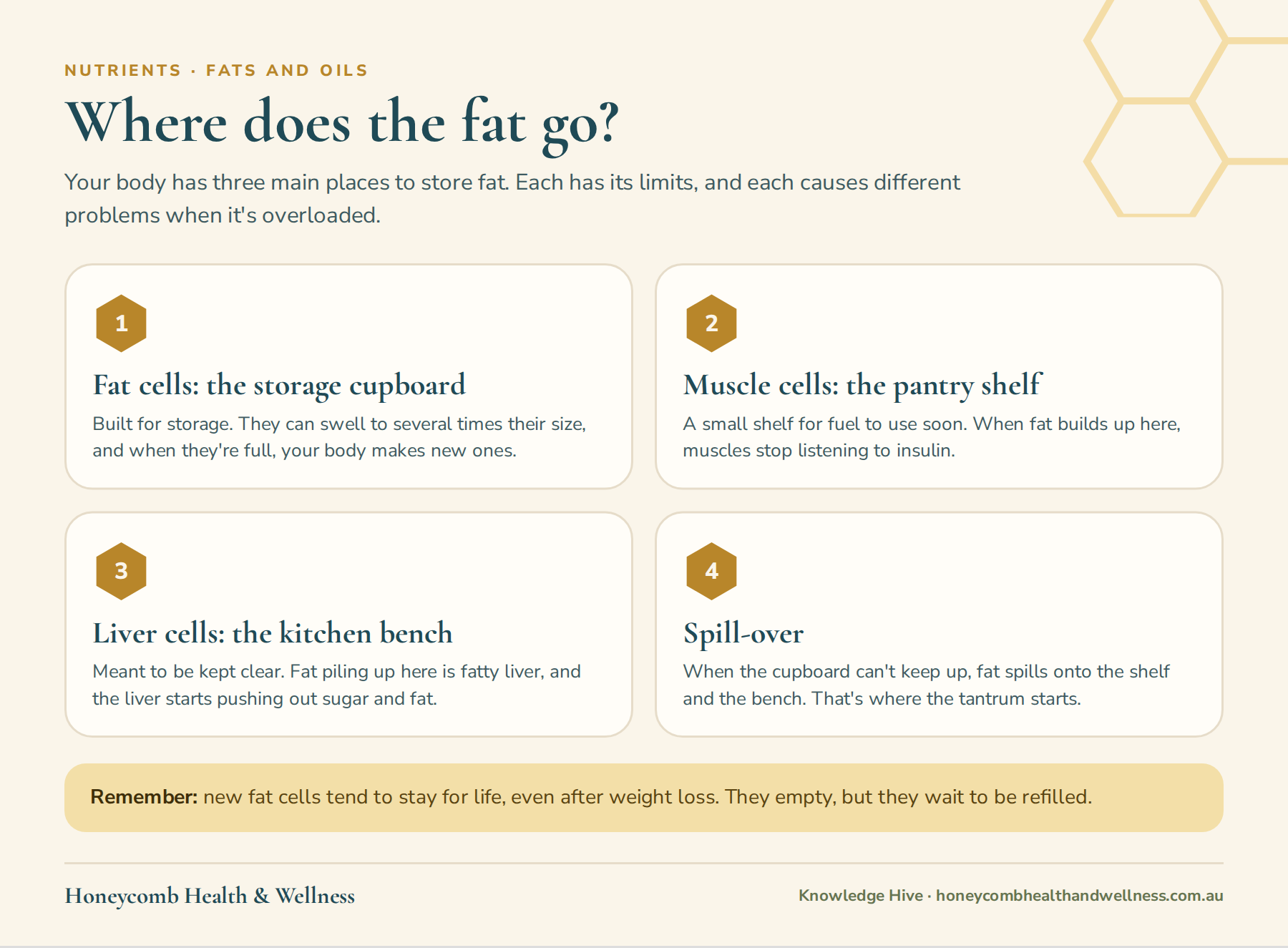
Three places to store fat
It’s kind of like the kitchen at home. Your fat cells are the big storage cupboard, made to hold a lot. Your muscle cells are the pantry shelf, with room for a few things you’ll use soon. And your liver cells are the kitchen bench, which works best when it’s kept clear. It’s not exactly like this scientifically, but it’s an easy way to understand it.
Fat cells: the cupboard that keeps growing
Fat cells are amazing at their job. As fat arrives, each cell swells, and a fat cell can grow to several times its starting size.
And when your fat cells are full, your body has another trick: it makes more fat cells. Researchers have watched this happen in adults who overeat for just eight weeks (Tchoukalova et al., 2010). So in practice, fat storage can just keep growing.
Here’s the catch: those new fat cells tend to stay. A landmark study that measured how long fat cells live found that the number of fat cells stays the same even after major weight loss. The cells shrink, but they don’t disappear (Spalding et al., 2008). They’re empty cupboards waiting to be refilled, which is one reason weight can creep back so easily. The best time to deal with fat build-up is early.
Muscle cells: the small pantry shelf
Your muscles keep a small amount of fat on hand as fuel for exercise. That’s normal and healthy. But muscle cells have limited storage. When fat keeps arriving, and there isn’t enough movement to use it up, it builds up on the shelf.
This is the fat that throws the tantrum we met in Part 2. Your muscles are where most of the glucose from your meals is meant to go, so when your muscles stop listening to insulin, blood sugar rises.
Liver cells: the kitchen bench
Your liver is also meant to stay fairly clear of fat. When fat piles up here, it’s called fatty liver (now often called MASLD), and it affects about one in four adults worldwide (Younossi et al., 2016). Most people have no idea, because there are usually no symptoms.
A fatty liver becomes insulin resistant too. Normally, insulin tells your liver to stop releasing sugar after a meal. A fatty liver doesn’t hear the message, so it keeps pushing sugar into your blood even when you’ve just eaten. It also sends out more fat into the blood, which shows up as high triglycerides. (Read Liver 101: your master filter.)
When the cupboard can’t keep up
Fat cells are the best place for extra fat, because they’re designed to hold it safely. The trouble starts when they can’t keep up: when they’re full, stressed and inflamed, or when more fat arrives at once than they can take in. Then the fat spills over onto the pantry shelf and the kitchen bench, into your muscle and liver (Snel et al., 2012).
That’s why some people who look slim can still have a fatty liver or insulin resistance. It’s not only about how much fat you carry. It’s about where it’s ending up.
The waistline clue
Fat stored deep inside your belly, around your organs, is closely linked to fat in the liver and to insulin resistance. A simple tape measure tells us a lot. For most adults, a waist above about 80 cm for women or 94 cm for men is a sign to take a closer look (these cut-offs vary for some backgrounds).
How do we know what’s happening?
- Fasting insulin and glucose, which together show how hard your pancreas is working
- Triglycerides, which often rise when the liver is overloaded
- Liver enzymes (ALT and GGT), and sometimes a liver ultrasound
- Waist measurement and how it changes over time
In clinic, I interpret these together, so we can see where the fat is building up and track it coming down.
The good news
Fat stored in the muscle and liver is the first to go when the fat stops coming in. In people with type 2 diabetes, losing about 8% of body weight normalised liver fat and improved the liver’s response to insulin (Petersen et al., 2005). The bench and the shelf clear first, and that’s where the biggest health wins are. We’ll look at how in Part 4: draining the fat from your cells.
Recipes that help
It’s not only how much fat you carry. It’s where it ends up that matters most.
References
- Spalding KL et al. Dynamics of fat cell turnover in humans. Nature. 2008;453(7196):783-787.
- Tchoukalova YD et al. Regional differences in cellular mechanisms of adipose tissue gain with overfeeding. Proceedings of the National Academy of Sciences. 2010;107(42):18226-18231.
- Snel M et al. Ectopic fat and insulin resistance: pathophysiology and effect of diet and lifestyle interventions. International Journal of Endocrinology. 2012;2012:983814.
- Younossi ZM et al. Global epidemiology of nonalcoholic fatty liver disease: meta-analytic assessment of prevalence, incidence, and outcomes. Hepatology. 2016;64(1):73-84.
- Petersen KF et al. Reversal of nonalcoholic hepatic steatosis, hepatic insulin resistance, and hyperglycemia by moderate weight reduction in patients with type 2 diabetes. Diabetes. 2005;54(3):603-608.
How Honeycomb can help
You don’t have to work this out alone
This information is general education and is not a substitute for individual advice. Please speak with your health practitioner before making changes, especially if you take prescribed medication.
Keep going
You’re not doing this alone
This information is general education and is not a substitute for individual advice. Please speak with your health practitioner before making changes, especially if you take prescribed medication.