When people hear “no oil”, the first question is always: “But how do I cook anything?” It’s a fair question. Most of us learnt to cook by starting with a splash of oil in the pan. But once you know a few simple tricks, cooking without oil becomes second nature, and your food tastes every bit as good.
Swapping out fats and oils, a four-part guide:
How to cook without oil (you are here)
Oil-free baking swaps
Oil-free dressings, sauces and dips
Swapping butter, margarine, cheese and spreads
Why leave out the oil?
Oil is 100% fat, with about 120 calories (500 kilojoules) in every tablespoon and almost no fibre or nutrients. It’s the fat without the packaging. When we’re working on blood sugar, weight, cholesterol or fatty liver, leaving out oil is one of the most powerful changes you can make. (Read Draining the fat from your cells and Why oils aren’t heart food.)
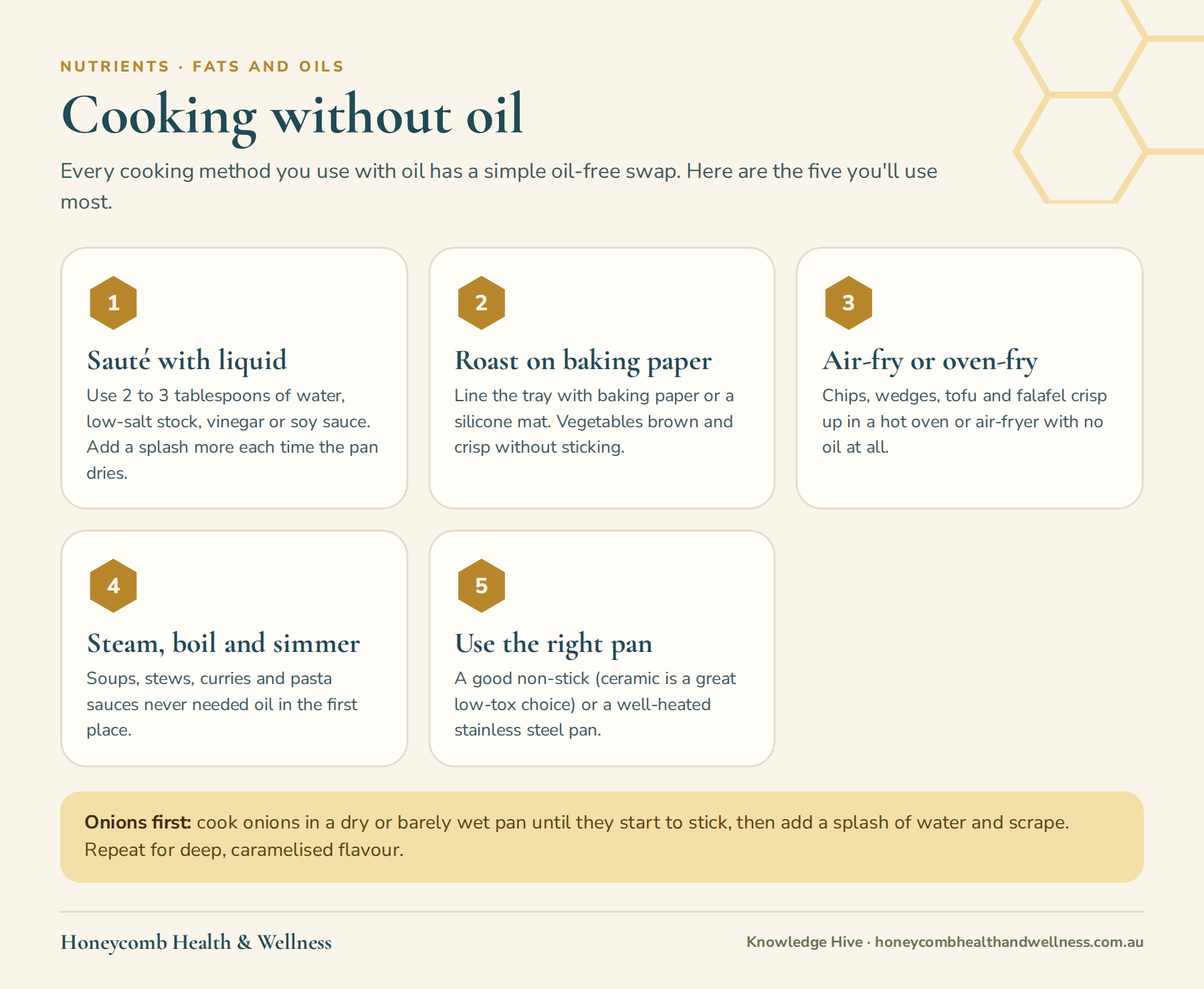
How to sauté without oil
This is the one skill that changes everything.
- Heat your pan over medium heat.
- Add chopped onion (or other vegetables) to the dry pan, or with 2 to 3 tablespoons of water or low-salt stock.
- Stir often. When the pan starts to dry out and the vegetables begin to stick, add another tablespoon or two of liquid and scrape up the brown bits. Those brown bits are pure flavour.
- Keep going until the vegetables are as soft and golden as you like.
Liquids to try: water, low-salt vegetable stock, a splash of salt-reduced soy sauce or tamari, balsamic or apple cider vinegar, lemon juice, or a little white wine if you use it.
How to roast without oil
- Line your tray with baking paper or a silicone mat.
- Cut vegetables into even pieces so they cook at the same rate, and spread them out in a single layer. Crowded trays steam instead of roast.
- For potatoes, try parboiling for 5 to 8 minutes, draining, then shaking them in the pot to rough up the edges. Those fluffy edges go golden and crispy.
- Season before roasting: a spray of lemon juice, aquafaba (the liquid from a tin of chickpeas) or a little stock helps herbs and spices stick.
- Roast hot, at 200 to 220°C, and turn halfway.
Oil-free “frying”
An air-fryer is a fantastic investment for oil-free cooking. Chips, wedges, potato gems, tofu, falafel and crumbed vegetables all crisp up beautifully with no oil. A hot oven on baking paper does the same job, just a little slower.
Stopping food from sticking
- Use a good non-stick pan. Ceramic-coated pans are a great low-tox choice.
- If you use stainless steel, heat it properly first. When a drop of water dances across the surface, it’s ready.
- Don’t move food too soon. Tofu, patties and pancakes release on their own once they’ve formed a crust.
- Keep a cup of water or stock beside the stove, and add a splash whenever things start to catch.
Swapping oil in recipes
| If the recipe says… | Do this instead |
|---|---|
| Heat oil and fry onion and garlic | Water or stock sauté |
| Toss vegetables in oil to roast | Baking paper, plus lemon juice or aquafaba to help seasoning stick |
| Shallow-fry or deep-fry | Oven-bake on baking paper or air-fry |
| Drizzle with oil to serve | A squeeze of lemon, balsamic or an oil-free dressing |
| Grease the tin | Baking paper or a silicone tray |
Watch, then cook
Sometimes it’s easiest to see it done. Our new Cook with Honeycomb video section shows you how to water-sauté, caramelise onions, roast potatoes and make crispy oil-free chips, step by step.
Recipes to start with
- Sweet Potato Fries
- Roasted Pumpkin Wedges
- A Tropical Twist to Traditional Dish
- Creamy Garlic Mushroom and Lentils
Once you’ve learnt to sauté with water, you’ll wonder why you ever needed oil.
References
- Esselstyn CB Jr et al. A way to reverse CAD? Journal of Family Practice. 2014;63(7):356-364b.
- Kahleova H et al. Effect of a low-fat vegan diet on body weight, insulin sensitivity, postprandial metabolism, and intramyocellular and hepatocellular lipid levels in overweight adults: a randomized clinical trial. JAMA Network Open. 2020;3(11):e2025454.
How Honeycomb can help
You don’t have to work this out alone
This information is general education and is not a substitute for individual advice. Please speak with your health practitioner before making changes, especially if you take prescribed medication.
Keep going
You’re not doing this alone
This information is general education and is not a substitute for individual advice. Please speak with your health practitioner before making changes, especially if you take prescribed medication.