
“Drink eight glasses of water a day” is one of the best-known health rules, but it’s not quite that simple. Some people need more, and some need less. Let’s look at what the research actually says, and how to know if you’re drinking enough.
Why water matters
Water carries nutrients to your cells, carries waste away through your kidneys and lymph, cushions your joints, keeps your bowels moving and helps control your body temperature. Even mild dehydration can bring on headaches, tiredness, poor concentration, constipation and cravings that feel like hunger.
How much do you need?
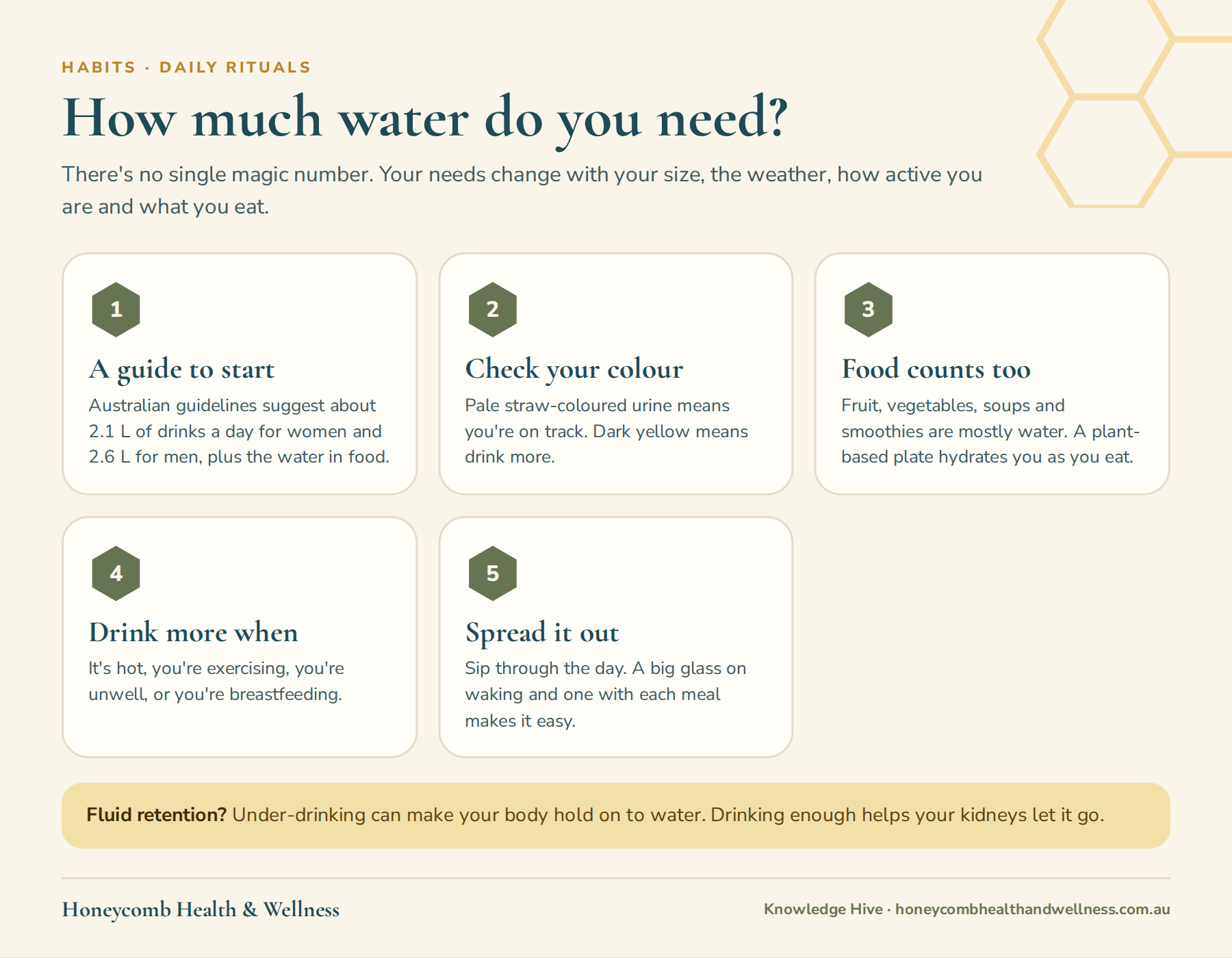
Australia’s Nutrient Reference Values suggest an adequate intake of about 2.8 litres of water a day for women and 3.4 litres for men, from all sources. About 2.1 litres (roughly 8 cups) for women and 2.6 litres (roughly 10 cups) for men comes from drinks, and the rest comes from food (NHMRC).
These are a guide, not a rule. You’ll need more when:
- It’s hot and humid (hello, Queensland summer)
- You’re exercising or working outdoors
- You’re unwell with a fever, vomiting or diarrhoea
- You’re pregnant or breastfeeding
- You’re eating a lot of salty food
The easy check: your colour
The simplest guide is the colour of your urine. Pale straw-coloured means you’re well hydrated. Dark yellow or amber means you need more. (B vitamins can turn urine bright yellow, so keep that in mind if you take a supplement.)
Thirst is a good guide for most people, but it gets weaker as we age. If you’re over 65, it’s worth drinking regularly through the day rather than waiting until you’re thirsty.
Water and fluid retention
It seems backwards, but if you’re retaining fluid, drinking more water often helps. When you’re under-hydrated, your body releases a hormone that tells your kidneys to hold on to water. When you’re well hydrated, your kidneys can relax and let go of extra salt and water. It’s kind of like a household on water restrictions: when the tank is low, everyone saves every drop. When the tank is full, you can let it flow. It’s not exactly like this scientifically, but it’s an easy way to understand it. (Read Fluid retention: how fruit, potassium and less salt help.)
What counts?
- Water, plain or sparkling, is always the best choice.
- Herbal teas, hot or iced.
- Fruit and vegetables. Watermelon, cucumber, oranges, lettuce and tomatoes are more than 90% water. On a whole food, plant-based diet, food can provide a good share of your water.
- Soups, smoothies and soy milk.
- Tea and coffee in moderation. A study comparing coffee with water found that moderate coffee drinking (about four cups a day) hydrated men just as well as water (Killer et al., 2014). More than that can affect sleep and anxiety, though.
Soft drinks, cordial and fruit juice add water but also a lot of sugar. Alcohol has the opposite effect, making you lose more fluid than you drink.
Making it a habit
- Start your day with a big glass of water before anything else.
- Have a glass with every meal.
- Keep a bottle in sight on your desk, in your bag and in the car. A glass or stainless steel bottle is a great low-tox choice.
- Flavour it naturally with lemon, lime, cucumber, mint, berries or a slice of ginger.
- Link it to a habit you already have, like a glass every time you boil the kettle.
Can you drink too much?
It’s rare, but yes. Drinking very large amounts quickly, especially during long endurance events, can dilute the sodium in your blood. Sip through the day rather than forcing down litres at once. If you have heart failure or kidney disease, or have been told to limit fluids, please follow your doctor’s advice about how much to drink.
Recipes that help
Your body is mostly water. Keep the tank topped up and every system, from your kidneys to your brain, works more easily.
References
- National Health and Medical Research Council. Nutrient Reference Values for Australia and New Zealand: Water.
- Killer SC, Blannin AK, Jeukendrup AE. No evidence of dehydration with moderate daily coffee intake: a counterbalanced cross-over study in a free-living population. PLoS One. 2014;9(1):e84154.
- Popkin BM, D’Anci KE, Rosenberg IH. Water, hydration, and health. Nutrition Reviews. 2010;68(8):439-458.
How Honeycomb can help
You don’t have to work this out alone
This information is general education and is not a substitute for individual advice. Please speak with your health practitioner before making changes, especially if you take prescribed medication.
Keep going
You’re not doing this alone
This information is general education and is not a substitute for individual advice. Please speak with your health practitioner before making changes, especially if you take prescribed medication.