
So many of the people I see in clinic tell me the same story. Their blood pressure was always fine, and then somewhere in their late forties or fifties it started to creep up. Nothing else seems to have changed. So what happened?
A big part of the answer is a layer of your body you’ve probably never heard of: the lining of your blood vessels, and a tiny gas it makes called nitric oxide.
Meet your artery lining
Every blood vessel in your body, from your biggest artery to the tiniest capillary, is lined with a single layer of cells called the endothelium. It’s only one cell thick, but laid out flat it would cover an enormous area.
This lining isn’t just wallpaper. It’s one of the busiest organs you have. Every second, it senses the blood flowing past and makes nitric oxide, which tells the muscle in your artery walls to relax.
The tennis courts
Here’s how I explain it, and it’s how it was first explained to me. When you’re a teenager, you have enough endothelial cells to line six to eight tennis courts. By the time you get to your fifties, you only have enough for a couple of tennis courts. And that’s why so many people start to have blood pressure issues in that time frame.
It’s not exactly like this scientifically, but it’s an easy way to understand it. What researchers actually measure is how well the lining works: how much nitric oxide it makes and how easily your arteries widen. In healthy people, that starts to fade from around 40 in men, and in women around a decade later, after menopause (Celermajer et al., 1994). Less nitric oxide means stiffer, tighter arteries, and blood pressure creeps up.

And here’s the hopeful part: you can’t turn back the calendar, but you can make the courts you have work much better. That’s where food comes in.
What nitric oxide does for you
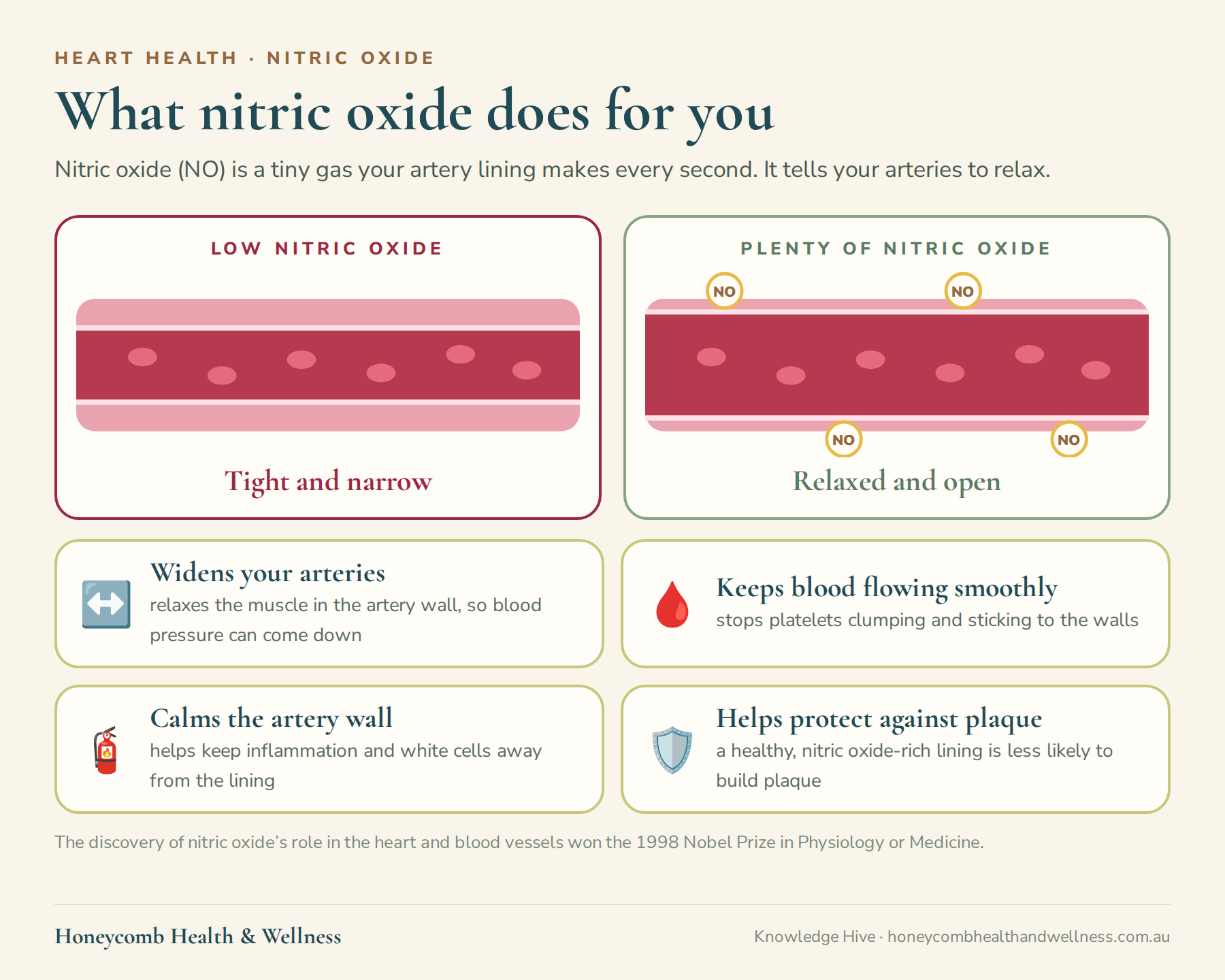
Nitric oxide is so important that the scientists who discovered its role in the heart and blood vessels won the 1998 Nobel Prize in Physiology or Medicine. Here’s what it does:
- Widens your arteries, so your heart doesn’t have to push as hard and blood pressure can come down.
- Keeps your blood flowing smoothly, by stopping platelets from clumping and sticking to the artery walls.
- Calms the artery wall, helping keep inflammation and white blood cells away from the lining.
- Helps protect against plaque. A lining that’s struggling to make nitric oxide is one of the earliest steps on the way to clogged arteries.
What wears your lining down
Age is only part of the story. Many everyday things make it harder for your lining to do its job:
- Oily and high-fat meals. In one study, a single high-fat fast-food meal reduced how well arteries widened for several hours afterwards (Vogel et al., 1997). Read Why oils aren’t heart food.
- Too much salt. High salt intake can impair the lining even when blood pressure doesn’t change (DuPont et al., 2013).
- High blood sugar and high LDL cholesterol, which both damage the lining over time.
- Smoking, one of the fastest ways to harm it.
- Sitting all day. Blood flowing past the lining as you move is what tells it to make nitric oxide.
- Long-term stress and poor sleep, which keep blood vessels tight.
A second way to make nitric oxide: from plants
This is the part I love. Your lining isn’t your only source of nitric oxide. Your body has a second pathway that starts on your plate.
Leafy greens and beetroot are rich in natural nitrate. When you eat them, friendly bacteria on your tongue turn that nitrate into nitrite. You swallow it, it’s absorbed into your blood, and your body turns it into nitric oxide right where your arteries need it (Lundberg et al., 2008). And this plant pathway doesn’t depend on your lining, so it keeps working as you get older.
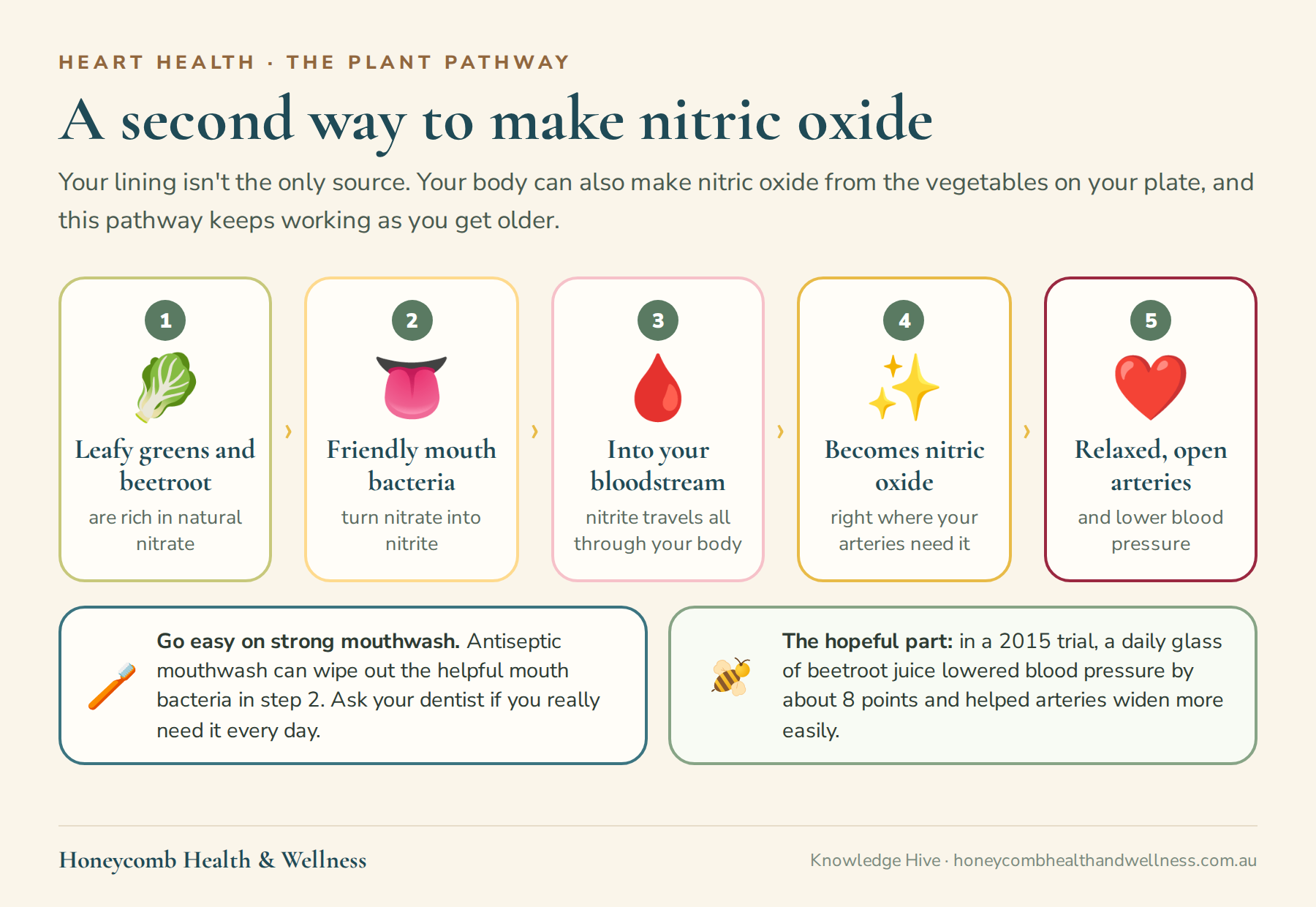
The research is encouraging. In a 2015 trial, people with high blood pressure drank a glass of beetroot juice every day for four weeks. Their blood pressure dropped by around 8 points, and their arteries widened more easily, an improvement of about 20% (Kapil et al., 2015).
One surprise: strong antiseptic mouthwash can wipe out the helpful bacteria on your tongue. In one study, using it twice a day for a week raised blood pressure (Kapil et al., 2013). If you use it every day, ask your dentist whether you really need it.
The nitric oxide all-stars
Some vegetables are especially rich in nitrate, and colourful plants are their perfect partners. Their polyphenols and vitamin C help protect nitric oxide once it’s made, so it lasts longer. In one study, a drink of blueberries improved how well arteries widened within a couple of hours (Rodriguez-Mateos et al., 2013).
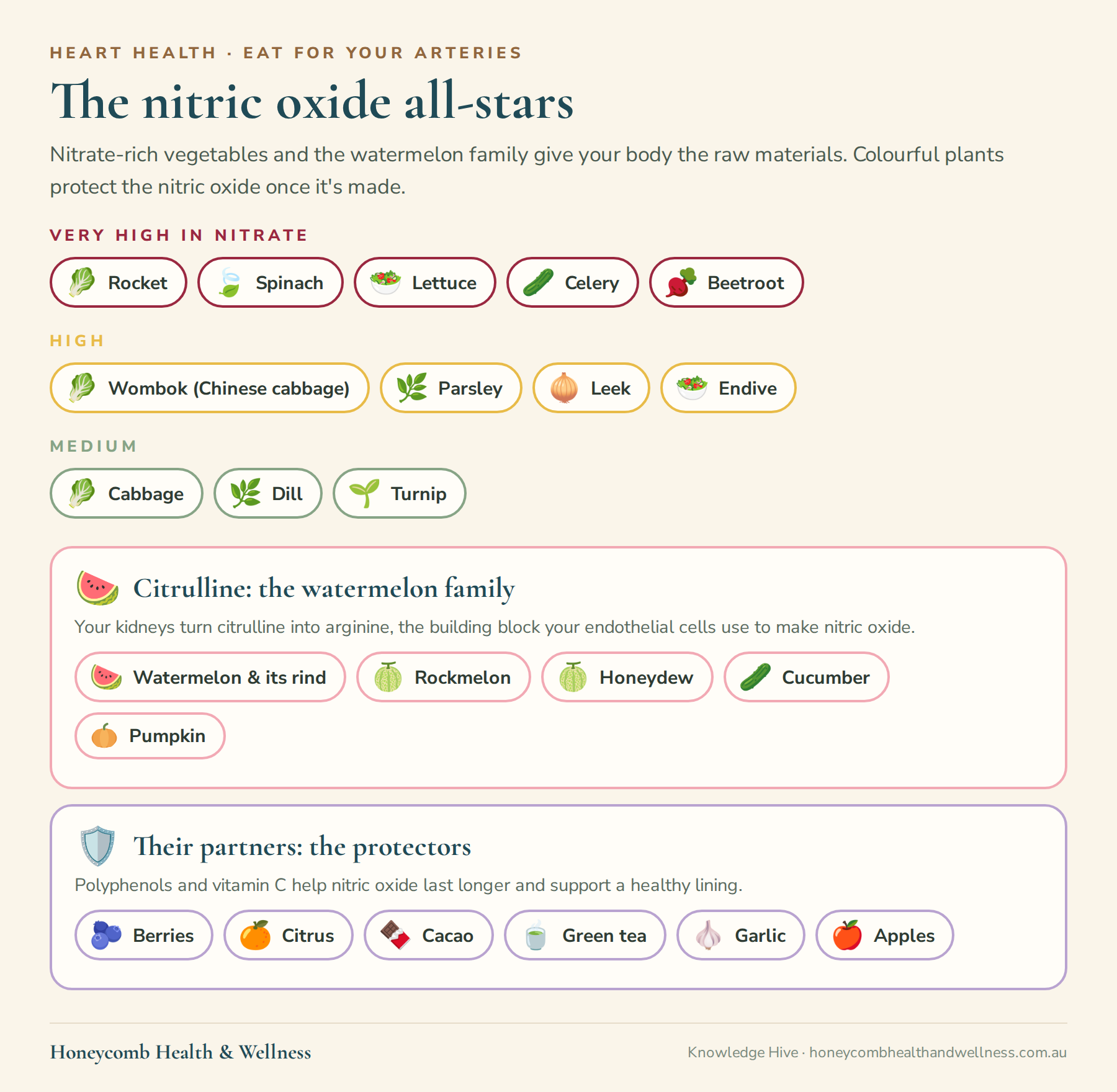
Notice that every one of them is a plant. This is one more reason a whole food, plant-based plate is so good for your arteries: it’s full of nitrate, full of protective plant compounds, and free of the oil and saturated fat that wear the lining down.
Why I love cold-pressed juice
I’m a big believer that the nutrients you get from cold-pressed juicing and eating plant-based can help your endothelial cells and the production of nitric oxide. A glass of fresh vegetable juice is one of the easiest ways I know to get a big handful of these nitrate-rich vegetables into your day, especially if you’d struggle to eat a whole bowl of rocket and three beetroot.
Here’s the juice I make. Think of it as a top-up alongside your meals, not a replacement for them. The whole vegetables on your plate bring fibre, which your gut and your cholesterol need.
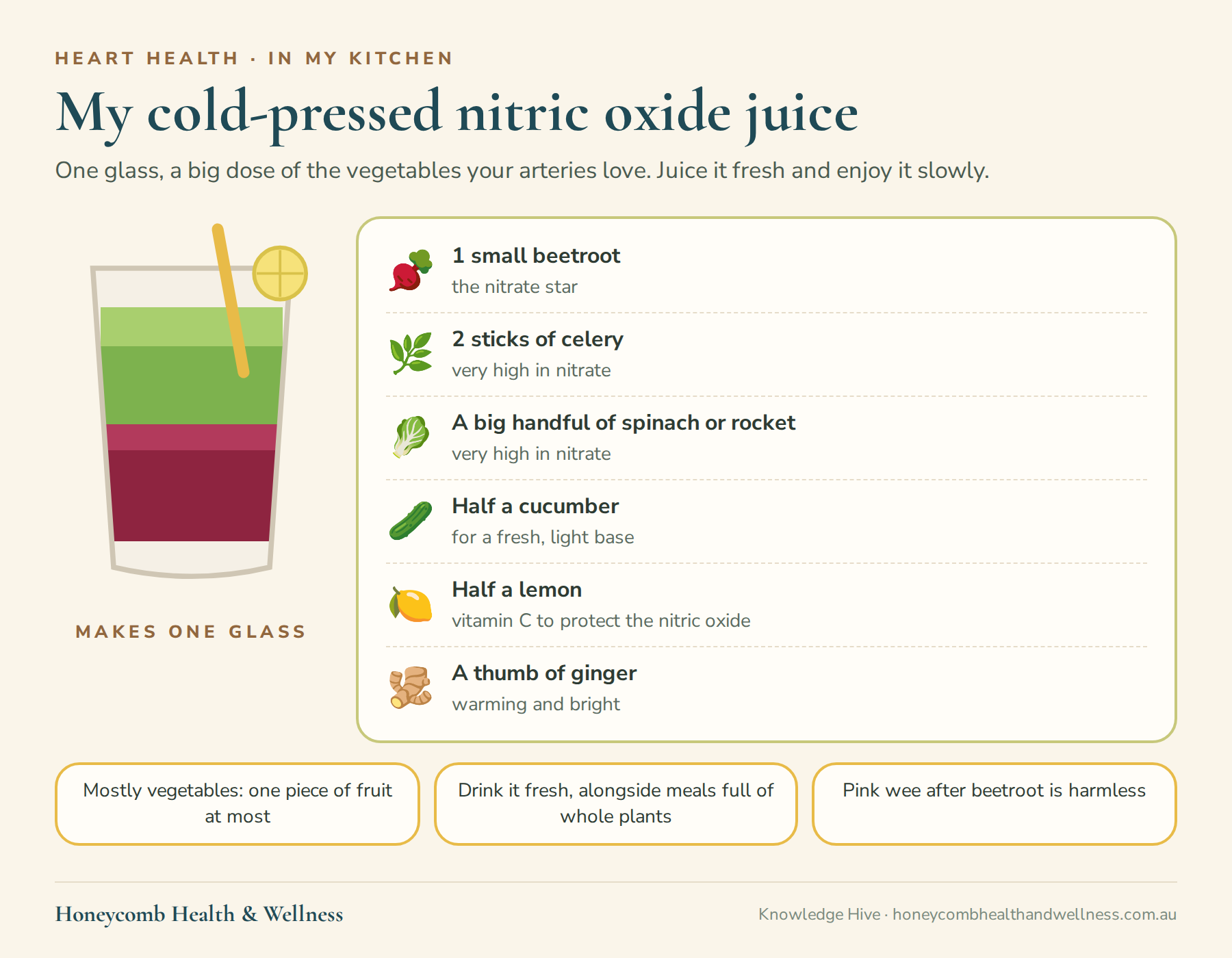
- Keep it mostly vegetables. One piece of fruit at most, so it doesn’t become a sugar hit.
- Pink wee is harmless. After beetroot, many people notice pink or red urine or bowel motions. It’s just the colour coming through.
- Kidney stones? Beetroot and spinach are high in oxalate. If you’ve had kidney stones, talk to me or your doctor before making this a daily habit.
- Taking warfarin? Leafy greens are rich in vitamin K, which affects how warfarin works. Keep your intake of greens steady from day to day, and talk to your prescribing doctor before starting daily green juices.
What you can start today
- Eat a leafy green every day, ideally rocket, spinach or lettuce. Make it a big salad, or stir a handful into soups and curries at the end.
- Add beetroot grated into salads, roasted, or in a cold-pressed juice a few times a week.
- Pair them with colour: berries, citrus, apples, garlic and a cup of green tea.
- Leave out the oil and keep salt low, so you’re not wearing your lining down while you build it up.
- Walk every day. Moving your blood is what tells your lining to make nitric oxide. Even a 10-minute walk after meals helps.
- Go easy on strong mouthwash, and look after your gums instead with brushing and flossing.
Recipes that help
Want to know how your heart is going? Start with my free Health Assessment. Inside the Honeycomb Community, the Six-Week Nutrition Reset fills your plate with leafy greens, beetroot and colourful plants from day one. And read Blood pressure and salt for the other half of the story.
A note on medication: please don’t stop or change any prescribed medication on your own. When you change the way you eat, your numbers can move quickly, so keep your prescribing doctor informed so your doses can be reviewed as you improve. This is especially important for blood pressure medication, because your numbers can fall as your arteries relax.
References
- Celermajer DS et al. Aging is associated with endothelial dysfunction in healthy men years before the age-related decline in women. Journal of the American College of Cardiology. 1994;24(2):471-476.
- Lundberg JO, Weitzberg E, Gladwin MT. The nitrate-nitrite-nitric oxide pathway in physiology and therapeutics. Nature Reviews Drug Discovery. 2008;7(2):156-167.
- Kapil V et al. Dietary nitrate provides sustained blood pressure lowering in hypertensive patients: a randomized, phase 2, double-blind, placebo-controlled study. Hypertension. 2015;65(2):320-327.
- Kapil V et al. Physiological role for nitrate-reducing oral bacteria in blood pressure control. Free Radical Biology and Medicine. 2013;55:93-100.
- Vogel RA, Corretti MC, Plotnick GD. Effect of a single high-fat meal on endothelial function in healthy subjects. American Journal of Cardiology. 1997;79(3):350-354.
- DuPont JJ et al. High dietary sodium intake impairs endothelium-dependent dilation in healthy salt-resistant humans. Journal of Hypertension. 2013;31(3):530-536.
- Rodriguez-Mateos A et al. Intake and time dependence of blueberry flavonoid-induced improvements in vascular function. American Journal of Clinical Nutrition. 2013;98(5):1179-1191.
- Santamaria P. Nitrate in vegetables: toxicity, content, intake and EC regulation. Journal of the Science of Food and Agriculture. 2006;86(1):10-17.
- The Nobel Prize in Physiology or Medicine 1998: Robert F Furchgott, Louis J Ignarro and Ferid Murad, for their discoveries concerning nitric oxide as a signalling molecule in the cardiovascular system.
How Honeycomb can help
You don’t have to work this out alone
This information is general education and is not a substitute for individual advice. Please speak with your health practitioner before making changes, especially if you take prescribed medication.
Keep going
You’re not doing this alone
This information is general education and is not a substitute for individual advice. Please speak with your health practitioner before making changes, especially if you take prescribed medication.