

If you’ve been told your blood sugar is creeping up, you’ve probably been handed a list of foods to avoid: bread, rice, potatoes, pasta, fruit. Many people end up eating mostly meat, eggs and cheese, and feeling miserable. And often their numbers don’t improve as much as they’d hoped.
I’d like to share a different picture, one that has helped many of my clients. It’s backed by research and it comes straight from the Starch Solution approach: whole starches, legumes and vegetables are your friends.
Why the cells stop listening
Insulin is like a key that opens your cells so sugar can move in from the blood. In insulin resistance, the locks are gummed up and the key doesn’t turn easily, so sugar builds up in the blood.
Here’s the surprise for many people: one of the main things gumming up the locks is fat building up inside your muscle and liver cells. It’s kind of like trying to get a key into a lock that’s been filled with butter. It’s not exactly like this scientifically, but it’s an easy way to understand it. That’s why a low-fat, whole food, plant-based diet can improve insulin sensitivity, even though it’s higher in carbohydrates.
What the research shows
In a 74-week randomised trial, people with type 2 diabetes who ate a low-fat vegan diet with no calorie limits improved their HbA1c (long-term blood sugar) and cholesterol at least as well as those on a conventional diabetes diet, and many were able to reduce their medications (Barnard et al., 2009).
A major series of reviews for the World Health Organization found that people eating the most fibre and whole grains had a lower risk of type 2 diabetes, heart disease and early death (Reynolds et al., 2019).
Whole versus refined
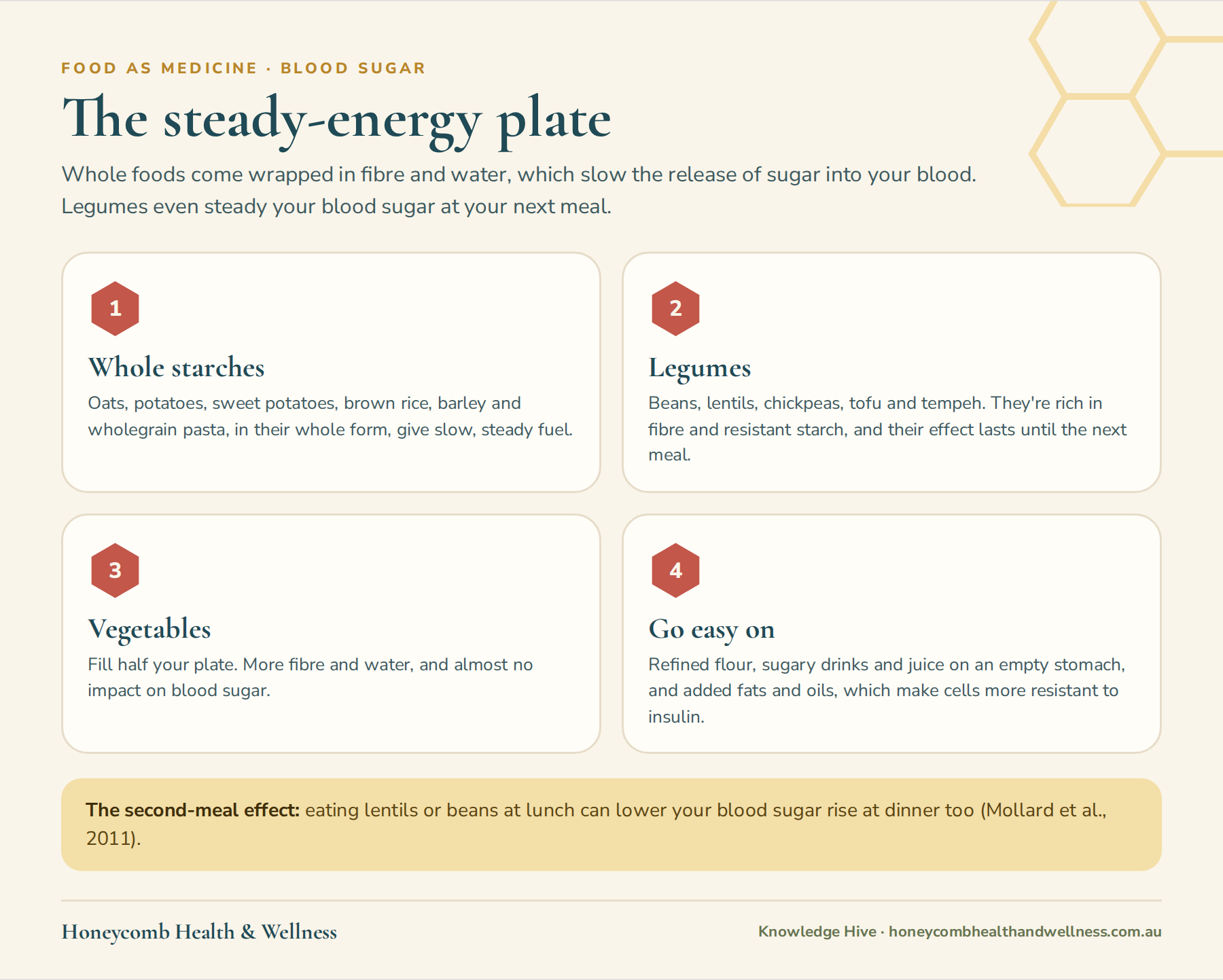
Not all carbohydrates are equal. A whole potato or a bowl of rolled oats comes packaged with fibre, water and nutrients that slow digestion. Turn the same food into chips, white bread, crackers or a sugary breakfast cereal and the packaging is gone, so the sugar hits your blood quickly.
Think of it as the difference between a slow-burning log and a sheet of newspaper on the fire.
Legumes: the secret weapon
Legumes have a lovely trick called the second-meal effect. When you eat lentils, chickpeas or beans at one meal, your blood sugar rise is lower not only at that meal, but at the next one too (Mollard et al., 2011). Gut bacteria ferment their fibre and resistant starch into compounds that improve insulin sensitivity.
Your steady-energy toolkit
- Legumes once or twice a day: a lentil soup at lunch, chickpeas in your salad, tofu in your stir-fry.
- Cook and cool your starches. Cooked and cooled potatoes, rice and pasta form more resistant starch, which feeds your gut and blunts the sugar rise. Reheating is fine!
- Vinegar with meals. A splash of apple cider vinegar in a dressing can soften the sugar rise.
- Walk after meals. Even 10 to 15 minutes helps your muscles soak up sugar.
- Eat fruit whole. Save juice for alongside a meal, and favour vegetable-based juices.
- Leave out the oil and keep higher-fat foods for the Relaxation phase while you’re working on a number.
- Sleep. One short night can make your cells less sensitive to insulin the next day.
If you’re working on blood sugar, the Elimination phase of our Six-Week Nutrition Reset is designed for exactly this. Inside the Honeycomb Community, you’ll find it laid out week by week.
Recipes that help
- Slow Cooker Kidney Bean & Barley Chili
- Nourish Your Body with Tomato Lentil Curry
- Pressure Cooker Apple Cinnamon Oats
- Coriander Lime Black Bean Nourish Bowl
Testing and support
Fasting glucose, HbA1c and fasting insulin give us a much fuller picture than glucose alone. In clinic I interpret these with functional testing and build a plan with nutrition, herbal medicine and supplements that support insulin sensitivity.
A note on medication: please don’t stop or change any prescribed medication on your own. When you change the way you eat, your numbers can move quickly, so keep your prescribing doctor informed so your doses can be reviewed as you improve. This is especially important for blood sugar medications and insulin, because your levels can fall quickly when you change the way you eat.
References
- Barnard ND et al. A low-fat vegan diet and a conventional diabetes diet in the treatment of type 2 diabetes: a randomized, controlled, 74-wk clinical trial. American Journal of Clinical Nutrition. 2009;89(5):1588S-1596S.
- Mollard RC et al. First and second meal effects of pulses on blood glucose, appetite, and food intake at a later meal. Applied Physiology, Nutrition, and Metabolism. 2011;36(5):634-642.
- Reynolds A et al. Carbohydrate quality and human health: a series of systematic reviews and meta-analyses. Lancet. 2019;393(10170):434-445.
- Roden M et al. Mechanism of free fatty acid-induced insulin resistance in humans. Journal of Clinical Investigation. 1996;97(12):2859-2865.
How Honeycomb can help
You don’t have to work this out alone
This information is general education and is not a substitute for individual advice. Please speak with your health practitioner before making changes, especially if you take prescribed medication.
Keep going
You’re not doing this alone
This information is general education and is not a substitute for individual advice. Please speak with your health practitioner before making changes, especially if you take prescribed medication.