When we talk about detox, most people think of green juice, swapping chemicals out of the bathroom cabinet, or eating more vegetables. Those things matter. But in clinic, I often find that the biggest load someone is carrying isn’t in their pantry. It’s in their diary, their phone, their home and their relationships.
The friend who leaves you exhausted after every coffee. The news playing in the background all evening. The kitchen bench you can’t see under the paperwork. Saying yes to one more thing when you’re already stretched. None of these are toxins in the usual sense, but your body responds to them in a very similar way.
What everyday stress does in your body
When something worries you, your brain sends a message down to your adrenal glands, and they release cortisol and adrenaline. Your heart beats faster, sugar is released into your blood for quick energy, and digestion and repair are put on hold. That’s brilliant for a short burst, like slamming on the brakes in traffic.
But it was never meant to run all day. When small stresses keep coming, cortisol stays up, and over time that wear and tear adds up. Scientists call it allostatic load (McEwen, 1998). It shows up as poor sleep, cravings and creeping blood sugar, a tummy that’s bloated or unsettled, more colds, tight muscles, headaches and a shorter fuse. You can read more in Stress and your body.
Your stress bucket
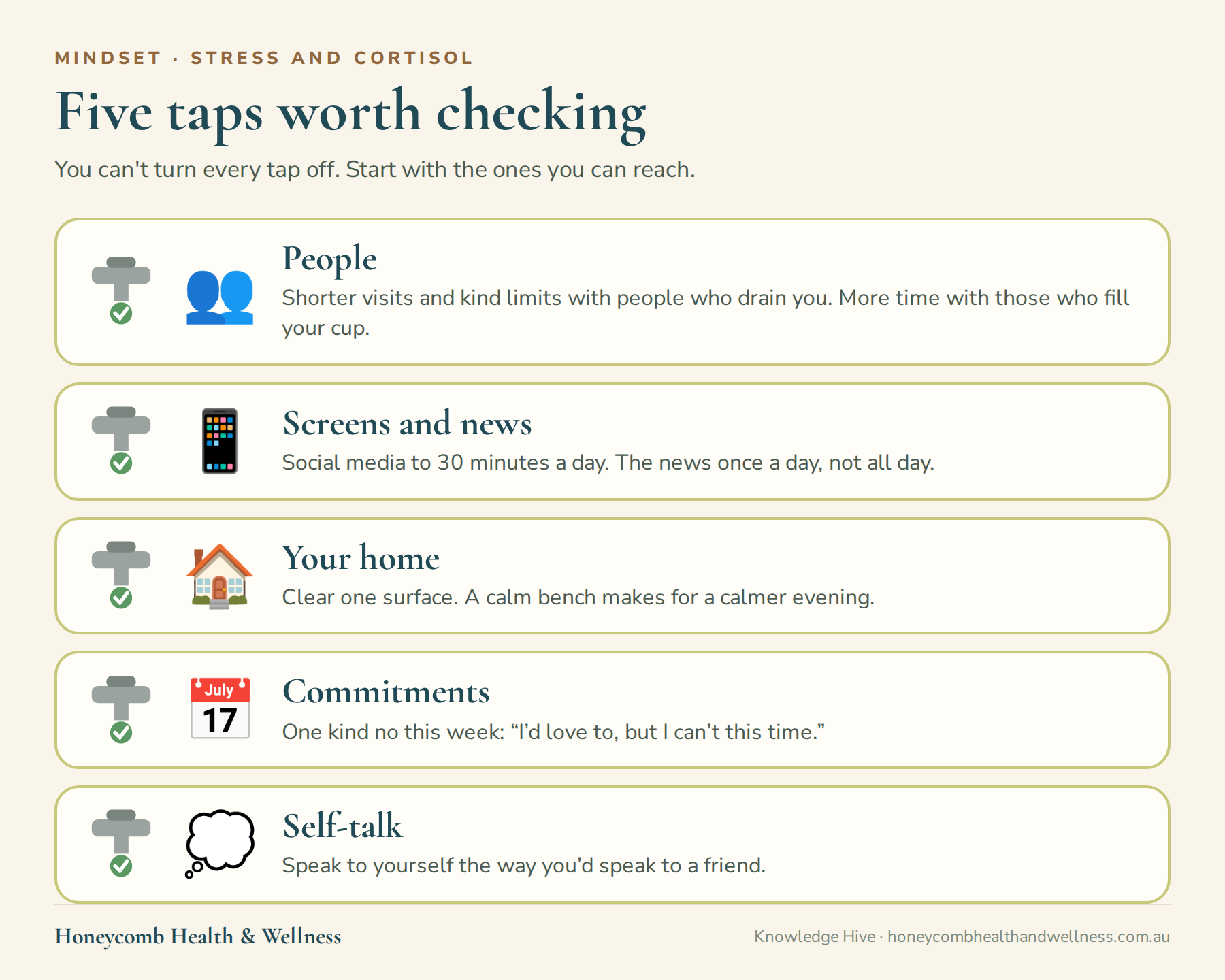
It’s kind of like this. Imagine you’re carrying a bucket. Every stress in your life pours in from its own tap: work deadlines, money worries, the news, a cluttered house, a tense relationship, a bad night’s sleep.
While there’s room in the bucket, you cope. But once it’s full, even a small splash makes it overflow, and that’s when you snap at the kids over spilt milk, lie awake at 3am, or get the headache or tummy upset that tells you something’s not right.
There are two ways to stop the overflow. You can turn off some of the taps, and you can open the drain at the bottom with the things that empty your bucket. It’s the same idea as our toxic load bucket, and it’s not exactly how it works scientifically, but it’s a picture that helps.
Five taps worth checking
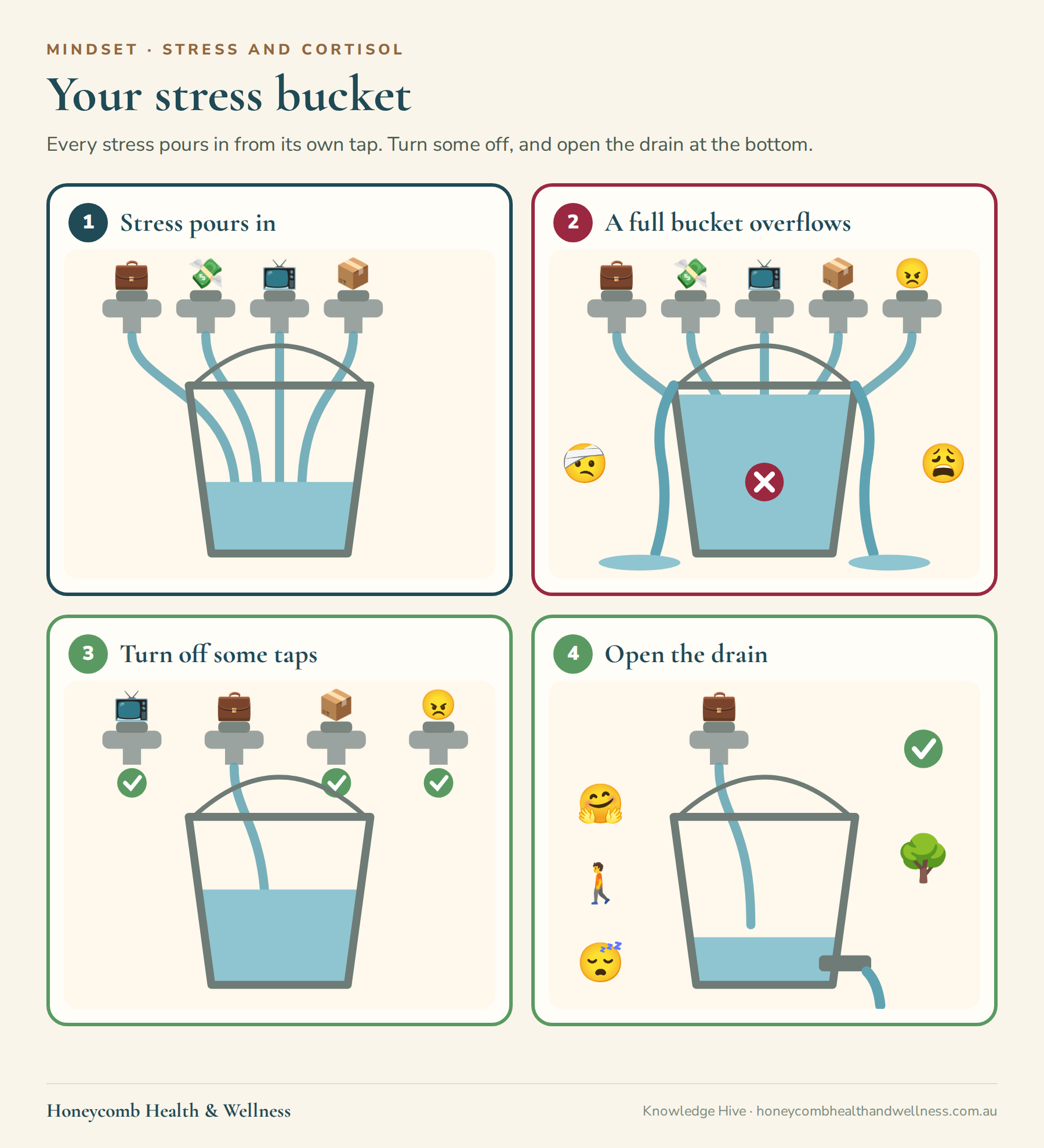
You can’t turn every tap off, and you don’t need to. Start with the ones you can reach.
- People. Good relationships are powerful medicine. A review of 148 studies found that people with strong social connections had a 50% better chance of survival over the study periods (Holt-Lunstad et al., 2010). But the opposite matters too: in a long-term study of British public servants, people whose close relationships were often negative had a higher risk of heart problems (De Vogli et al., 2007). You don’t have to cut people off. Shorter visits, kinder limits and more time with the people who fill your cup all count.
- Screens and the news. In a three-week trial, university students who limited social media to 30 minutes a day felt less lonely and less depressed (Hunt et al., 2018). And after the Boston Marathon bombing, people who watched six or more hours of coverage a day reported more acute stress than some people who were actually there (Holman et al., 2014). Staying informed is good. Staying glued to it isn’t.
- Your home. In one study, women who described their homes as cluttered or unfinished had a flatter daily cortisol pattern and a lower mood across the day, while those who described their homes as restful did better (Saxbe and Repetti, 2010). One clear bench can make a difference.
- Your commitments. Every yes is a no to something else, often your rest. It’s okay to say, “I’d love to, but I can’t this time.”
- Your self-talk. The voice in your head can be the loudest tap of all. If yours is often harsh, read Limiting beliefs: the stories that keep you stuck.
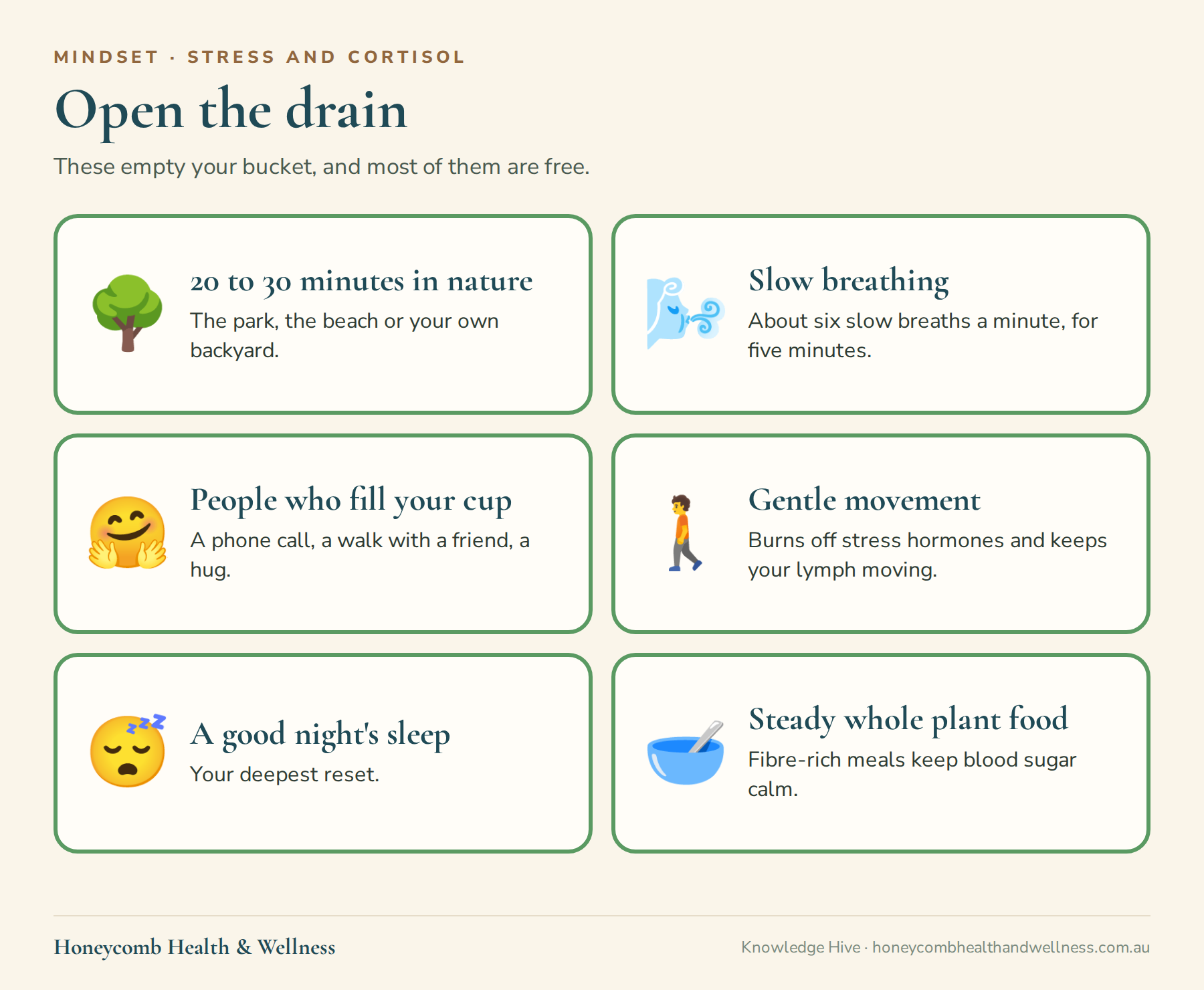
Open the drain
This is the hopeful part. Some things actively empty your bucket, and most of them are free:
- Time in nature. In a study of city dwellers, a “nature pill” of 20 to 30 minutes outside, sitting or walking somewhere with a sense of nature, gave the biggest drop in the stress hormone cortisol (Hunter et al., 2019). A local park or your own backyard counts.
- Slow breathing. Breathing slowly, about six breaths a minute, calms the nervous system and is linked to feeling more relaxed and less anxious (Zaccaro et al., 2018). Try five-minute nervous system resets.
- People who fill your cup. A phone call, a walk with a friend, a hug.
- Movement. Gentle movement burns off stress hormones and keeps your lymph moving. See Move your lymph.
- Sleep. Your deepest reset. See Sleep: your deepest detox.
- Food that steadies you. Whole plant foods with plenty of fibre keep your blood sugar steady, so you’re not riding the stress-sugar rollercoaster. Go easy on caffeine after lunch and on alcohol, which both make sleep lighter.
What stress looks like in your body
It helps to know your own early warning signs, so you can open the drain before the bucket spills. Common ones are a tight jaw or shoulders, a racing mind at bedtime, sugar cravings, a bloated or unsettled tummy, catching every cold going, and feeling teary or snappy over little things.
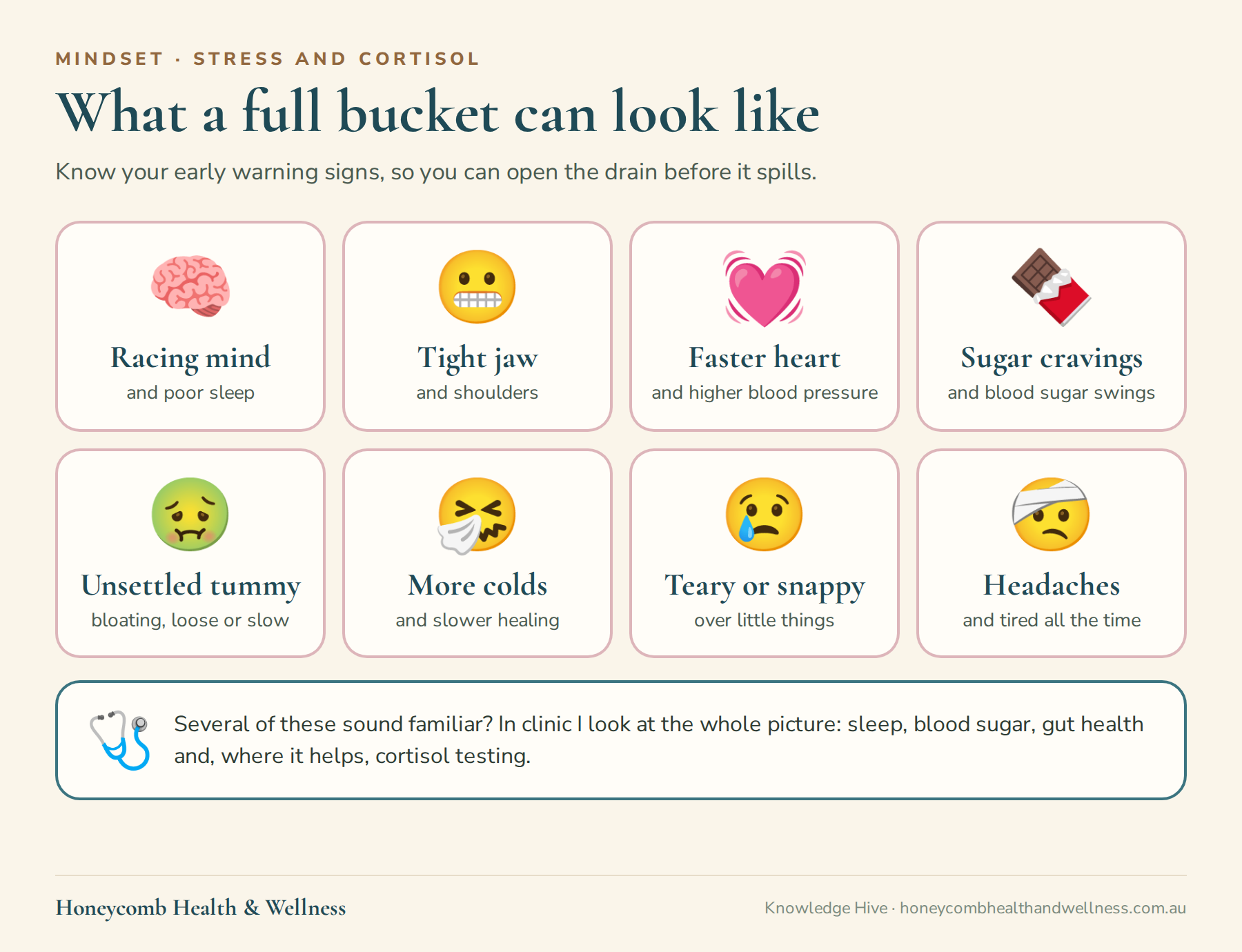
If several of these sound familiar, it’s worth looking deeper. In clinic I look at the whole picture, including sleep, blood sugar, gut health and, where it helps, functional testing such as cortisol, and build a plan with nutrition, herbal medicine and lifestyle support.
If the people tap is running: easing out of people pleasing
Wanting to be liked is human. It becomes a stress tap when you’re saying yes so often that there’s nothing left for you. A few gentle shifts help:
- Accept that not everyone will like you. That’s not a failure. People are different, and you can’t force a connection that isn’t there.
- Remember you have a choice. Try a pause line: “Let me check and get back to you.” It gives you time to decide whether it’s a yes or a kind no.
- Choose your priorities. You can help others without helping with everything. Pick the few that matter most.
- Listen to the knot in your stomach. If your heart sinks when a certain name pops up on your phone, that feeling is information. It may be time for a little more distance.
Who are you becoming?
Detoxing your life isn’t about becoming a different person or cutting everyone out. It’s about choosing, a little at a time, what you let pour into your bucket. Every small no to something that drains you is a yes to your health, your family and the life you actually want.
“Come with me by yourselves to a quiet place and get some rest.” (Mark 6:31) Rest is part of the design, and your body is a gift worth caring for.
What you can start today
- Unfollow five accounts that leave you feeling worse.
- Check the news once a day, not all day.
- Clear one surface in your home, like the kitchen bench or your bedside table.
- Say one kind no this week.
- Take a 20-minute nature pill: a walk, the park, or the backyard with a cuppa.
- Call someone who fills your cup.
Recipes that help
Comforting, steadying food makes a calm evening easier:
- Creamy Turmeric Pumpkin Soup: warm, gentle and full of colour
- Lentil & Potato Soup: slow-release energy to keep blood sugar steady
- Chocolate Blueberry Chia & Flax Pudding: a calming treat with omega-3s from chia and flax
Not sure where your stress is showing up? Start with my free Health Assessment, and inside the Honeycomb Community you’ll find simple daily rituals to keep your bucket from overflowing.
You can’t turn off every tap, but you can always open the drain.
If you’re struggling, please reach out. In clinic I can help with the physical side of stress, and you don’t have to carry it alone. If you need someone to talk to now, call Lifeline on 13 11 14 or Beyond Blue on 1300 22 4636, any time.
References
- McEwen BS. Protective and damaging effects of stress mediators. New England Journal of Medicine. 1998;338(3):171-179.
- Holt-Lunstad J, Smith TB, Layton JB. Social relationships and mortality risk: a meta-analytic review. PLoS Medicine. 2010;7(7):e1000316.
- De Vogli R, Chandola T, Marmot MG. Negative aspects of close relationships and heart disease. Archives of Internal Medicine. 2007;167(18):1951-1957.
- Hunt MG, Marx R, Lipson C, Young J. No more FOMO: limiting social media decreases loneliness and depression. Journal of Social and Clinical Psychology. 2018;37(10):751-768.
- Holman EA, Garfin DR, Silver RC. Media’s role in broadcasting acute stress following the Boston Marathon bombings. PNAS. 2014;111(1):93-98.
- Saxbe DE, Repetti R. No place like home: home tours correlate with daily patterns of mood and cortisol. Personality and Social Psychology Bulletin. 2010;36(1):71-81.
- Hunter MR, Gillespie BW, Chen SY. Urban nature experiences reduce stress in the context of daily life based on salivary biomarkers. Frontiers in Psychology. 2019;10:722.
- Zaccaro A et al. How breath-control can change your life: a systematic review on psycho-physiological correlates of slow breathing. Frontiers in Human Neuroscience. 2018;12:353.
How Honeycomb can help
You don’t have to work this out alone
This information is general education and is not a substitute for individual advice. Please speak with your health practitioner before making changes, especially if you take prescribed medication.
Keep going
You’re not doing this alone
This information is general education and is not a substitute for individual advice. Please speak with your health practitioner before making changes, especially if you take prescribed medication.