
I’ve heard so many versions of the same sentence in clinic. “I’ve tried everything.” “I’m just not a morning person.” “Everyone in my family is big.” “I’ll never be able to give up chocolate.” “Healthy eating is too expensive for people like us.”
These aren’t excuses. They’re beliefs: stories we’ve told ourselves so many times that they feel like facts. And because we believe them, we act in ways that prove them true.
Paths in the grass
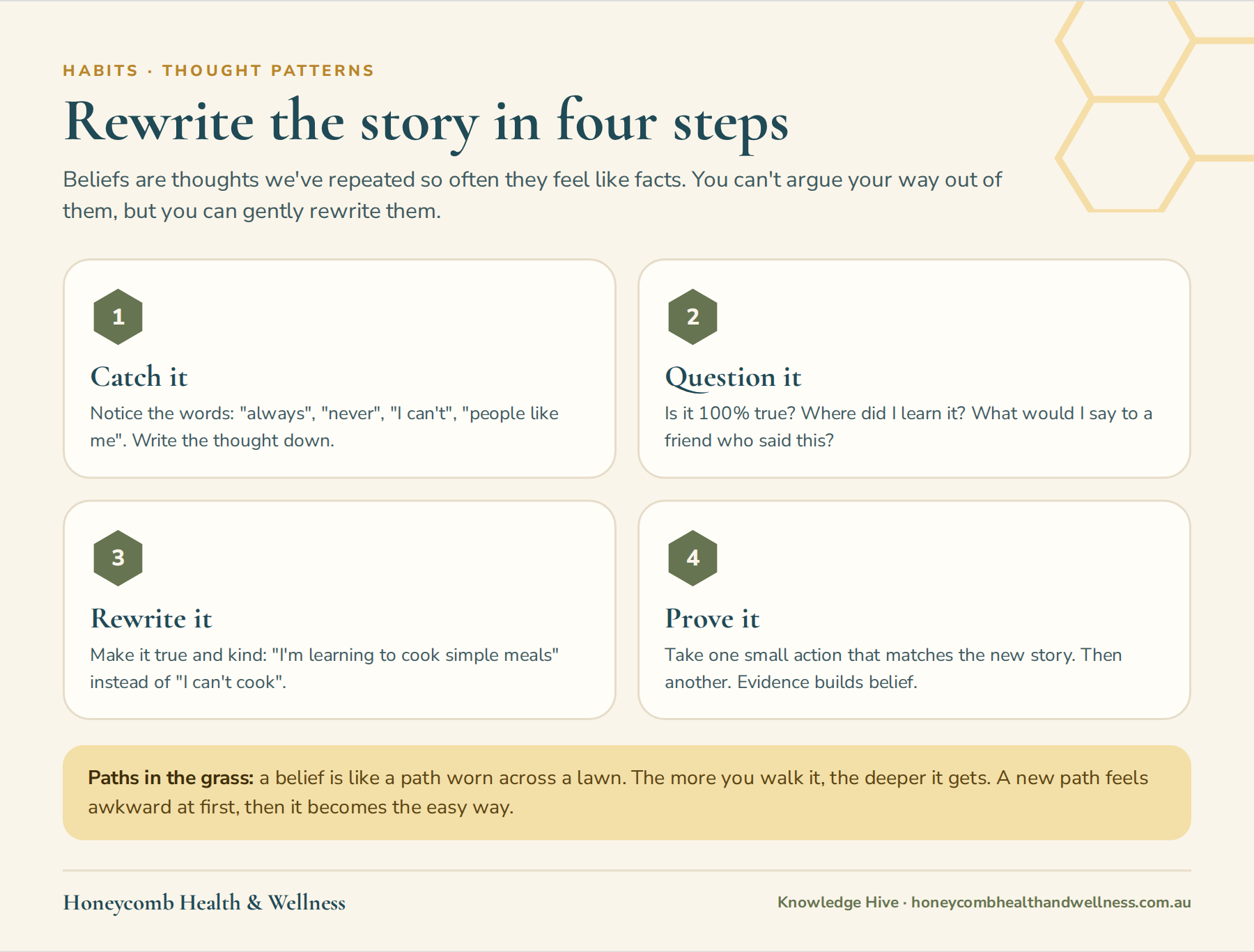
It’s kind of like a path across a lawn. The first time you walk across, you barely leave a mark. But walk the same way every day and soon there’s a worn path, and it becomes the easiest way to go. Our thoughts are like that. The more we think a thought, the stronger the brain pathway becomes, until it’s automatic. It’s not exactly like this scientifically, but it’s an easy way to understand it.
The beautiful part is that new paths can be made. It feels awkward at first, walking through the long grass. But keep walking it, and the old path starts to grow over.
Where beliefs come from
Many of our beliefs were formed when we were very young, from what we heard and saw at home, at school and in the media. In my years in early childhood, I saw how quickly little ones absorb the words around them. A child who’s told “you’re the fussy eater” often grows into an adult who believes it.
Your mindset changes your body
Research shows that what we believe can affect our bodies in surprising ways. In one study, hotel housekeepers were told that their daily work met the guidelines for an active lifestyle. Four weeks later, without changing their activity, they had lost a little weight and their blood pressure had dropped, compared with housekeepers who weren’t told (Crum and Langer, 2007).
In another study, people drank the same milkshake twice. When they were told it was an indulgent, high-calorie shake, their hunger hormone dropped much more than when they were told it was a “sensible” diet shake (Crum et al., 2011). Our expectations shape our biology.
Common health stories, rewritten
- “I’ve tried everything” → “I haven’t found the right approach for me yet, and I’m still learning.”
- “I can’t cook” → “I can make three simple meals, and I’m learning a fourth.”
- “It’s in my genes” → “My genes load the gun, but my habits pull the trigger, and I choose my habits.”
- “I have no willpower” → “I’m setting up my home and my routine so the healthy choice is the easy choice.”
- “Healthy food is too expensive” → “Beans, oats, potatoes and frozen vegetables are some of the cheapest foods in the supermarket.”
Identity is the key
Tony Robbins often says that the strongest force in the human personality is the need to stay consistent with who we believe we are. That’s why identity-based habits work so well. Instead of “I’m trying to eat healthier”, try “I’m someone who looks after my body”. Then ask, “What would someone like that do right now?”
Carol Dweck’s research on a growth mindset shows a similar thing: people who believe their abilities can grow, with effort and learning, keep going when things get hard (Dweck, 2006). Add one powerful word to your vocabulary: yet. “I don’t enjoy vegetables… yet.”
Be gentle with yourself
You are fearfully and wonderfully made. Speak to yourself the way you would speak to a child you love, or to your best friend. Change grows best in kindness, not criticism.
A simple practice for this week
- Write down one belief about your health that keeps you stuck.
- Ask: is it 100% true? Where did it come from?
- Rewrite it into something true, kind and hopeful.
- Write the new belief on a sticky note on your mirror.
- Take one small action each day that proves it.
For more on making new thoughts stick, read 4 simple steps for making positive affirmations work for you.
Recipes to prove your new story
- Greek Chickpeas on Toast (“I can cook” in 10 minutes)
- A Fiery Fiesta for Your Taste Buds!, a family favourite
- Peanut Butter Date Balls
The story you tell yourself becomes the life you live. You hold the pen.
If deep-rooted beliefs, past trauma or low mood are holding you back, a psychologist or counsellor can help, and I’m happy to work alongside them.
References
- Crum AJ, Langer EJ. Mind-set matters: exercise and the placebo effect. Psychological Science. 2007;18(2):165-171.
- Crum AJ et al. Mind over milkshakes: mindsets, not just nutrients, determine ghrelin response. Health Psychology. 2011;30(4):424-429.
- Dweck CS. Mindset: The New Psychology of Success. New York: Random House; 2006.
- Lally P et al. How are habits formed: modelling habit formation in the real world. European Journal of Social Psychology. 2010;40(6):998-1009.
How Honeycomb can help
You don’t have to work this out alone
This information is general education and is not a substitute for individual advice. Please speak with your health practitioner before making changes, especially if you take prescribed medication.
Keep going
You’re not doing this alone
This information is general education and is not a substitute for individual advice. Please speak with your health practitioner before making changes, especially if you take prescribed medication.