

You know that moment when your chest tightens, your thoughts race and you snap at someone you love? That’s your nervous system hitting the accelerator. In Stress and your body, I explained why that happens. This article is your toolkit for what to do about it, in the moment.
Meet your vagus nerve
Your vagus nerve is the longest nerve of its kind in your body. It wanders from your brainstem down through your throat, heart, lungs and gut. It’s the main nerve of your rest-and-repair system.
It works a bit like a car’s brake pedal. Stress is the accelerator, and the vagus nerve is the brake. You can’t stop the accelerator from ever being pressed, but you can learn to press the brake on purpose. It’s not exactly like this scientifically, but it’s an easy way to understand it.
Why breathing works so well
Breathing is the one part of your nervous system you can control directly. When you breathe slowly, with a longer breath out than in, your heart rate slows and your body gets the message that you’re safe. A systematic review of slow breathing found it increased calm, relaxation and alertness, and reduced anxiety and anger (Zaccaro et al., 2018).
A Stanford study compared five minutes a day of different practices for a month. The “cyclic sigh”, with a double breath in and a long breath out, improved mood and reduced breathing rate the most, even more than mindfulness meditation (Balban et al., 2023).
The five resets
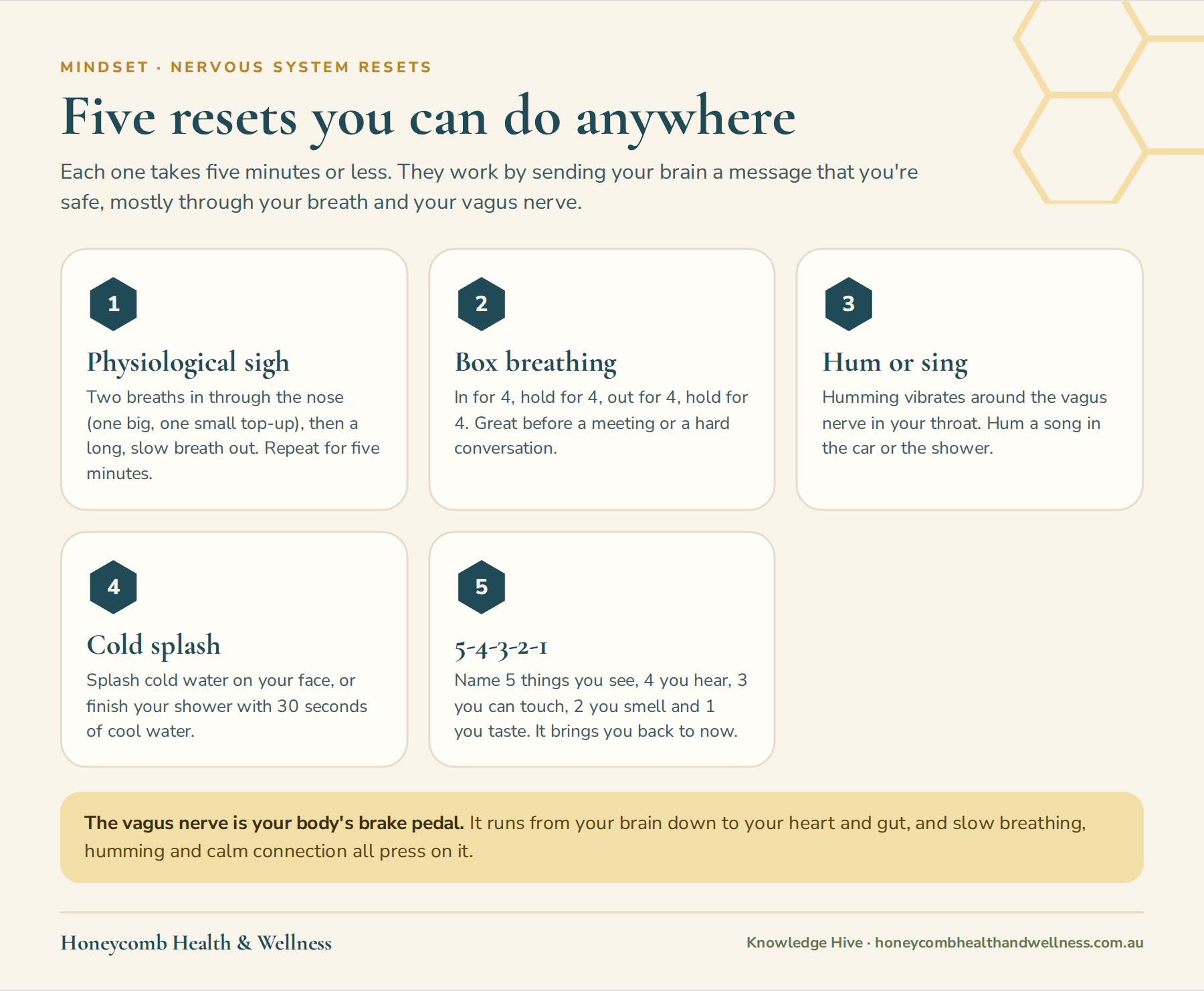
1. The physiological sigh. Breathe in through your nose, then take a second short sip of air on top. Then let it all out slowly through your mouth. Children do this naturally after a big cry. Five minutes a day is a powerful habit, and one or two sighs can settle you in the moment.
2. Box breathing. In for 4, hold for 4, out for 4, hold for 4. Picture tracing the sides of a square. It’s steady and structured, which makes it great when your mind is busy.
3. Hum, sing or gargle. The vagus nerve connects to the muscles of your throat and voice box. Humming, singing and gargling create gentle vibrations there. It’s the reason singing in the car feels so good!
4. A splash of cold. Cold water on your face triggers the “dive reflex”, which slows the heart. Splash your face, hold a cold pack to your cheeks or finish your shower with cool water.
5. 5-4-3-2-1 grounding. Anxiety lives in the future. This simple game brings your senses back to the present moment. I used versions of this with anxious little ones for years, and it works just as well for grown-ups.
Make it a habit
- Attach it to something you already do. Three physiological sighs every time you sit in the car. Box breathing while the kettle boils.
- Practise when you’re calm, so it’s automatic when you’re not.
- Teach your family. Children love “smell the flower, blow out the candle” breathing. Doing it together calms the whole house.
- Notice the win. After each reset, rate your calm from 1 to 10. Watching the number change builds belief.
You can’t always choose what happens to you, but you can choose your next breath.
Calm starts in the kitchen too
Blood sugar crashes feel just like anxiety: shaky, irritable and on edge. Meals built on whole starches, legumes and fibre keep your energy steady, so your nervous system isn’t fighting a rollercoaster. Magnesium-rich foods like leafy greens, legumes, whole grains and pumpkin seeds help too.
If anxiety, panic or low mood is affecting your daily life, please reach out for support. These tools help, but you don’t have to manage alone. I work alongside psychologists and counsellors, and in clinic I can support your nervous system with herbal medicine, nutrition and lifestyle changes.
References
- Balban MY et al. Brief structured respiration practices enhance mood and reduce physiological arousal. Cell Reports Medicine. 2023;4(1):100895.
- Zaccaro A et al. How breath-control can change your life: a systematic review on psycho-physiological correlates of slow breathing. Frontiers in Human Neuroscience. 2018;12:353.
- Breit S et al. Vagus nerve as modulator of the brain-gut axis in psychiatric and inflammatory disorders. Frontiers in Psychiatry. 2018;9:44.
How Honeycomb can help
You don’t have to work this out alone
This information is general education and is not a substitute for individual advice. Please speak with your health practitioner before making changes, especially if you take prescribed medication.
Keep going
You’re not doing this alone
This information is general education and is not a substitute for individual advice. Please speak with your health practitioner before making changes, especially if you take prescribed medication.