

Most of the clients who sit in front of me are stressed. Not always dramatically, just a constant hum: too much to do, not enough sleep, worry about family, money or health. Many have been living like that for so long that it feels normal.
But stress isn’t only a feeling. It’s a full-body chemical event, and over time it affects nearly every system we work on at Honeycomb.
The tiger in the traffic jam
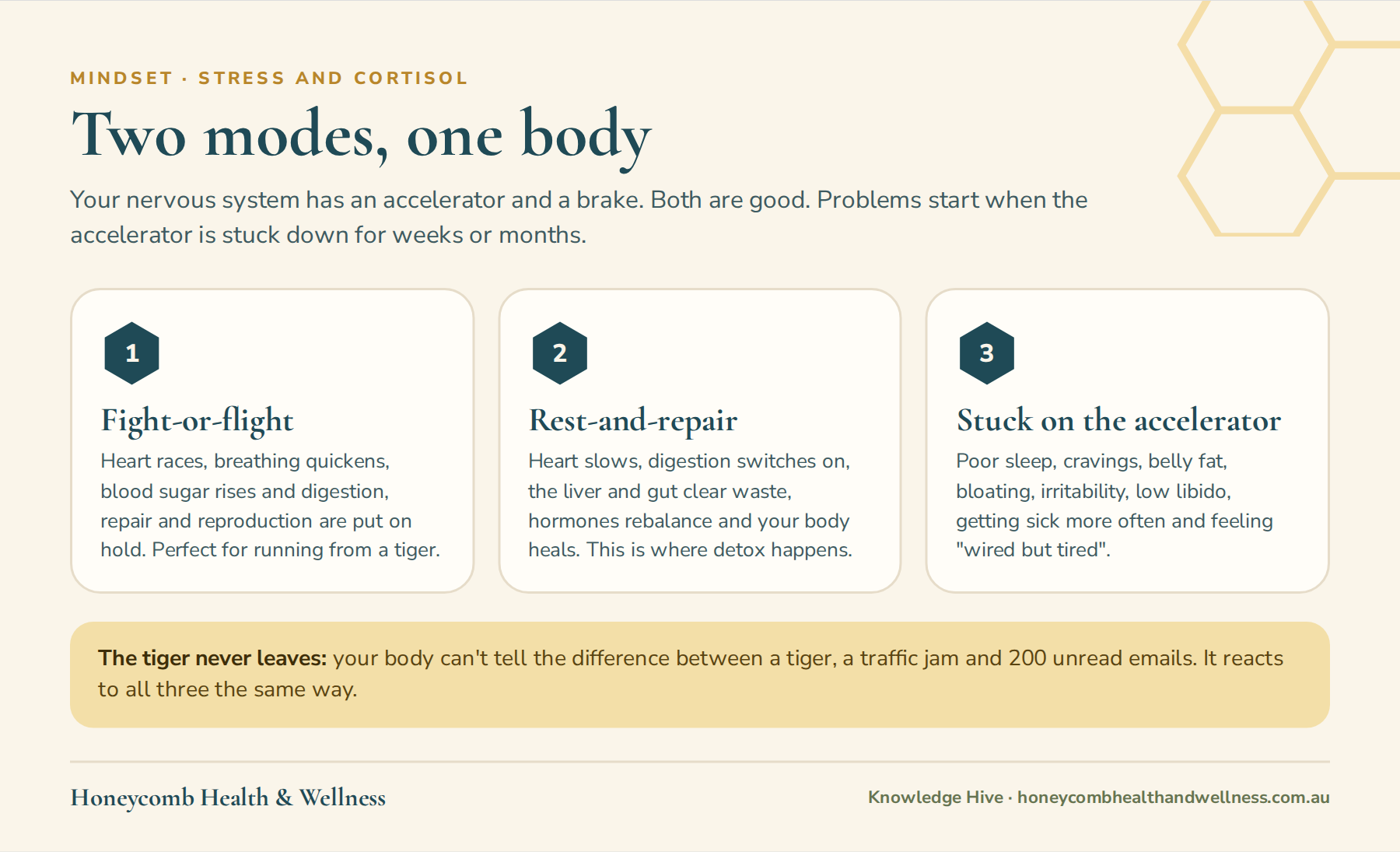
Imagine our ancestors walking through the bush and spotting a tiger. Instantly, the body floods with adrenaline and cortisol. The heart pumps harder, the lungs open up, sugar pours into the blood for energy, and anything that isn’t urgent (digestion, healing, fertility, detox) is put on hold. You run, you escape, and then you rest. The stress switches off.
Today, the tiger is a traffic jam, a difficult conversation, a pinging phone or a bank statement. The trouble is, these tigers don’t go away. So the stress switch stays on, sometimes for years. It’s not exactly like this scientifically, but it’s an easy way to understand it.
What cortisol does in the long run
Cortisol is not a bad hormone. It wakes you up in the morning and helps you handle challenges. The researcher Bruce McEwen described how the same stress hormones that protect us in the short term can cause wear and tear when they stay high for long periods (McEwen, 1998). Over time, this can show up as:
- Blood sugar swings and cravings, especially for sugar and salty snacks, and fat stored around the middle.
- Gut problems: bloating, reflux, IBS and changes in bowel habits, because digestion is “switched off” under stress.
- Hormone disruption: irregular cycles, worse PMS, low libido and a rougher perimenopause.
- Poor sleep, especially waking at 3 am with a racing mind.
- Lower immunity, so you catch every cold going around.
- Slower detox, because your body is busy surviving rather than repairing.
If you’d like to see your own pattern, a cortisol test can show how your levels move through the day. Read more in Cortisol curves don’t lie.
Switching to rest-and-repair
You can’t always remove the tiger, but you can teach your body that it’s safe again. These are some of the quickest ways I know:
- Breathe out longer than you breathe in. In for 4, out for 6 to 8, for two minutes. Long exhales tap on the brake.
- Eat sitting down, without screens, and chew well. Digestion only works properly in rest-and-repair.
- Get morning light in your eyes for 10 minutes. It helps set a healthy cortisol rhythm.
- Move your body gently every day: walking, stretching, gardening or swimming.
- Steady your blood sugar with whole starches, legumes and fibre at every meal, and go easy on caffeine.
- Protect your sleep with a wind-down routine and a screen curfew.
- Connect. A hug, a laugh with a friend or a phone call with someone who loves you is a real stress reliever.
For more quick resets, read Five-minute nervous system resets.
Herbal and nutritional support
In clinic, nervous system support is one of my favourite areas to work in. Herbal medicine, such as adaptogens and calming nervines, and nutrients like magnesium can make a big difference when they’re chosen for your situation. This is something I tailor carefully, because the right herb depends on whether you’re wired, exhausted or both.
A word on mindset
Rest is not laziness. It’s part of the design. Even the creation story builds in a day of rest. When you rest, your body isn’t doing nothing: it’s digesting, repairing, detoxing and rebalancing. Give yourself permission to switch off.
Recipes that calm
- Gingerbread Oatmeal for a steady-energy breakfast
- Creamy Turmeric Pumpkin Soup
- Slow Cooker Spiced Carrot & Lentil Soup, ready when you walk in the door
A note on medication: please don’t stop or change any prescribed medication on your own. When you change the way you eat, your numbers can move quickly, so keep your prescribing doctor informed so your doses can be reviewed as you improve.
References
- McEwen BS. Protective and damaging effects of stress mediators. New England Journal of Medicine. 1998;338(3):171-179.
- Zaccaro A et al. How breath-control can change your life: a systematic review on psycho-physiological correlates of slow breathing. Frontiers in Human Neuroscience. 2018;12:353.
- Epel ES et al. Stress and body shape: stress-induced cortisol secretion is consistently greater among women with central fat. Psychosomatic Medicine. 2000;62(5):623-632.
How Honeycomb can help
You don’t have to work this out alone
This information is general education and is not a substitute for individual advice. Please speak with your health practitioner before making changes, especially if you take prescribed medication.
Keep going
You’re not doing this alone
This information is general education and is not a substitute for individual advice. Please speak with your health practitioner before making changes, especially if you take prescribed medication.