Have you ever wondered why your friend can drink coffee all day, live on four hours’ sleep and wear perfume without a second thought, while you get a headache walking past the cleaning aisle? Or why symptoms that were never there in your twenties seem to arrive all at once in your forties?
In clinic I explain this with one simple picture: the toxic load bucket.
Picture a bucket
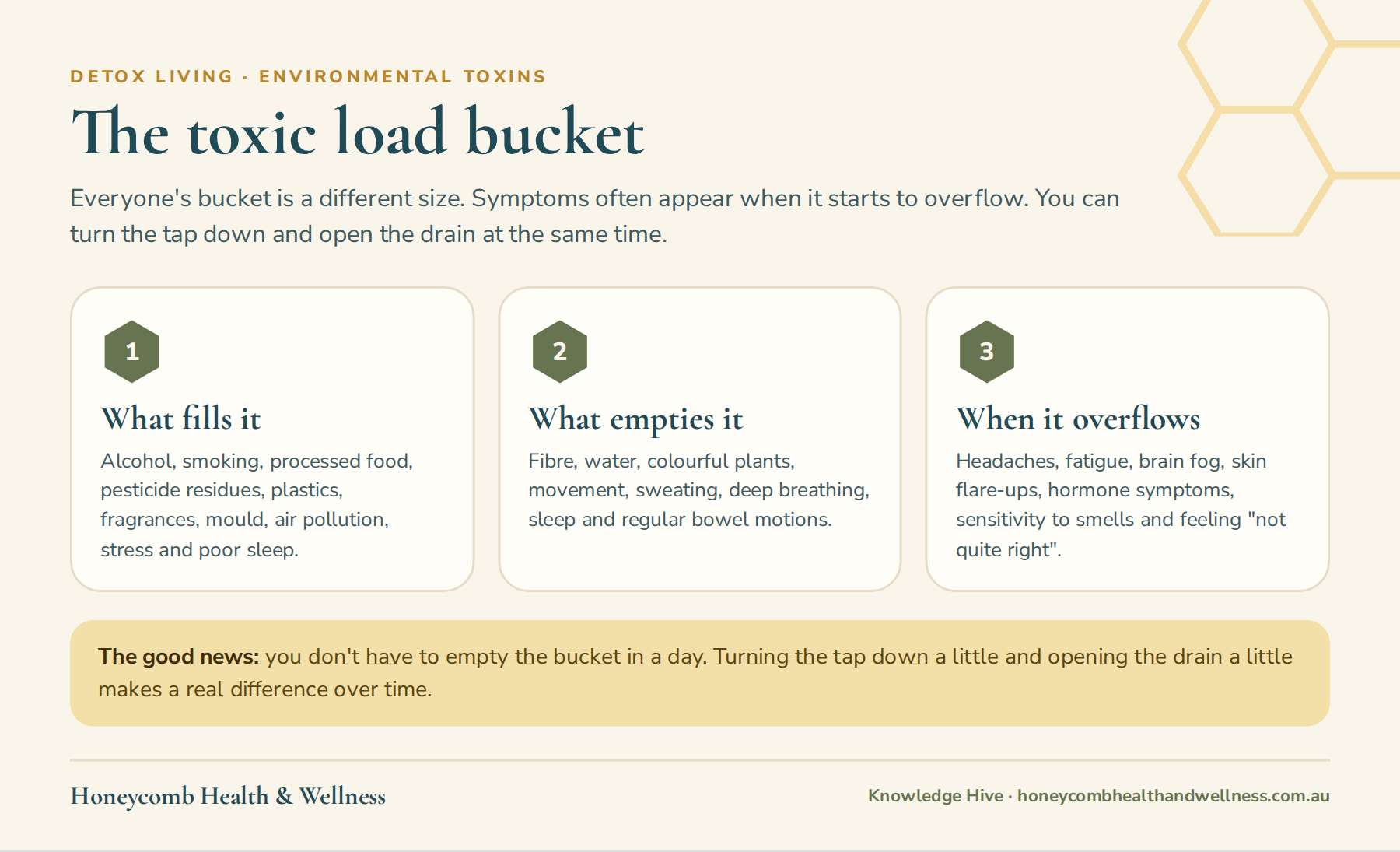
It’s kind of like this. Imagine you carry a bucket inside you. Every exposure to something your body has to process adds a little water: a glass of wine, car exhaust, a fragranced candle, a stressful week, pesticide residue on your apples. At the bottom of the bucket there’s a drain, and that’s your detox system: your liver, gut, kidneys, lymph, skin and lungs.
As long as the water drains out as fast as it pours in, you feel fine. But if the tap runs faster than the drain, the bucket slowly fills. When it overflows, you notice symptoms. It’s not exactly like this scientifically, but it’s an easy way to understand it.
Why everyone’s bucket is different
Your bucket size and drain speed depend on your genes, your gut health, your nutrient status, your age and your history. Some people inherit a slower detox pathway. Others have a sluggish bowel, so waste sits around longer. Someone who has been through years of stress, poor sleep or illness may start with a fuller bucket.
That’s why I never compare one client to another. Your bucket is yours, and we work with it.
The modern tap is running fast
The Lancet Commission on Pollution and Health estimated that pollution was responsible for about nine million deaths worldwide in 2015, which is more than tobacco, alcohol or road accidents (Landrigan et al., 2018). Most of us aren’t living next to a factory, but we’re exposed to small amounts of many chemicals every day, through food, water, air, plastics, cleaning products and cosmetics.
No single exposure is usually the problem. It’s the combination, day after day, that fills the bucket.
Signs your bucket may be full
- Tiredness that sleep doesn’t fix
- Headaches or brain fog
- Sensitivity to perfumes, smoke or chemical smells
- Skin flare-ups, rashes or acne
- Bloating and sluggish bowels
- Hormone symptoms, like heavier periods or PMS
- Aches and pains that move around
These symptoms can have many causes, which is why the right testing matters. In clinic I use functional testing to get to the root cause, rather than guessing, and then build a treatment plan with nutrition, herbal medicine, targeted supplements and lifestyle changes.
Turn down the tap
- Start with what you eat and drink every day. Swap ultra-processed foods for whole plants, cut back on alcohol and filter your drinking water.
- Air your home. Open the windows for ten minutes a day, and vacuum with a HEPA filter. Indoor air is often more polluted than outdoor air.
- Ditch the fragrance. Air fresheners, plug-ins, scented candles and fabric softeners are some of the easiest swaps.
- Swap as things run out. Don’t throw everything out at once. When a product finishes, replace it with a simpler one.
Open the drain
- Fibre at every meal, so waste leaves the body instead of being reabsorbed.
- Water, two to three litres a day for most adults, more in the Queensland heat.
- Crucifers and greens daily: broccoli, cabbage, rocket, kale and Brussels sprouts.
- Move and sweat. A brisk walk, a sauna or gardening on a warm day.
- Sleep and stress care, because a stressed body detoxes less efficiently.
You can’t control every exposure in the world. You can control what comes through your own front door.
Recipes that help
- Spicy Cucumber Juice for hydration
- Minestrone Soup for fibre and colour
- Easy 20-Minute Tofu Quinoa Bowl for Detox and Energy with plenty of greens
Keep it hopeful
This isn’t about fear. Your body is wonderfully made, and it’s built to cope with a certain amount of load. Our job is simply to stop overfilling the bucket and to help the drain run freely. Small changes, made consistently, add up to a lighter bucket and a lighter you.
Not sure where your bucket sits? Our free Health Assessment is a great first step.
References
- Landrigan PJ et al. The Lancet Commission on pollution and health. Lancet. 2018;391(10119):462-512.
- Gore AC et al. EDC-2: The Endocrine Society’s second scientific statement on endocrine-disrupting chemicals. Endocrine Reviews. 2015;36(6):E1-E150.
- Klein AV, Kiat H. Detox diets for toxin elimination and weight management: a critical review of the evidence. Journal of Human Nutrition and Dietetics. 2015;28(6):675-686.
How Honeycomb can help
You don’t have to work this out alone
This information is general education and is not a substitute for individual advice. Please speak with your health practitioner before making changes, especially if you take prescribed medication.
Keep going
You’re not doing this alone
This information is general education and is not a substitute for individual advice. Please speak with your health practitioner before making changes, especially if you take prescribed medication.