For many women, the week before a period comes with a familiar list: jeans that won’t do up, sore and heavy breasts, puffy fingers, a bloated belly and the scales up a kilo or two. Then, a day or two after the period starts, it all lets go.
That’s not in your head, and it’s not fat. It’s fluid, and it’s driven by your hormones.
What’s happening in your cycle
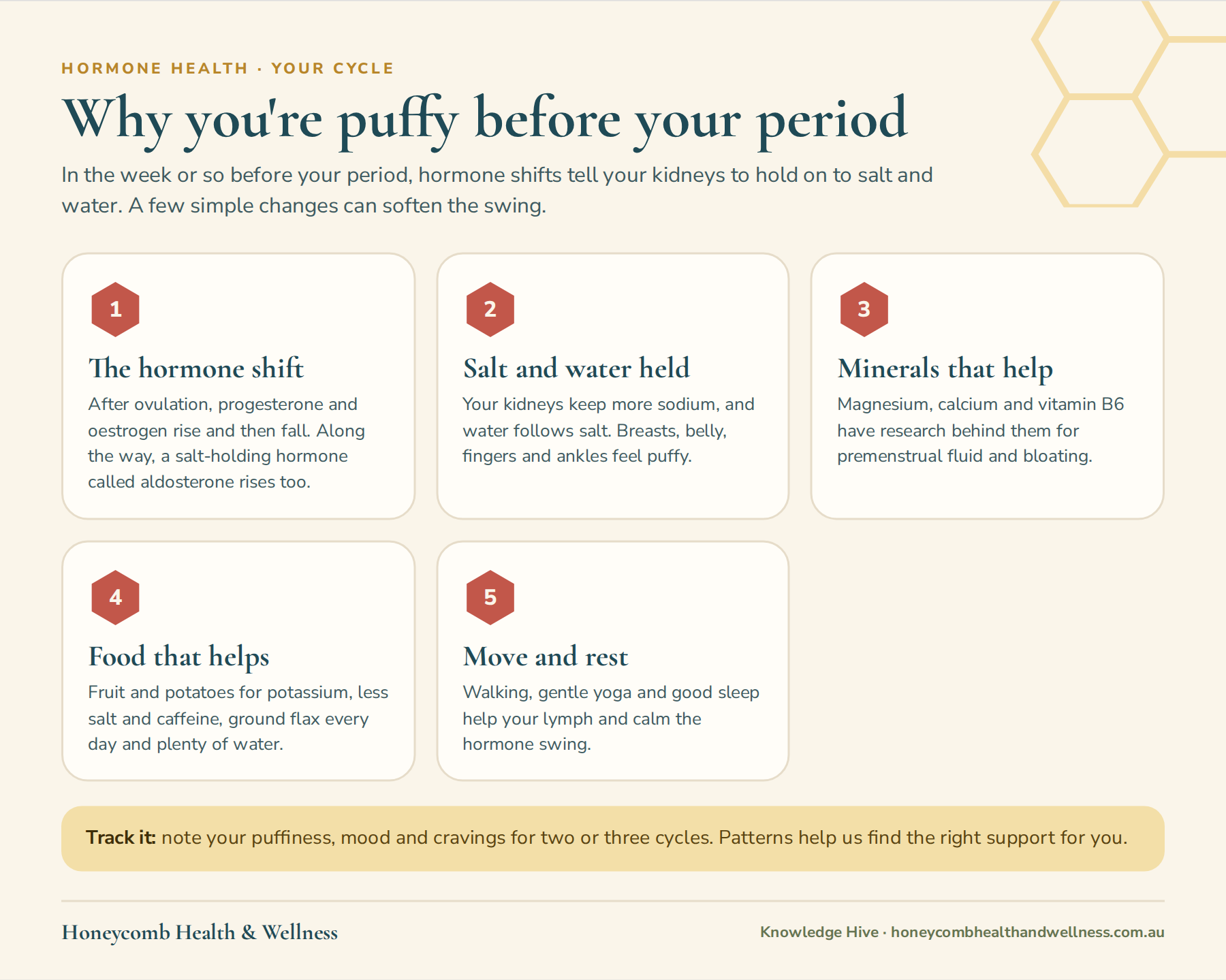
In the second half of your cycle, after ovulation, progesterone and oestrogen rise and then fall away before your period. Oestrogen encourages your body to hold on to salt and water. And during this phase, a hormone called aldosterone, the body’s main “hold on to salt” signal, also tends to rise.
Aldosterone tells your kidneys to keep more sodium. And remember: water follows salt. So you hold on to more water, and it shows up in your breasts, belly, hands and ankles. (Read Fluid retention: how fruit, potassium and less salt help.)
It’s kind of like the tide coming in. Each month, the hormone tide rises and brings water with it, and when your period arrives, the tide goes back out. We can’t stop the tide, but we can make it a gentle one instead of a king tide. It’s not exactly like this scientifically, but it’s an easy way to understand it.
Why it’s worse for some women
- A high-salt, low-potassium diet amplifies the hormone signal.
- Oestrogen dominance, when oestrogen is high relative to progesterone, often from a sluggish liver and gut. (Read Foods that support hormone balance.)
- Stress, which lowers progesterone and nudges up salt-holding hormones.
- Low magnesium, which is common, and is used up faster when you’re stressed.
- Perimenopause, when cycles become less predictable and the swings can be bigger.
Minerals and vitamins with research behind them
- Magnesium. In a two-month trial, women taking 200 mg of magnesium a day had fewer premenstrual fluid symptoms, such as weight gain, swollen hands and feet, breast tenderness and bloating, by the second month (Walker et al., 1998). Food sources: leafy greens, pumpkin seeds, beans, wholegrains and cacao.
- Calcium. In a large trial, 1,200 mg of calcium a day reduced premenstrual symptoms including water retention by about half over three cycles (Thys-Jacobs et al., 1998). Food sources: calcium-set tofu, fortified soy milk, tahini, Asian greens and almonds.
- Vitamin B6. A review of trials found B6 may help premenstrual symptoms, at doses up to 100 mg a day (Wyatt et al., 1999). Food sources: potatoes, bananas, chickpeas and wholegrains.
Supplements work best when they’re matched to you, and more isn’t better (high doses of B6 over long periods can cause nerve problems). In clinic, I tailor the form and dose, and may add herbal medicine, such as chaste tree (vitex), which has good research for premenstrual symptoms (Schellenberg, 2001).
What you can start today
- Load up on fruit and potatoes in the second half of your cycle for potassium.
- Ease off salt and salty snacks in the 10 days before your period, when cravings for chips often peak.
- Cut back on caffeine and alcohol, which can worsen breast tenderness and mood.
- Have 1 to 2 tablespoons of ground flax every day. It supports healthy oestrogen clearance through the gut.
- Keep moving. Walking and gentle yoga help your lymph clear fluid, and they ease cramps and mood too.
- Drink water through the day, even though it seems backwards.
- Track your cycle and your symptoms for two or three months, so we can see the pattern.
When to get it checked
Mild puffiness before a period is common. But if your symptoms are severe, affect your work or relationships, or come with very low mood, please reach out. Severe premenstrual mood changes (PMDD) are real and treatable. And swelling that doesn’t follow your cycle, or comes with breathlessness, needs checking by a doctor.
In clinic, I look at your hormones, liver and gut together, often with hormone testing across your cycle, to find out why the swing is so big for you.
Recipes that help
- Chocolate Blueberry Chia & Flax Pudding
- Beetroot & Mango Glow Smoothie
- Lentil & Potato Soup
- Raspberry Cinnamon Breakfast Bowl
We can’t stop the hormone tide, but with the right food and support, it can come in gently.
A note on medication: please don’t stop or change any prescribed medication on your own. When you change the way you eat, your numbers can move quickly, so keep your prescribing doctor informed so your doses can be reviewed as you improve. This includes the contraceptive pill and any fluid tablets.
References
- Walker AF et al. Magnesium supplementation alleviates premenstrual symptoms of fluid retention. Journal of Women’s Health. 1998;7(9):1157-1165.
- Thys-Jacobs S et al. Calcium carbonate and the premenstrual syndrome: effects on premenstrual and menstrual symptoms. American Journal of Obstetrics and Gynecology. 1998;179(2):444-452.
- Wyatt KM et al. Efficacy of vitamin B-6 in the treatment of premenstrual syndrome: systematic review. BMJ. 1999;318(7195):1375-1381.
- Schellenberg R. Treatment for the premenstrual syndrome with agnus castus fruit extract: prospective, randomised, placebo controlled study. BMJ. 2001;322(7279):134-137.
How Honeycomb can help
You don’t have to work this out alone
This information is general education and is not a substitute for individual advice. Please speak with your health practitioner before making changes, especially if you take prescribed medication.
Keep going
You’re not doing this alone
This information is general education and is not a substitute for individual advice. Please speak with your health practitioner before making changes, especially if you take prescribed medication.