


Think about your morning routine. Shampoo, conditioner, body wash, face wash, moisturiser, deodorant, sunscreen, make-up, perfume, hair spray, lip balm. It’s easy to use a dozen products before breakfast, each with 10 to 30 ingredients.
Your skin is a living organ, not a raincoat. Some ingredients do pass through it, especially from products that stay on all day. So let’s look at what’s in the bathroom cabinet, and which swaps make the biggest difference.
The ingredients worth knowing
- Fragrance or parfum: one word on the label can represent dozens of undisclosed chemicals, including phthalates that help scents last longer. It’s also one of the most common causes of skin allergies.
- Parabens (methylparaben, propylparaben and others): preservatives that can weakly mimic oestrogen.
- Some phenols, such as triclosan (an antibacterial) and some chemical UV filters like oxybenzone.
- Formaldehyde releasers (such as DMDM hydantoin): preservatives that slowly release small amounts of formaldehyde.
These ingredients are permitted in small amounts, and one product on its own isn’t likely to cause harm. My concern is the daily layering of many products, on many areas of skin, for many years. Remember the toxic load bucket?
Where to start
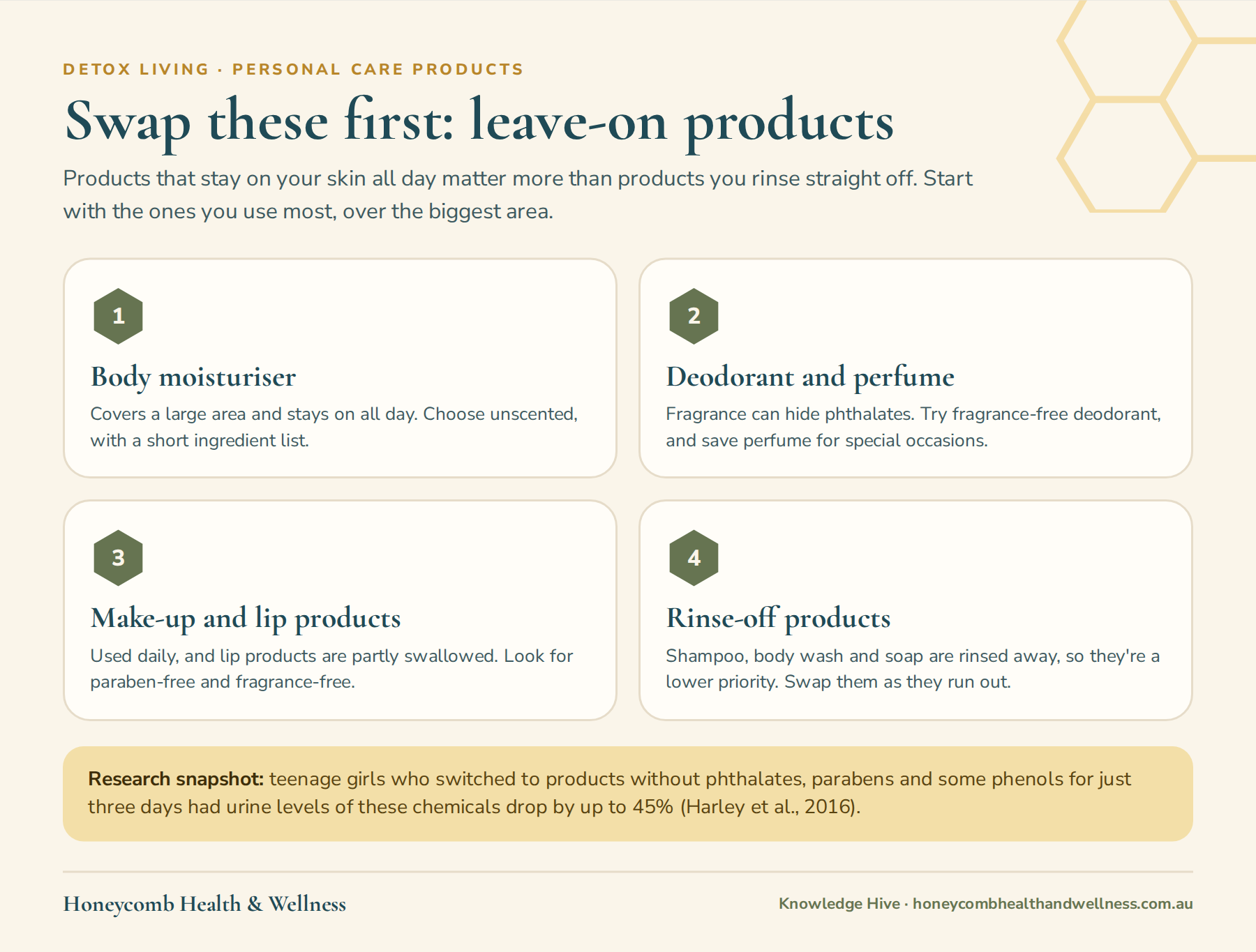
It’s a bit like spilling something on the carpet. A drop that’s wiped straight up leaves no trace, but a spill that sits there all day soaks in. Products you rinse off are the quick wipe, and leave-on products are the spill that sits. It’s not exactly like this scientifically, but it’s a simple way to choose what to swap first.
The good news: it changes fast
In the HERMOSA study, 100 teenage girls switched to personal care products labelled free of phthalates, parabens, triclosan and oxybenzone for just three days. Levels of several of these chemicals in their urine dropped by between about 27% and 45% (Harley et al., 2016). Your body clears many of these chemicals quickly once you stop putting them on.
Simple swaps
- Moisturiser: a fragrance-free cream, or plain shea butter, cold-pressed oils like jojoba, or aloe vera gel.
- Deodorant: an unscented, aluminium-free version. Give your body two to three weeks to adjust.
- Perfume: keep it for special occasions, or dab a little on your clothes instead of your skin.
- Sunscreen: always wear it in Australia! Mineral sunscreens with zinc oxide are a great choice for daily use.
- Hand soap: plain soap, without triclosan or antibacterial claims.
- For the little ones: babies and children have thinner skin and are smaller, so simple, unscented products matter most for them.
Helpful label tips
- Ingredients are listed from most to least, so the first five tell you most of the story.
- “Natural” and “botanical” aren’t regulated terms.
- Look for “fragrance free” rather than “unscented”, which can sometimes mean a masking fragrance has been added.
- Free apps and online databases can help you check a product while you shop.
Feed your skin from the inside
Your skin reflects what’s happening inside. Water, colourful plants, omega-3s from ground flax and chia, and a healthy gut often do more for your skin than any cream. Clear skin starts in the kitchen.
Swap as you go. When something runs out, choose a simpler version. In a year, your whole cabinet will have changed.
Recipes for glowing skin
References
- Harley KG et al. Reducing phthalate, paraben, and phenol exposure from personal care products in adolescent girls: findings from the HERMOSA intervention study. Environmental Health Perspectives. 2016;124(10):1600-1607.
- Gore AC et al. EDC-2: The Endocrine Society’s second scientific statement on endocrine-disrupting chemicals. Endocrine Reviews. 2015;36(6):E1-E150.
How Honeycomb can help
You don’t have to work this out alone
This information is general education and is not a substitute for individual advice. Please speak with your health practitioner before making changes, especially if you take prescribed medication.
Keep going
You’re not doing this alone
This information is general education and is not a substitute for individual advice. Please speak with your health practitioner before making changes, especially if you take prescribed medication.