

When people first learn about toxic load, the instinct is often to clear out every cupboard and start again. Please don’t! It’s expensive, it’s overwhelming and it’s wasteful. A healthier home is built one swap at a time.
I’ll show you where to start, so your effort goes where it makes the most difference.
Why your home matters
Australians spend around 90% of their time indoors, and indoor air can contain higher levels of some pollutants than outdoor air. Cleaning sprays, air fresheners, scented candles, new furniture and mould all add to the mix.
A large Norwegian study followed more than 6,000 people for 20 years. Women who regularly used cleaning sprays at home or worked as cleaners had a faster decline in lung function, similar in size to smoking about 10 to 20 cigarettes a day for the same period (Svanes et al., 2018). It’s a striking finding, and a good reason to simplify.
Start with the air
- Open windows for at least ten minutes a day, ideally across the house so air flows through.
- Lose the fragrance: plug-in air fresheners, aerosol sprays, scented candles and incense are the easiest and cheapest change. Simmer a pot of water with lemon peel, cinnamon and cloves instead.
- Use the rangehood every time you cook.
- Shoes off at the door. Shoes carry pesticides, lead dust and road grime inside.
- Deal with mould quickly. Fix leaks, run the bathroom fan and wipe condensation. For more than a small patch, get professional help.
Then the cleaning cupboard
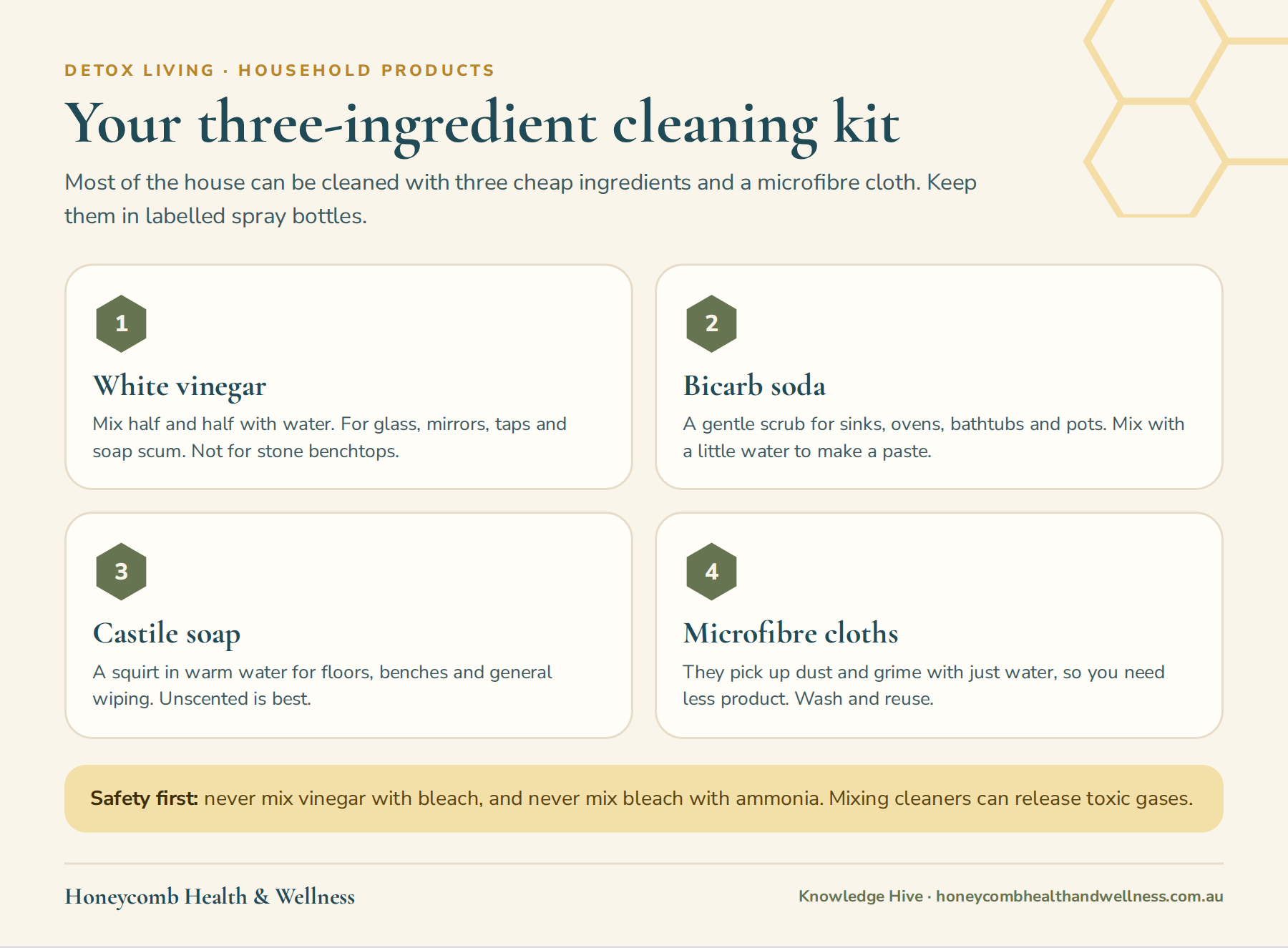
When I was running my early childhood centres, I learned that children copy everything. If they see you cleaning with a simple spray bottle and a cloth, that becomes normal for them. It’s one of the loveliest jobs to share with little ones, because there’s nothing dangerous in the bottle.
Then the laundry
- Choose an unscented, plant-based laundry liquid.
- Skip fabric softener. Half a cup of white vinegar in the rinse softens clothes, and the smell disappears as they dry.
- Use wool dryer balls instead of dryer sheets.
- Dry clothes in the sunshine, which is nature’s free freshener.
Reading labels without the overwhelm
Australian cleaning products don’t have to list every ingredient, which makes label reading tricky. Here’s a short cheat sheet:
- Look for “fragrance free” or “unscented” rather than “natural fragrance”.
- Fewer ingredients is usually better.
- Be cautious with antibacterial sprays for everyday use. Soap and water clean most surfaces well.
- Keep anything with a poison warning locked away from children, even “green” brands.
A budget-friendly order of swaps
- Week 1: remove air fresheners and scented candles (saves money!).
- Week 2: make your vinegar and castile soap sprays.
- Week 3: switch to unscented laundry liquid and drop the softener.
- Week 4: replace the next product that runs out.
- Ongoing: replace scratched non-stick pans and plastic containers as they wear out.
A healthy home isn’t a perfect home. It’s a home with a little less coming in and a lot more fresh air.
Make it a family project
Give everyone a job. One child can be in charge of opening windows in the morning, another can label the spray bottles. When children help create the change, they own it, and you’ll be amazed how quickly they start reminding you.
If your health has been affected by chemical sensitivities, mould or a high toxic load, I can help you work through it in clinic, starting with functional testing to get to the root cause.
Recipes for a fresh kitchen
- Green Lemonade Smoothie (save the lemon peels for your simmer pot)
- Lentil & Potato Soup, a cheap, nourishing batch cook
- Raspberry Dressing to use up a jar for storage
References
- Svanes Ø et al. Cleaning at home and at work in relation to lung function decline and airway obstruction. American Journal of Respiratory and Critical Care Medicine. 2018;197(9):1157-1163.
- Landrigan PJ et al. The Lancet Commission on pollution and health. Lancet. 2018;391(10119):462-512.
- Gore AC et al. EDC-2: The Endocrine Society’s second scientific statement on endocrine-disrupting chemicals. Endocrine Reviews. 2015;36(6):E1-E150.
How Honeycomb can help
You don’t have to work this out alone
This information is general education and is not a substitute for individual advice. Please speak with your health practitioner before making changes, especially if you take prescribed medication.
Keep going
You’re not doing this alone
This information is general education and is not a substitute for individual advice. Please speak with your health practitioner before making changes, especially if you take prescribed medication.