

It’s 3 pm. You’ve had a long day, someone said something that stung, and before you know it you’re standing at the pantry eating biscuits you don’t even really want. Sound familiar?
First, let me say this clearly: emotional eating doesn’t mean you’re weak or broken. Food is comfort. It’s love, celebration and connection. We’ve been soothed with food since the day we were born. The problem is only when food becomes the only way we know how to cope.
Why it happens
- Food changes how we feel, fast. Sugary, fatty and salty foods trigger the brain’s reward system, giving a quick lift.
- Stress hormones drive cravings. Cortisol increases appetite, especially for high-calorie foods.
- Tiredness masquerades as hunger. Poor sleep increases the hunger hormone ghrelin and lowers the fullness hormone leptin.
- Restriction backfires. Strict diets make food more emotionally loaded, and “I’ve blown it” thinking leads to more eating.
- Old habits. If treats were used as rewards or comfort in childhood, the brain learned that link early.
Physical hunger or emotional hunger?
- Physical hunger builds slowly, can be satisfied by many foods, sits in the stomach and stops when you’re full.
- Emotional hunger comes on suddenly, craves one specific food, sits in the head and mouth, and often leaves guilt behind.
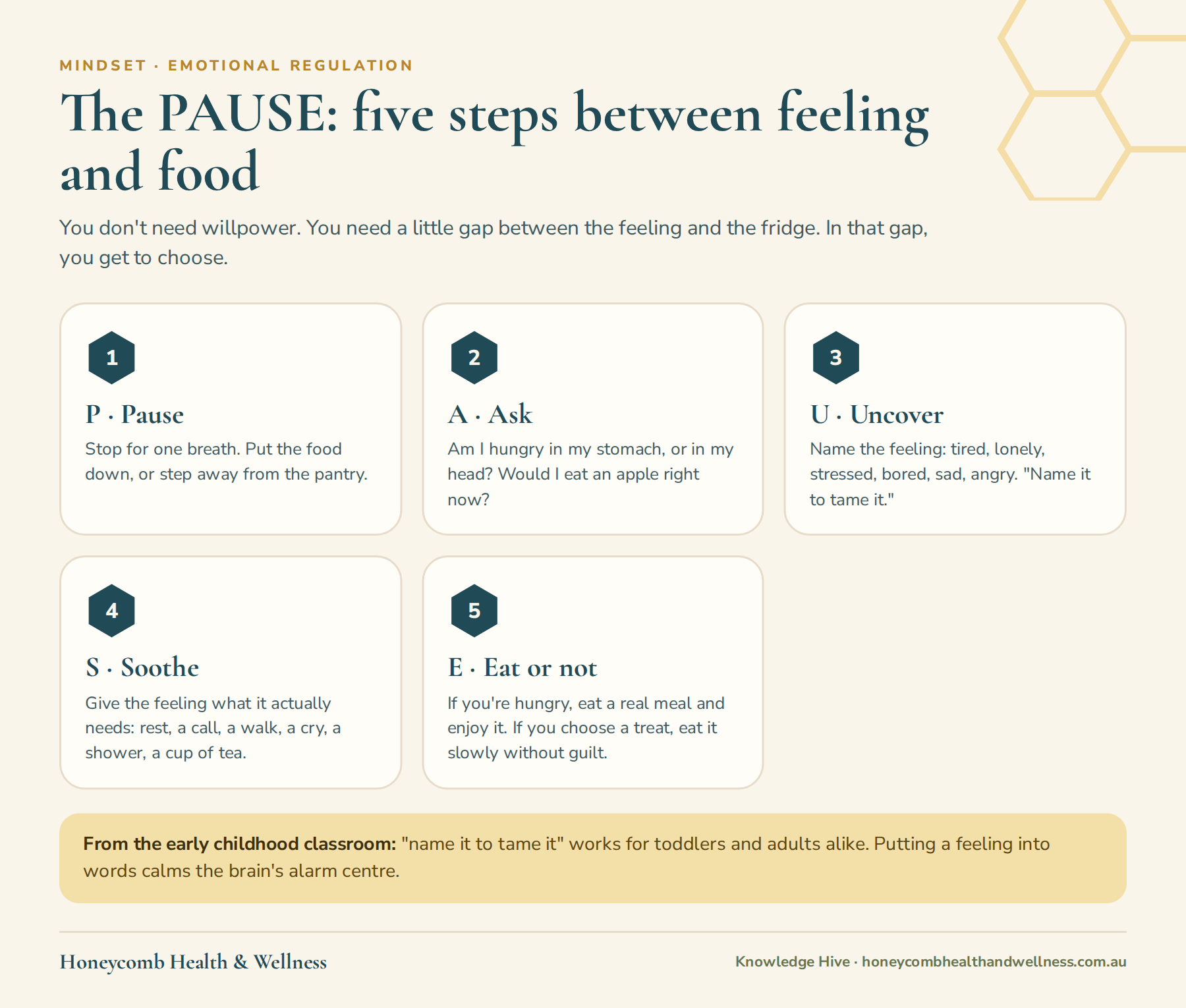
A simple test I give clients: would I eat an apple right now? If the answer is yes, you’re probably hungry, so eat a proper meal. If the answer is “no, I want chocolate”, it’s likely a feeling asking for attention.
Name it to tame it
In my 20 years in early childhood, the most powerful tool I taught educators and parents was this: when a child is overwhelmed, help them name the feeling. “You’re feeling really angry because your tower fell down.” Watch a toddler soften the moment they feel understood.
It works for adults too. In a brain imaging study, simply putting feelings into words reduced activity in the amygdala, the brain’s alarm centre (Lieberman et al., 2007). Dr Dan Siegel, who calls this “name it to tame it”, explains it beautifully for parents.
Building your comfort menu
When you uncover the feeling, you need something else to reach for. Write a list of comforts that aren’t food and keep it on the fridge. Here are some ideas:
- Stressed: a walk around the block, five physiological sighs, a shower.
- Lonely: call or text a friend, or post in the Honeycomb Community.
- Tired: a 20-minute rest, or an early night.
- Bored: a short task, music, the garden or a hobby.
- Sad: a cry, journalling, a cuddle with a pet or a loved one.
- Celebrating: a bath, a new book, a walk somewhere beautiful.
Make the food environment work for you
- Eat regular, satisfying meals. Whole starches, legumes and vegetables keep you full and your blood sugar steady, so you’re not running on empty at 3 pm.
- Keep easy, healthy comfort food ready: a pot of soup, baked potatoes, fruit, or oil-free hummus with vegetables.
- Put the trigger foods out of sight, or don’t bring them home at all.
Let go of the guilt
If you eat emotionally, you haven’t failed. Guilt only adds another feeling to eat over. Get curious instead: what was I really needing? Each time you notice, you’re rewiring an old pattern. That’s progress.
You’re not trying to never feel. You’re learning to feel without the fridge doing all the work.
Recipes for comforting, nourishing food
- Chocolate Avocado Pudding (a Relaxation phase treat)
- Cheezy Creamy Pasta & Lentils
- Apple Crumble Bites
If emotional eating feels out of control, or you’re experiencing binge eating, please reach out for support. In clinic I work alongside psychologists and counsellors to support you as a whole person.
References
- Lieberman MD et al. Putting feelings into words: affect labeling disrupts amygdala activity in response to affective stimuli. Psychological Science. 2007;18(5):421-428.
- Siegel DJ, Bryson TP. The Whole-Brain Child. New York: Delacorte Press; 2011.
- Spiegel K et al. Sleep curtailment in healthy young men is associated with decreased leptin levels, elevated ghrelin levels, and increased hunger and appetite. Annals of Internal Medicine. 2004;141(11):846-850.
- Epel E et al. Stress may add bite to appetite in women: a laboratory study of stress-induced cortisol and eating behavior. Psychoneuroendocrinology. 2001;26(1):37-49.
How Honeycomb can help
You don’t have to work this out alone
This information is general education and is not a substitute for individual advice. Please speak with your health practitioner before making changes, especially if you take prescribed medication.
Keep going
You’re not doing this alone
This information is general education and is not a substitute for individual advice. Please speak with your health practitioner before making changes, especially if you take prescribed medication.