

It’s the question every plant-based eater hears: “But where do you get your protein?” It’s asked with genuine concern, so let’s answer it properly.
How much do you actually need?
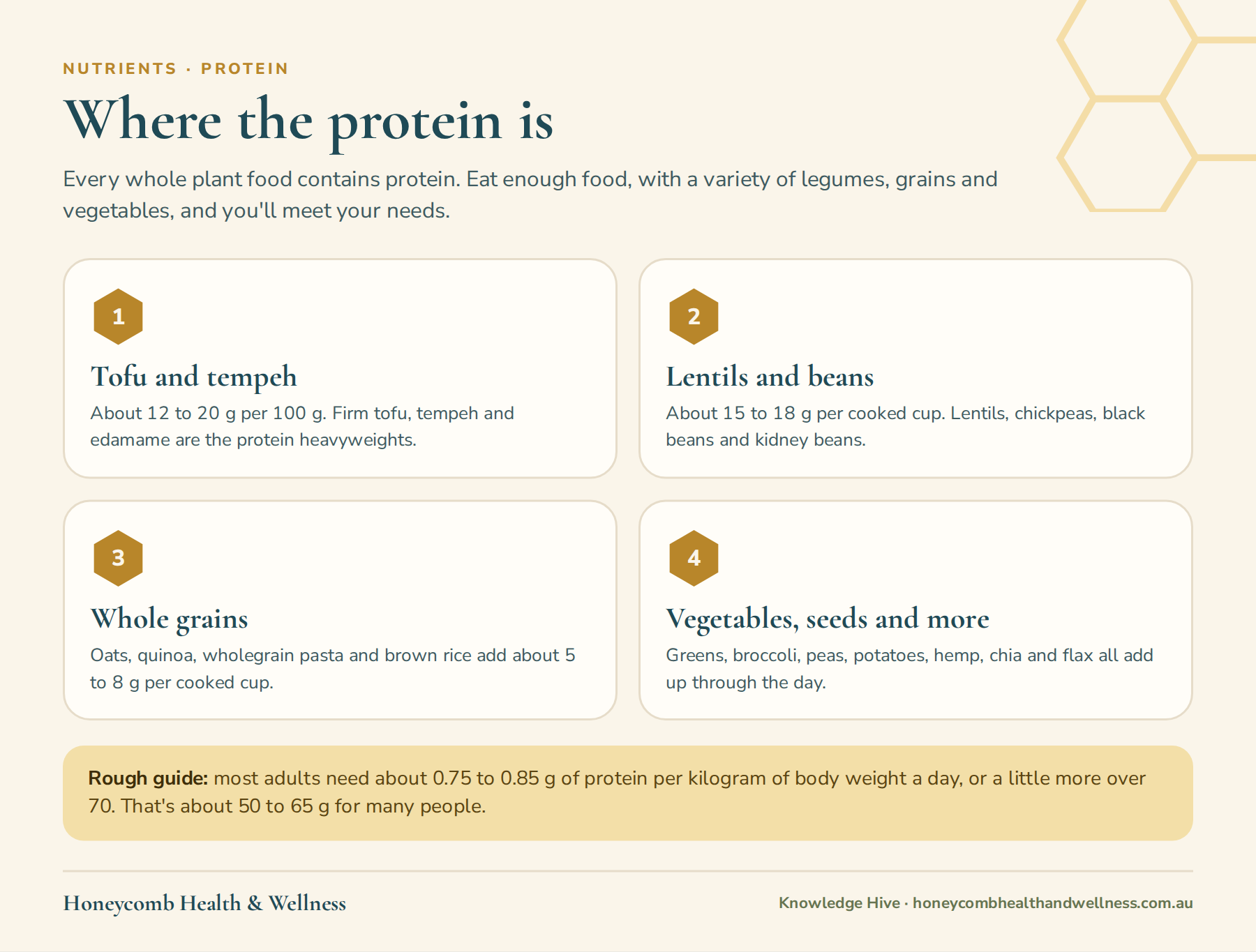
Australia’s Nutrient Reference Values recommend about 0.75 grams of protein per kilogram of body weight a day for women and 0.84 grams for men, rising to about 0.94 and 1.07 grams after 70. For a 70 kg woman, that’s around 53 grams a day.
Most Australians eat well above their protein needs. Extra protein isn’t stored as muscle. It’s burned for energy or stored as fat, and the excess has to be processed by your liver and kidneys.
Building blocks in every plant
Protein is made of 20 amino acids, which are a bit like Lego bricks. Your body takes them apart and rebuilds them into whatever it needs: muscle, enzymes, hormones and antibodies. Nine of those bricks are “essential”, which means you must get them from food.
Here’s the part many people don’t realise: all plants contain all nine essential amino acids, just in different proportions. Legumes are rich in lysine, and grains are rich in methionine. Eat a variety through the day and your body pools them together. You don’t need to combine them at every meal, which was an old idea that has since been dropped. It’s not exactly like this scientifically, but think of it as filling up a Lego tub over the day rather than at every single meal.
A day of plant protein
| Meal | Example | Protein (approx.) |
|---|---|---|
| Breakfast | Oats with soy milk, ground flax and berries | 15 g |
| Lunch | Lentil soup and a wholegrain roll | 20 g |
| Snack | Edamame or oil-free hummus with vegetables | 8 g |
| Dinner | Tofu stir-fry with broccoli and brown rice | 25 g |
| Total | about 68 g |
What the research says
A large review on protein in vegetarian diets concluded that well-planned plant-based diets easily meet protein and amino acid needs for adults when energy needs are met and a variety of foods is eaten (Mariotti and Gardner, 2019). Plant protein also comes with fibre and without the saturated fat and cholesterol found in animal protein.
When to pay more attention
- Over 65s: muscle mass naturally declines with age, so include legumes, tofu or tempeh at most meals, and do some strength exercise.
- Athletes and very active people: you may need a little more. Eating more food overall usually covers it.
- Pregnancy and breastfeeding: needs rise, and an individual plan is worthwhile.
- Small appetites: if you’re not eating enough food overall, protein can fall short. Focus on legumes and soy first.
The simple Honeycomb rule
Include a legume at least twice a day. Beans, lentils, chickpeas, tofu, tempeh, edamame or soy milk all count. Add whole grains, vegetables and a spoonful of seeds, and protein takes care of itself.
Recipes that help
If you’re eating enough whole plant food to feel satisfied, you’re very likely eating enough protein.
If you’re losing weight without trying, recovering from illness or surgery, or worried about muscle loss, I’d love to create an individual plan for you in clinic.
References
- Mariotti F, Gardner CD. Dietary protein and amino acids in vegetarian diets: a review. Nutrients. 2019;11(11):2661.
- National Health and Medical Research Council. Nutrient Reference Values for Australia and New Zealand: Protein.
- Young VR, Pellett PL. Plant proteins in relation to human protein and amino acid nutrition. American Journal of Clinical Nutrition. 1994;59(5 Suppl):1203S-1212S.
How Honeycomb can help
You don’t have to work this out alone
This information is general education and is not a substitute for individual advice. Please speak with your health practitioner before making changes, especially if you take prescribed medication.
Keep going
You’re not doing this alone
This information is general education and is not a substitute for individual advice. Please speak with your health practitioner before making changes, especially if you take prescribed medication.