
Hormones are your body’s messengers. Tiny amounts travel through your blood and tell your cells when to grow, rest, ovulate, store fat, burn fuel or make more energy. Because they work in such tiny amounts, your hormone system is exquisitely sensitive.
That’s why scientists pay close attention to endocrine-disrupting chemicals: substances that can interfere with the way hormones work. The Endocrine Society, the world’s largest organisation of hormone specialists, has published two major statements on them (Gore et al., 2015).
The copied key
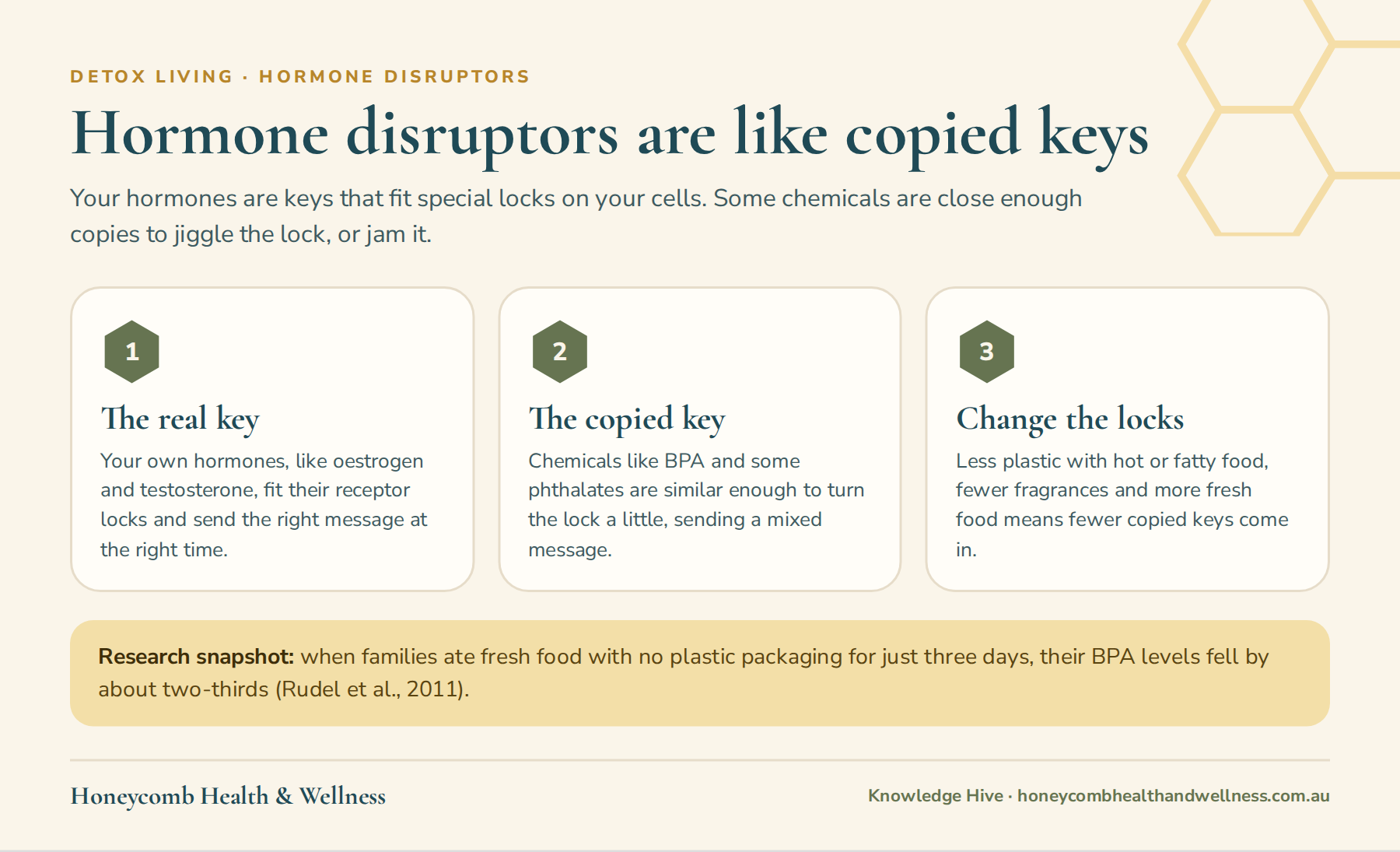
It works a bit like this. Your hormones are keys, and each cell has locks (called receptors) that only the right key should open. Some chemicals are shaped enough like a real hormone that they can jiggle the lock, turning it a little or blocking the real key from getting in. The message gets muddled. It’s not exactly like this scientifically, but it’s an easy way to understand it.
The two you’ll hear about most
Bisphenol A (BPA) is used to make hard, clear plastics and the linings of some food and drink cans. It behaves a little like oestrogen in the body. Many products are now “BPA free”, but some replacements, such as BPS, appear to behave in similar ways.
Phthalates make plastics soft and flexible, and help fragrances last longer. They’re found in some food packaging, cling wraps, vinyl and many fragranced products. Some phthalates can interfere with testosterone and other hormones.
How they get in
Mostly through food. Chemicals can move from packaging into food, and they move more easily when food is hot, fatty or acidic, or when plastic is old, scratched or heated.
The encouraging part is how quickly levels can drop. In one study, families switched to fresh, unpackaged food stored in glass and stainless steel for just three days. Their BPA levels fell by about two-thirds, and levels of one common phthalate by more than half (Rudel et al., 2011). These chemicals don’t hang around for long, so every swap counts.
In clinic
I often think about hormone disruptors when clients come to me with PMS, heavy or painful periods, fertility challenges, low testosterone or thyroid symptoms. They’re rarely the only cause, but lowering the load is something everyone can do. Alongside it, we support the liver and gut, which clear used hormones and chemicals from the body.
Testing what’s actually in your body
Sometimes it helps to see what’s really coming in. In clinic, we offer functional testing such as the ALL-Tox Environmental Toxins Profile, a simple urine test done through a NATA-accredited Australian pathology lab. It measures bisphenols, phthalates, parabens, PFAS and some pesticides, along with toxic metals, moulds and solvents. Instead of guessing, we can see which chemicals are showing up, focus your swaps where they’ll make the most difference, then retest to see your progress.
Here are two snapshots from a sample report (not a real patient’s results), so you can see what the results look like:

Sample report only. Notice that BPA is low, but its replacement, BPS, is close to the top of its range. This is exactly what can happen when someone has switched to “BPA-free” plastics that use BPS instead.

Sample report only. Each phthalate has its own marker, and they point to different sources. For example, mono-ethyl phthalate comes from a phthalate widely used to make fragrances last, so a higher result often points us towards perfume, air fresheners and scented products.
Testing isn’t needed for everyone, and it’s always interpreted alongside your symptoms and history. If you’d like to know whether it’s right for you, book an appointment and we can talk it through.
Practical swaps (start with the kitchen)
- Never heat food in plastic. Microwave in glass or ceramic, and let food cool before it goes into a plastic container.
- Store leftovers in glass jars or containers. Old pasta sauce jars are perfect.
- Drink from glass or stainless steel, especially for hot drinks, and don’t leave plastic water bottles in a hot car.
- Choose fresh and frozen over canned where you can, or look for cans labelled BPA free. Dried beans and lentils are cheaper anyway!
- Swap cling wrap for beeswax wraps, a plate over a bowl, or a container with a lid.
- Go fragrance free. Choose unscented laundry, cleaning and personal care products. “Fragrance” on a label can hide phthalates.
- Replace scratched non-stick pans with stainless steel, cast iron or ceramic as they wear out.
For little ones: bath toys and teethers
Babies and toddlers put everything in their mouths, and soft plastic is often softened with phthalates. In Australia, plastic toys, dummies and teethers for children under 3 can’t contain more than 1% of the phthalate DEHP, but the ban doesn’t cover other phthalates, and it doesn’t apply to second-hand toys. So for anything that gets chewed:
- Teethers: choose natural rubber, food-grade silicone or untreated wood over soft, squishy plastic.
- Bath toys: skip soft vinyl squirters (they also grow mould inside). Look for solid natural rubber or silicone toys you can open and clean.
- Hand-me-downs: older soft plastic toys were made before the rules, so keep them out of little mouths.
- Look for “phthalate-free” on soft toys, and when in doubt, choose wood, fabric or silicone.
You don’t have to throw out every container today. Replace them as they wear out, and start with the one you heat.
Food that helps your hormones
Your liver packages up hormones and chemicals, and your gut carries them out. Fibre, cruciferous vegetables and ground flaxseed support both. Read more in Foods that support hormone balance.
Recipes that help
- Cinnamon Overnight Oats, made the night before in a glass jar
- One Pan Tempeh & Veggies for crucifers and fibre
- Creamy Turmeric Pumpkin Soup, perfect for glass-jar lunches
A note on medication: please don’t stop or change any prescribed medication on your own. When you change the way you eat, your numbers can move quickly, so keep your prescribing doctor informed so your doses can be reviewed as you improve.
References
- Gore AC et al. EDC-2: The Endocrine Society’s second scientific statement on endocrine-disrupting chemicals. Endocrine Reviews. 2015;36(6):E1-E150.
- Rudel RA et al. Food packaging and bisphenol A and bis(2-ethylhexyl) phthalate exposure: findings from a dietary intervention. Environmental Health Perspectives. 2011;119(7):914-920.
- Harley KG et al. Reducing phthalate, paraben, and phenol exposure from personal care products in adolescent girls: findings from the HERMOSA intervention study. Environmental Health Perspectives. 2016;124(10):1600-1607.
- Product Safety Australia. Permanent ban: DEHP in children’s plastic items. productsafety.gov.au.
How Honeycomb can help
You don’t have to work this out alone
This information is general education and is not a substitute for individual advice. Please speak with your health practitioner before making changes, especially if you take prescribed medication.
Keep going
You’re not doing this alone
This information is general education and is not a substitute for individual advice. Please speak with your health practitioner before making changes, especially if you take prescribed medication.
