
In Liver 101, we looked at how your liver unwraps and packages waste so it can leave your body. Both steps rely on nutrients from food. If the raw materials aren’t there, the work slows down.
So let’s go shopping for your liver.
Cruciferous vegetables: the stars
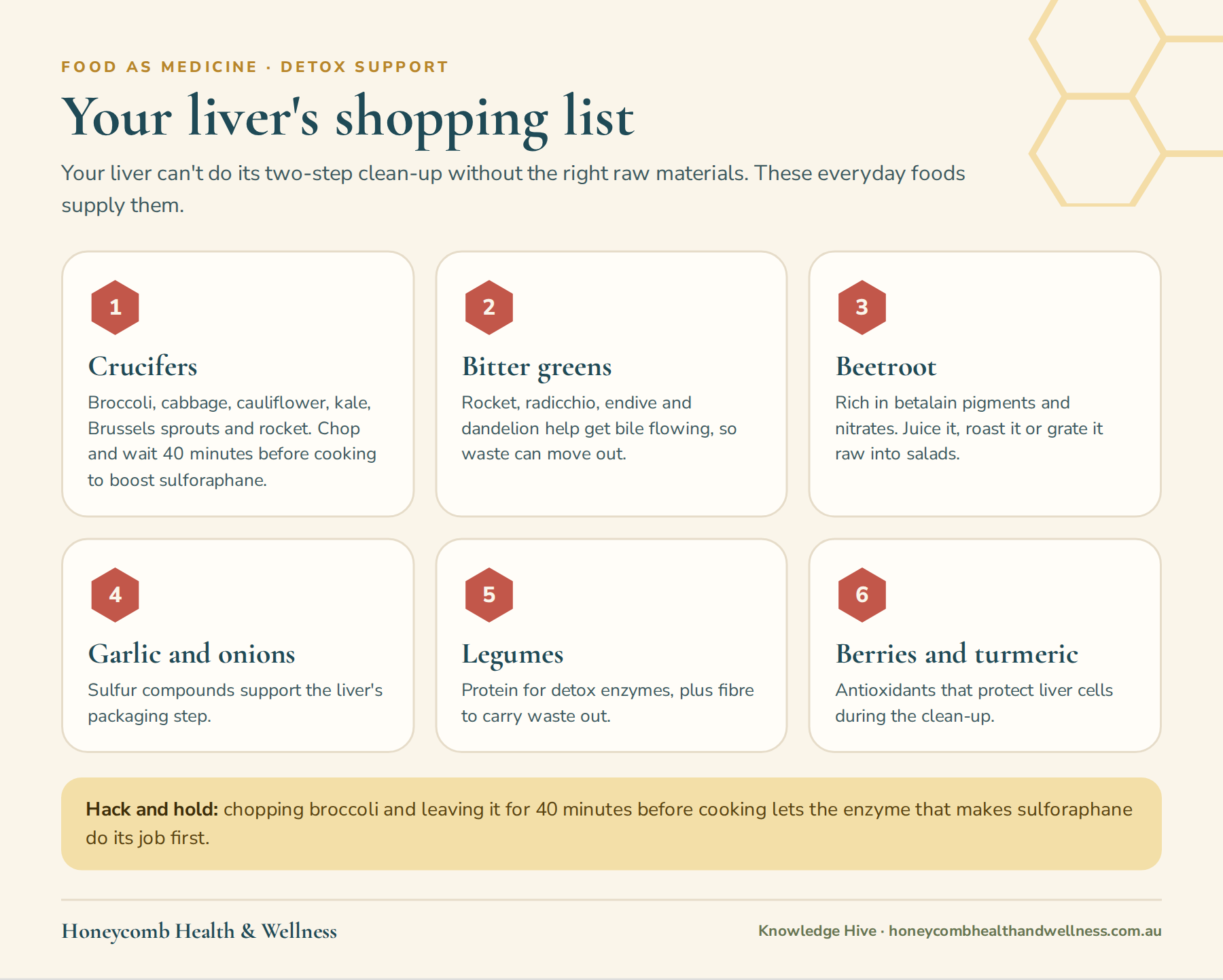
Broccoli, cauliflower, cabbage, kale, Brussels sprouts, bok choy, rocket and radish all belong to the cruciferous family. They contain compounds called glucosinolates. When you chop or chew them, an enzyme turns these into active compounds like sulforaphane, which switch on the liver’s phase 2 “packaging” enzymes (Hayes et al., 2008).
There’s a clever trick here, popularised by Dr Greger. Heat destroys the enzyme that makes sulforaphane. So chop your broccoli first, let it sit for about 40 minutes, then cook it. He calls it “hack and hold”. Or sprinkle a little mustard powder (which contains the same enzyme) on cooked crucifers.
Aim for at least a cup of crucifers a day. Broccoli sprouts are especially rich, and easy to grow on the kitchen bench.
Bitter greens: getting the bile moving
Bitter tastes stimulate digestive juices, including bile, which carries waste out of the liver. Traditionally, many cultures started a meal with bitter greens for exactly this reason. Try rocket, radicchio, endive, dandelion greens or a squeeze of lemon in warm water before meals.
It’s a bit like opening the back door of a busy kitchen. Once bile is flowing freely, the rubbish can get out to the bins. It’s not exactly like this scientifically, but it’s an easy way to understand it.
Beetroot: the colour of support
Beetroot is a much-loved part of many detox traditions, including the Gerson approach. Its deep red pigments, called betalains, are antioxidants, and its natural nitrates support healthy blood flow. Don’t be alarmed if your urine or bowel motions turn pink after eating it. That’s quite normal!
More foods your liver loves
- Garlic, onions and leeks provide sulfur compounds for the packaging step.
- Legumes provide protein for building detox enzymes and fibre for escorting waste out.
- Berries are full of antioxidants that protect liver cells.
- Turmeric supports bile flow and has anti-inflammatory properties. Combine it with black pepper.
- Green tea contains catechins. A cup or two a day is plenty; concentrated green tea extract supplements are a different story and can harm the liver.
- Lemon and grapefruit bring vitamin C and bitter compounds. Grapefruit interacts with many medications, so check with your pharmacist.
- Water carries water-soluble waste out through your kidneys.
And go easy on
- Alcohol, which the liver must prioritise above everything else
- Sugary drinks and fructose syrups, which drive fat into the liver
- Fried foods and added oils
- Ultra-processed foods with long ingredient lists
A liver-loving day
- Morning: warm water with lemon, then oats with berries and ground flax.
- Mid-morning: a vegetable juice with beetroot, carrot, celery and ginger.
- Lunch: a big salad of rocket and shredded cabbage with chickpeas, grated beetroot and an oil-free dressing.
- Dinner: a stir-fry with broccoli, bok choy, garlic and tofu over brown rice.
Recipes that help
- Power Punch Juice
- Elevate Your Dinner with Tofu Vegetable Stir Fry
- Apple Kohlrabi Salad
- Everything Bagel Cauliflower Steaks
Every cup of crucifers is a gift to your liver.
A note on medication: please don’t stop or change any prescribed medication on your own. When you change the way you eat, your numbers can move quickly, so keep your prescribing doctor informed so your doses can be reviewed as you improve. Some foods, such as grapefruit and large amounts of leafy greens, can interact with certain medications, so ask your doctor or pharmacist if you’re unsure.
References
- Hayes JD, Kelleher MO, Eggleston IM. The cancer chemopreventive actions of phytochemicals derived from glucosinolates. European Journal of Nutrition. 2008;47 Suppl 2:73-88.
- Hodges RE, Minich DM. Modulation of metabolic detoxification pathways using foods and food-derived components: a scientific review with clinical application. Journal of Nutrition and Metabolism. 2015;2015:760689.
- Mazidi M, Kengne AP. Higher adherence to plant-based diets are associated with lower likelihood of fatty liver. Clinical Nutrition. 2019;38(4):1672-1677.
How Honeycomb can help
You don’t have to work this out alone
This information is general education and is not a substitute for individual advice. Please speak with your health practitioner before making changes, especially if you take prescribed medication.
Keep going
You’re not doing this alone
This information is general education and is not a substitute for individual advice. Please speak with your health practitioner before making changes, especially if you take prescribed medication.