
If I could give every client one thing, it might be a good night’s sleep. So many of the people I see are running on five or six hours, then wondering why they’re tired, hungry, foggy and can’t shift weight. Sleep isn’t a luxury. It’s one of the most powerful health tools we have.
The night cleaners
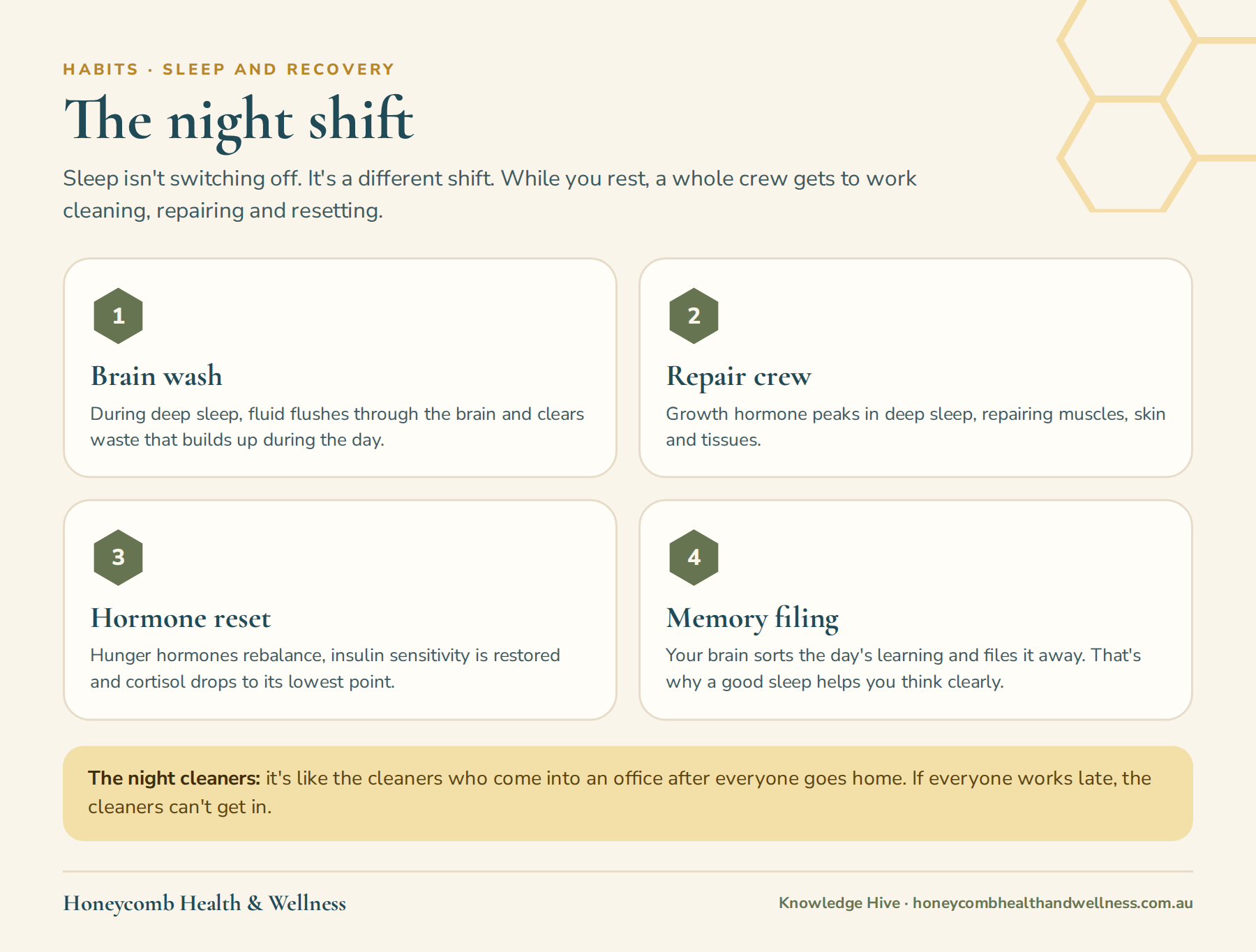
It’s kind of like an office building. During the day it’s busy with people working. At night, when everyone goes home, the cleaners come in. They empty the bins, vacuum, wipe the desks and get everything ready for the morning. But if people keep working late, the cleaners can’t do their job, and the mess piles up. It’s not exactly like this scientifically, but it’s an easy way to understand it.
Your brain has its own cleaning system, called the glymphatic system. In a landmark study, researchers found that during sleep, the spaces between brain cells expand by about 60%, allowing fluid to flush waste out much faster than when awake (Xie et al., 2013). Some of that waste includes proteins linked to Alzheimer’s disease.
What happens when you don’t sleep enough
- Hunger goes up. Short sleep raises the hunger hormone ghrelin and lowers the fullness hormone leptin, so you crave more food, especially sugary snacks (Spiegel et al., 2004).
- Blood sugar suffers. Just a week of restricted sleep made healthy young men less able to handle glucose (Spiegel et al., 1999).
- Stress rises. Cortisol stays higher in the evening.
- Immunity drops, so you catch more colds.
- Mood and focus slide, making everything feel harder.
How much do you need?
Most adults need seven to nine hours a night, and older adults seven to eight (Hirshkowitz et al., 2015). Teenagers need eight to ten. If you need an alarm and a coffee to function every day, you’re probably not getting enough.
A wind-down routine that works
When I worked in childcare, rest time had a clear routine: lights dimmed, quiet music, the same story, a cuddle. Children’s bodies learned to switch off. We can do the same for ourselves.
- One hour before bed: screens off or on night mode, lights dimmed, a cup of herbal tea like chamomile.
- Thirty minutes before bed: a warm shower or bath. As your body cools afterwards, it signals sleep.
- In bed: write a quick to-do list for tomorrow so your mind can let go, then three things you’re grateful for.
- Lights out: a few minutes of slow breathing, out longer than in.
Set up your cave
- Cool (around 18 to 20 °C), dark and quiet
- Phone charging outside the bedroom
- Blackout curtains or an eye mask
- The same wake time every day, even on weekends
Daytime habits for better nights
- Morning light within an hour of waking
- Caffeine before midday only
- Daily movement, but not intense exercise right before bed
- Finish dinner two to three hours before bed
- Go easy on alcohol, which knocks out deep sleep in the second half of the night
- Carbohydrate-rich dinners (like potato, rice or oats) can help some people sleep more soundly
When it’s more than habits
If you snore loudly, wake gasping, wake at the same time every night, or feel exhausted despite enough time in bed, it’s worth looking deeper. Sleep apnoea needs a medical sleep study. In clinic, I look at the other drivers of poor sleep, like cortisol patterns, blood sugar, hormones and nutrient levels, and support you with herbal medicine and nutrition.
Recipes for the evening
- Potato & Leek Soup for an early, comforting dinner
- Mashed Pumpkin with Cinnamon
- Cherry Banana Smoothie (cherries contain a little natural melatonin)
Sleep is not time wasted. It’s time your body uses to heal.
References
- Xie L et al. Sleep drives metabolite clearance from the adult brain. Science. 2013;342(6156):373-377.
- Spiegel K et al. Sleep curtailment in healthy young men is associated with decreased leptin levels, elevated ghrelin levels, and increased hunger and appetite. Annals of Internal Medicine. 2004;141(11):846-850.
- Spiegel K, Leproult R, Van Cauter E. Impact of sleep debt on metabolic and endocrine function. Lancet. 1999;354(9188):1435-1439.
- Hirshkowitz M et al. National Sleep Foundation’s sleep time duration recommendations: methodology and results summary. Sleep Health. 2015;1(1):40-43.
How Honeycomb can help
You don’t have to work this out alone
This information is general education and is not a substitute for individual advice. Please speak with your health practitioner before making changes, especially if you take prescribed medication.
Keep going
You’re not doing this alone
This information is general education and is not a substitute for individual advice. Please speak with your health practitioner before making changes, especially if you take prescribed medication.