
When I ran early childhood centres, routine was everything. Children feel safe when they know what comes next: morning circle, play, lunch, rest, story. A predictable rhythm calms their nervous system and helps them thrive.
Grown-ups aren’t so different. Your body runs on a built-in clock, called your circadian rhythm, and it loves routine as much as any toddler.
Your body’s clock
Almost every cell in your body follows a roughly 24-hour clock. Your hormones, digestion, liver enzymes, body temperature and even your gut bacteria change through the day. Morning light sets the master clock in your brain, and the timing of meals helps set the clocks in your liver and gut.
It’s kind of like an orchestra. Your brain is the conductor, and every organ is a musician. When the conductor keeps good time, the music flows. When the timing is all over the place (late nights, screens at midnight, dinner at 10 pm), each musician starts playing to their own beat. It’s not exactly like this scientifically, but it’s an easy way to understand it.
A morning ritual
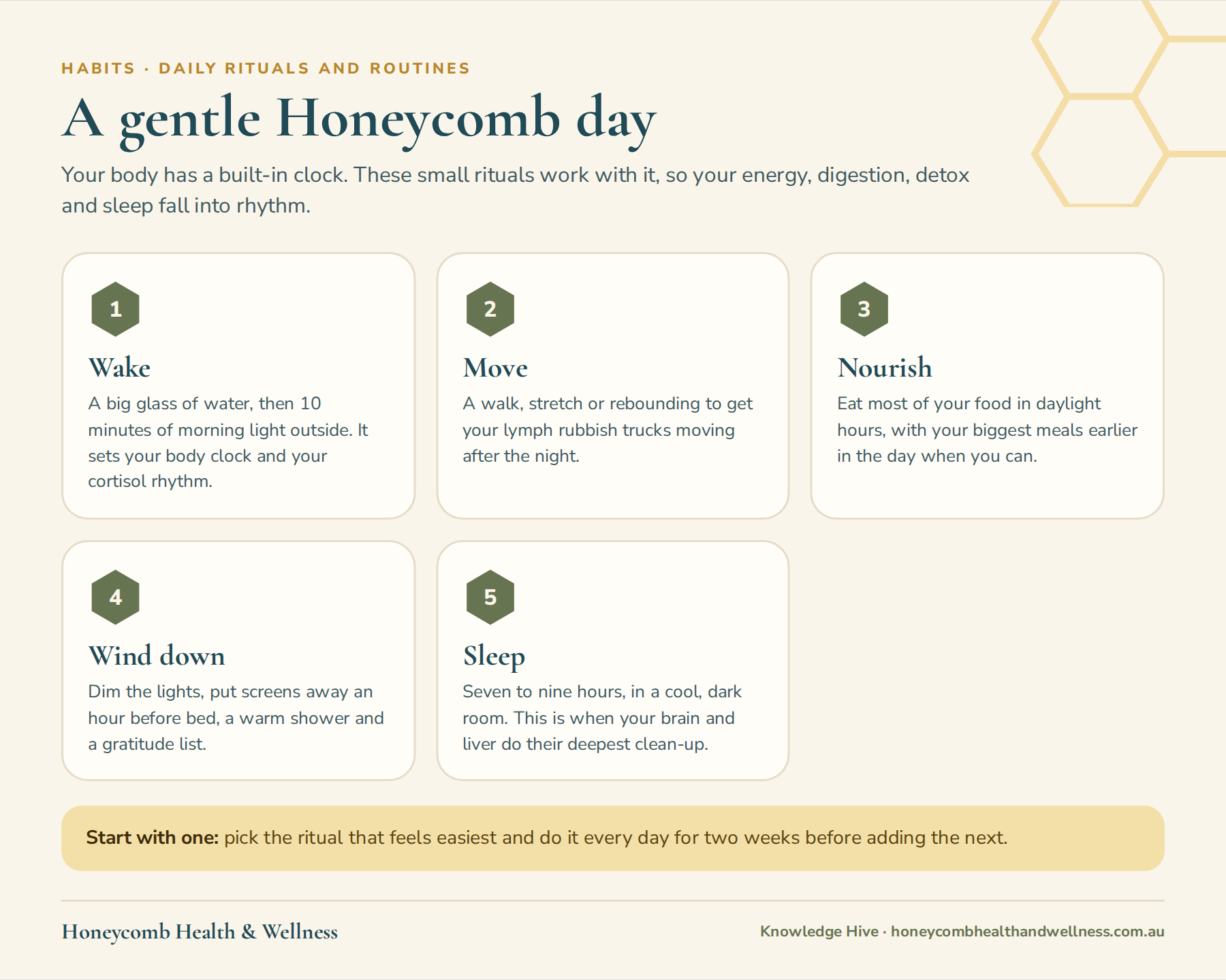
- Water before coffee. You lose water overnight through breathing. A big glass of water, with a squeeze of lemon if you like, rehydrates you and gets your bowel moving.
- Morning light. Ten minutes outside, without sunglasses, tells your brain it’s daytime and sets up better sleep tonight.
- Move. A short walk, gentle stretching, yoga or a few minutes on a rebounder gets your lymph flowing.
- A moment of intention. Before the phone, take three breaths and ask: “Who do I want to be today?” Some people pray, some journal, some simply sit with a cup of tea.
- A fibre-rich breakfast, like oats with berries and ground flax.
An evening ritual
- Finish eating two to three hours before bed where you can, so digestion isn’t competing with repair.
- A short walk after dinner helps steady blood sugar.
- Dim the lights and put screens away an hour before bed. Bright light at night delays your sleep hormone, melatonin.
- A warm shower or bath, then let your body cool down. A dropping body temperature signals sleep.
- Three good things. Write down three things you’re grateful for. It shifts your mind from worry to peace.
- Same bedtime, most nights. Your body loves consistency.
Why rituals work better than willpower
Researchers following people building new habits found it took anywhere from 18 to 254 days for a habit to become automatic, with an average of about 66 days (Lally et al., 2010). Missing a day here and there didn’t derail them. What mattered was repeating the habit in the same situation, so it became linked to a cue.
That’s why rituals are so powerful. When your morning water always follows your feet hitting the floor, you stop having to think about it. It becomes who you are.
Start small
Please don’t try to do all of this tomorrow! Pick the one ritual that feels easiest, and do it every day for two weeks. Then add the next. Small daily wins build a new identity: I’m someone who looks after my body.
Recipes for your rituals
- Cinnamon Pear Oatmeal for a warming morning
- Green Lemonade Smoothie
- Veggie & Vermicelli Noodle Soup for a light, early dinner
You don’t rise to the level of your goals. You fall to the level of your routines. So make the routine kind.
References
- Lally P et al. How are habits formed: modelling habit formation in the real world. European Journal of Social Psychology. 2010;40(6):998-1009.
- Xie L et al. Sleep drives metabolite clearance from the adult brain. Science. 2013;342(6156):373-377.
- Chang AM et al. Evening use of light-emitting eReaders negatively affects sleep, circadian timing, and next-morning alertness. Proceedings of the National Academy of Sciences. 2015;112(4):1232-1237.
How Honeycomb can help
You don’t have to work this out alone
This information is general education and is not a substitute for individual advice. Please speak with your health practitioner before making changes, especially if you take prescribed medication.
Keep going
You’re not doing this alone
This information is general education and is not a substitute for individual advice. Please speak with your health practitioner before making changes, especially if you take prescribed medication.