
If I had to choose one organ to love a little more, it would be the liver. It sits quietly under your right ribs, weighs about 1.5 kilograms, and does more than 500 jobs. It never complains, until it’s really overloaded.
What your liver does all day
- Filters your blood: about 1.5 litres pass through it every minute.
- Processes waste: alcohol, medications, used hormones, pesticides and the waste your cells make.
- Makes bile to digest fats, and as a way to send waste to the bowel.
- Manages fuel: it stores glucose and releases it between meals to keep your blood sugar steady.
- Makes cholesterol and the proteins that help your blood clot.
- Stores vitamins and minerals, like vitamin B12, vitamin A and iron.
- Balances hormones, by clearing used oestrogen and other hormones.
How the liver cleans up
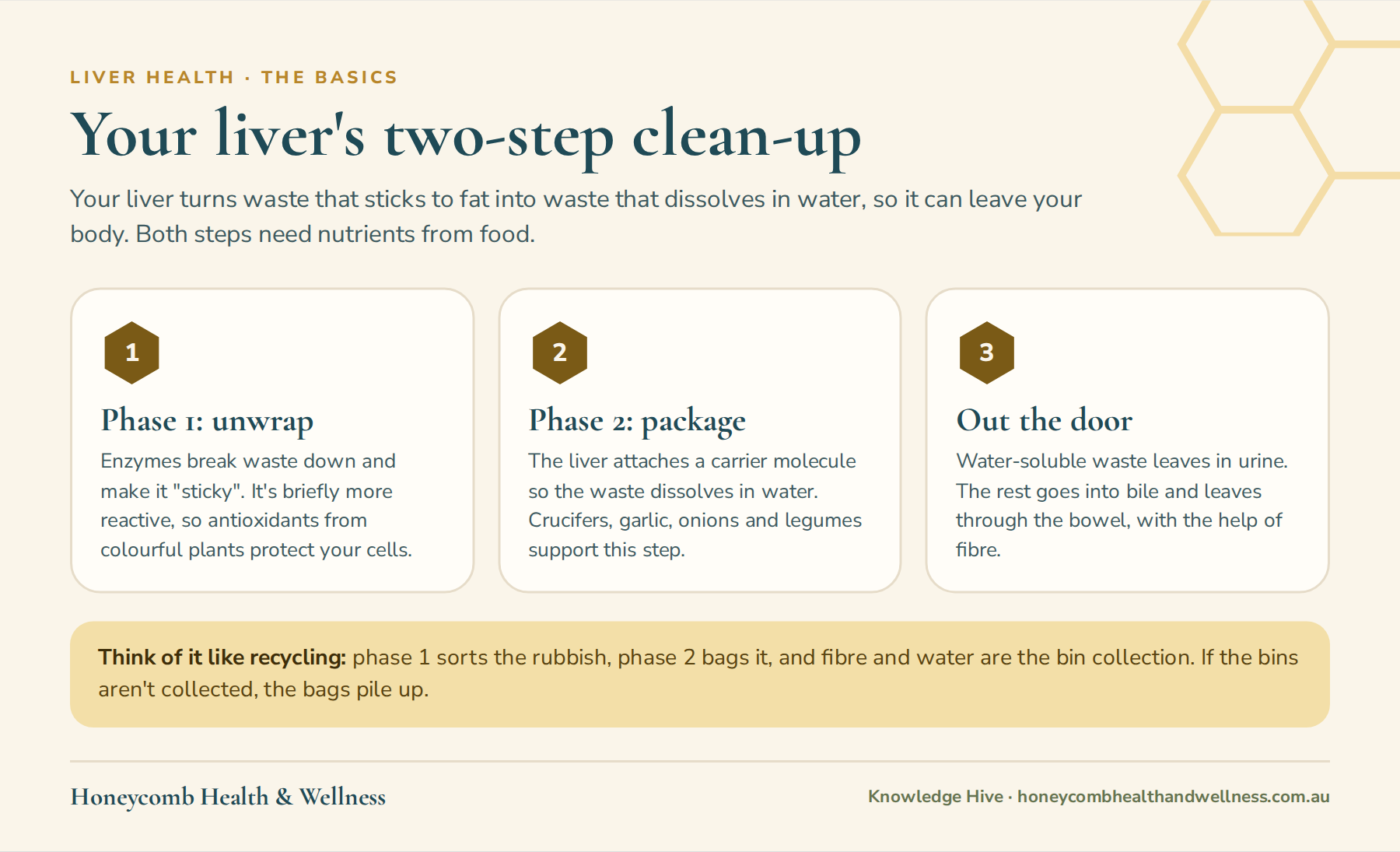
Many toxins are fat-soluble, which means they like to hide in fatty tissues and can’t simply be washed out in urine. Your liver’s job is to change them into a water-soluble form so they can leave.
It’s a bit like sorting the recycling at home. Phase 1 sorts it, phase 2 bags it, and your bowel and kidneys take the bags to the kerb. If the bin truck doesn’t come (hello, constipation!), the bags start piling up in the garage. It’s not exactly like this scientifically, but it’s an easy way to understand it.
Signs your liver may be overloaded
- Tiredness, especially waking up tired
- Bloating and difficulty digesting fatty meals
- Nausea, or a bitter taste in the mouth
- Weight gain around the middle
- PMS, heavy periods or hormone imbalance
- Skin issues, like acne, rashes and itching
- Feeling worse after alcohol, or sensitivity to smells
- Waking between 1 and 3 am
These signs aren’t specific to the liver, so they’re a reason to look closer, not to self-diagnose. Liver function tests, iron studies and other bloods can tell us a lot, and in clinic I interpret them alongside functional testing to get to the root cause.
The silent epidemic: fatty liver
Non-alcoholic fatty liver disease, now often called MASLD, affects about one in four adults worldwide (Younossi et al., 2016). It’s closely linked to insulin resistance, excess weight around the middle and a diet high in added sugars, refined foods and saturated fat. Most people have no symptoms. Read more in my article on fatty liver.
The encouraging news is that the liver is remarkably good at repairing itself. People who eat more healthy plant foods have a lower likelihood of fatty liver (Mazidi and Kengne, 2019), and in many people it improves with weight loss and food changes.
How to love your liver
- Eat crucifers every day: broccoli, cauliflower, cabbage, kale, rocket and Brussels sprouts.
- Add bitter greens: rocket, radicchio, endive and dandelion stimulate bile flow.
- Fill up on fibre so the waste your liver sends out actually leaves.
- Cut back on alcohol, sugary drinks and ultra-processed foods.
- Keep a steady weight and move every day. Even a 5 to 10% weight loss can reduce liver fat.
- Sleep, because your liver does much of its repair work overnight.
For more ideas on the plate, read Foods that love your liver.
Recipes that help
- Elevate Your Dinner with Tofu Vegetable Stir Fry
- Apple Kohlrabi Salad, a crunchy crucifer
- Bean Machine Juice
Your liver is working for you every minute of every day. A little care goes a very long way.
A note on medication: please don’t stop or change any prescribed medication on your own. When you change the way you eat, your numbers can move quickly, so keep your prescribing doctor informed so your doses can be reviewed as you improve.
References
- Younossi ZM et al. Global epidemiology of nonalcoholic fatty liver disease: meta-analytic assessment of prevalence, incidence, and outcomes. Hepatology. 2016;64(1):73-84.
- Mazidi M, Kengne AP. Higher adherence to plant-based diets are associated with lower likelihood of fatty liver. Clinical Nutrition. 2019;38(4):1672-1677.
- Hodges RE, Minich DM. Modulation of metabolic detoxification pathways using foods and food-derived components: a scientific review with clinical application. Journal of Nutrition and Metabolism. 2015;2015:760689.
How Honeycomb can help
You don’t have to work this out alone
This information is general education and is not a substitute for individual advice. Please speak with your health practitioner before making changes, especially if you take prescribed medication.
Keep going
You’re not doing this alone
This information is general education and is not a substitute for individual advice. Please speak with your health practitioner before making changes, especially if you take prescribed medication.