Do you check your emails in bed? Answer a work message while the kids are in the bath? Lie awake going over tomorrow’s to-do list, or feel that Sunday-afternoon dread creeping in? You’re not alone. In clinic, I often see people who are tired but wired: exhausted all day, then wide awake at night, with tight shoulders, a jumpy tummy and a short fuse.
Very often, the missing piece isn’t another supplement. It’s a boundary: a clear line where work stops and the rest of your life begins. Phones, laptops and working from home have made that line very blurry. Let’s look at why it matters so much, and how to draw it again.
Your body needs an ‘off’ switch
Stress isn’t the enemy. A deadline gives you a burst of cortisol and adrenaline that helps you focus and get things done. The problem comes when the stress switch never turns off. Your body is designed to work hard and then recover, like a tide that goes out and comes back in.
Researchers call that recovery psychological detachment: not just being away from work, but not thinking about it either. People who mentally switch off in their evenings and weekends have better mood, less exhaustion and better sleep, and they’re actually more engaged at work the next day (Sonnentag, 2012).
The catch is that a phone in your pocket keeps you half at work. In one diary study, people who used their smartphone for work in the evening found it harder to switch off and felt more drained the next day (Derks and Bakker, 2014). There’s even a name for the itch to reply straight away: workplace telepressure. People who feel it most report more burnout and poorer sleep (Barber and Santuzzi, 2015).
The phone battery
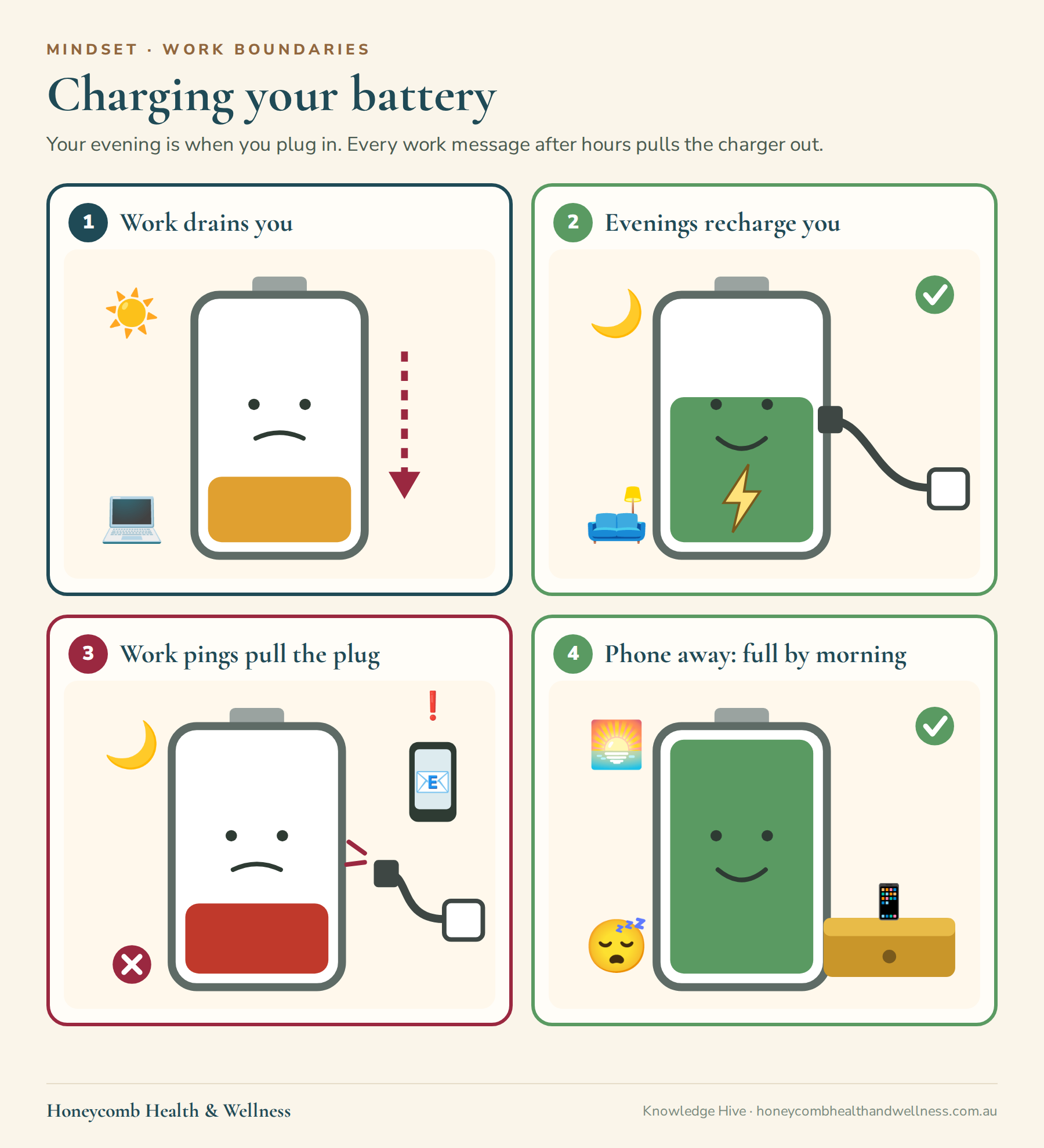
It’s kind of like this. Think of your energy as your phone battery. You start the day full, and work drains it. Your evening is when you plug in to charge.
Every time you check an email or answer a work message after hours, it’s like pulling the charger out. You go to bed on 40% and wake up on 50%. Do that night after night and you start every day half empty, wondering why you’re so tired. It’s not exactly like this scientifically, but it’s an easy way to picture it: recovery only happens while you’re plugged in.
Why it matters for your health
This isn’t just about feeling a bit flat. Long hours and never switching off show up in the body:
- Your heart. A World Health Organization and International Labour Organization study estimated that working 55 hours or more a week led to about 745,000 deaths from stroke and heart disease in a single year (Pega et al., 2021). In a large review of more than 600,000 people, long hours were linked to a higher risk of stroke (Kivimäki et al., 2015).
- Your sleep. Bright screens late at night hold back melatonin, your sleepy hormone. In one trial, reading on a tablet before bed meant people took longer to fall asleep and felt less alert the next morning than when they read a printed book (Chang et al., 2015). Read more in Sleep: your deepest detox.
- Your blood sugar and gut. Ongoing stress keeps cortisol up, which nudges blood sugar higher and slows digestion. It’s one reason stressed evenings so often end in the pantry. See Stress and your body and Emotional eating.
- Burnout. The World Health Organization now describes burnout as the result of workplace stress that hasn’t been managed: exhaustion, feeling cynical or distant from your job, and getting less done.
The four things that actually recharge you
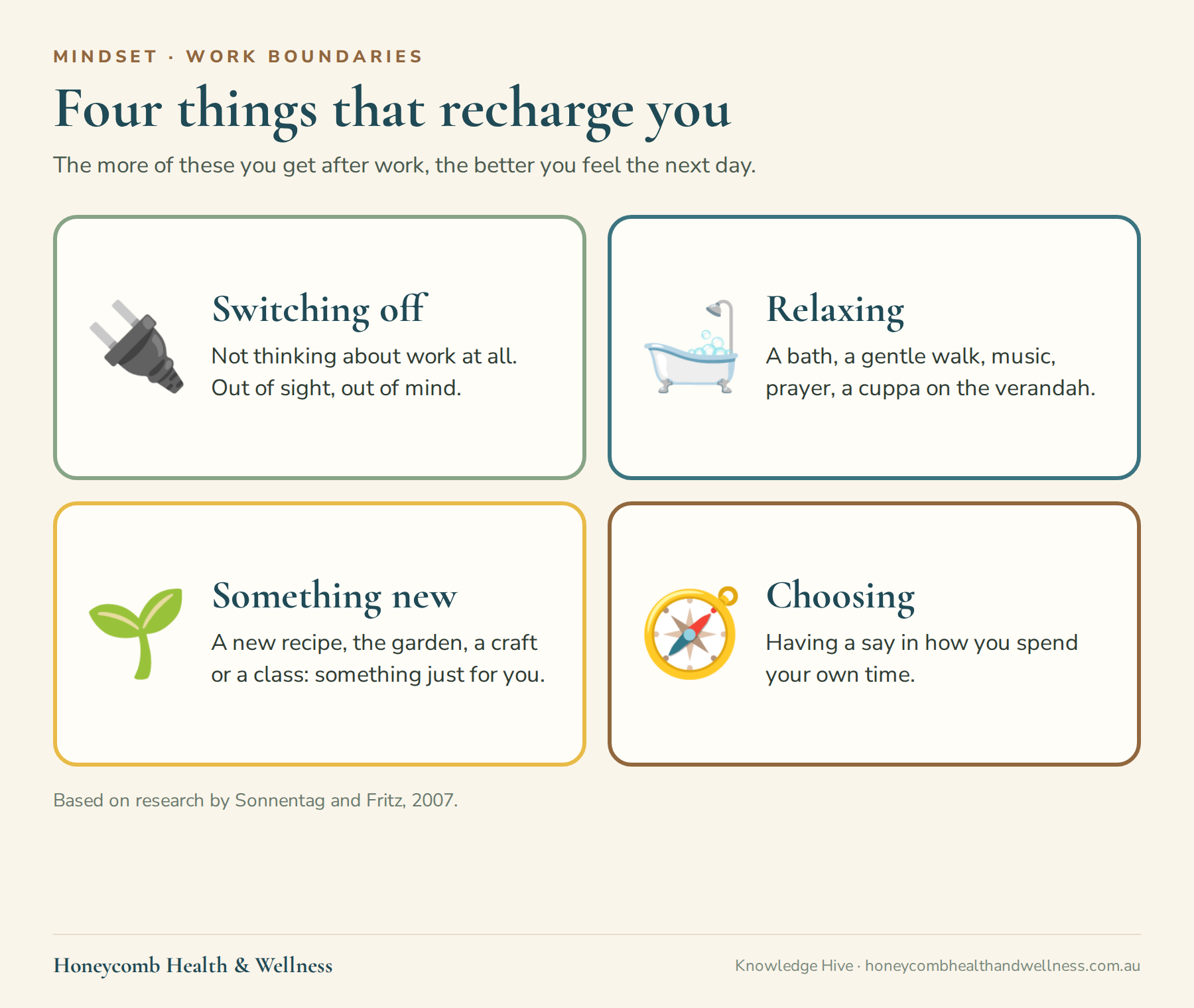
Rest isn’t only lying on the couch. Researchers have found four kinds of recovery experience, and the more of them you get, the better you feel (Sonnentag and Fritz, 2007):
- Switching off: not thinking about work at all.
- Relaxing: anything that slows you down, like a bath, a gentle walk, music or prayer.
- Something new: learning or doing something just for you, like a new recipe, gardening, a craft or a class.
- Choosing: having some control over how you spend your own time.
You have the right to disconnect
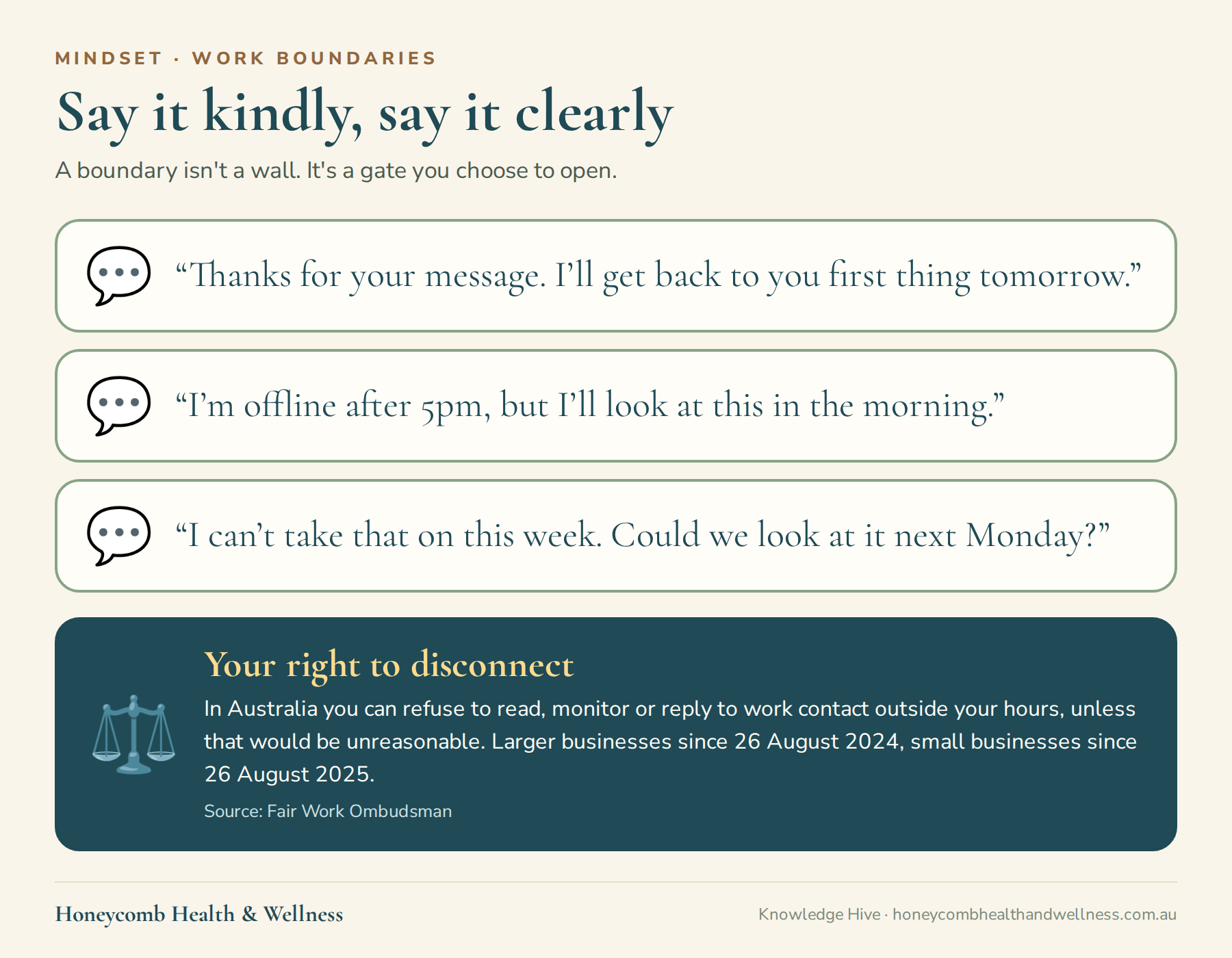
Here’s something many Australians don’t know. Since 26 August 2024, employees of larger businesses have a legal right to disconnect, and since 26 August 2025 that includes people who work for small businesses too. It means you can refuse to read, monitor or respond to work contact outside your working hours, unless refusing would be unreasonable (Fair Work Ombudsman).
If you run your own business, work from home or care for a family, no law will do it for you. You have to give yourself that right. I know how hard that can be, and how much better everyone is for it when you do.
Draw the line: five boundaries to try
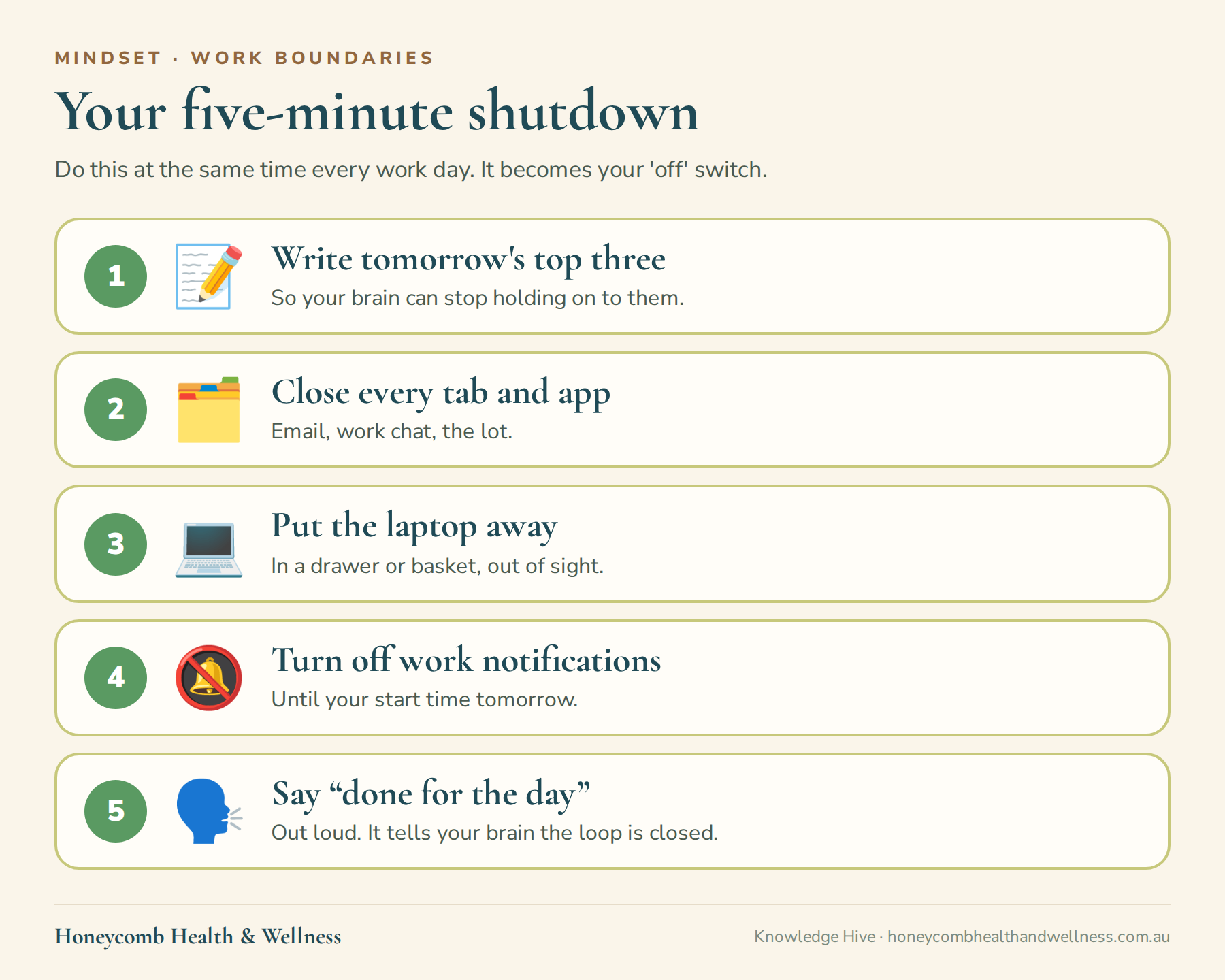
- Set a finishing time, and finish with a short shutdown ritual: write tomorrow’s top three jobs, close every tab, and say out loud, “Done for the day.” It sounds silly, but it tells your brain the loop is closed.
- Give work a home. If you work at the kitchen table, pack the laptop into a drawer or basket at the end of the day, so it isn’t staring at you over dinner.
- Turn off work notifications after hours, and move email and work chat apps off your home screen. Out of sight really is out of mind.
- Tell people. Put your hours in your email signature and let clients and colleagues know when you’ll reply. Most people respect a boundary that’s said kindly and clearly.
- Protect your first and last hour. No work, news or scrolling for the first hour after you wake and the last hour before bed.
Not sure what to say? Simple, friendly words work best:
- “Thanks for your message. I’ll get back to you first thing tomorrow.”
- “I’m offline after 5pm, but I’ll look at this in the morning.”
- “I can’t take that on this week. Could we look at it next Monday?”
Sort your list: the four boxes
When your to-do list feels endless, it’s hard to switch off because everything feels urgent. The Eisenhower Matrix, named after US President Dwight Eisenhower, sorts tasks by two questions: is it urgent, and is it important?
- Urgent and important: do it now. Real deadlines and genuine emergencies.
- Important but not urgent: schedule it. This is where your health lives: meal prep, movement, sleep, planning and the people you love. Put it in the diary so it doesn’t get pushed out.
- Urgent but not important: hand it over or batch it. Most interruptions, many emails and other people’s last-minute requests.
- Neither: let it go. Mindless scrolling and tasks that don’t serve your goals.
Write your list once a week, sort each task quickly (go with your first instinct, or everything ends up in box one) and check in on it each morning. The more you protect box two, the fewer emergencies end up in box one.
Who are you becoming?
Boundaries can feel selfish at first, especially if you’re the one everyone relies on. But a boundary isn’t a wall to keep people out. It’s a gate that lets you choose what comes in, so you can show up for the people and work you love with energy left over.
Start to see yourself as someone who rests well, not someone who gets through. Rest is part of the design, not a reward you earn once everything’s done. Your body is a gift worth caring for.
What you can start today
- Pick your finishing time for tonight and write it down.
- Do the five-minute shutdown when you get there.
- Turn off email notifications after hours on your phone.
- Charge your phone outside the bedroom and use a cheap alarm clock instead.
- Plan one thing just for you this week: a walk, a class, time in the garden.
Recipes that help
Easy, ready-to-go meals take the pressure off busy evenings, so you can switch off sooner:
- Slow Cooker Spiced Carrot & Lentil Soup: into the slow cooker in the morning, ready when you finish
- Cinnamon Overnight Oats: made the night before, so your morning starts calm
- Potato & Leek Soup: cosy, simple and freezes well
If you’re running on empty, my free Health Assessment is a good place to start, and inside the Honeycomb Community you’ll find others building gentler rhythms too.
Rest isn’t a reward for getting everything done. It’s part of the design.
If you’re struggling, please reach out. In clinic I can help with the physical side of stress, and you don’t have to carry it alone. If you need someone to talk to now, call Lifeline on 13 11 14 or Beyond Blue on 1300 22 4636, any time.
References
- Sonnentag S. Psychological detachment from work during leisure time: the benefits of mentally disengaging from work. Current Directions in Psychological Science. 2012;21(2):114-118.
- Sonnentag S, Fritz C. The Recovery Experience Questionnaire: development and validation of a measure for assessing recuperation and unwinding from work. Journal of Occupational Health Psychology. 2007;12(3):204-221.
- Derks D, Bakker AB. Smartphone use, work-home interference, and burnout: a diary study on the role of recovery. Applied Psychology. 2014;63(3):411-440.
- Barber LK, Santuzzi AM. Please respond ASAP: workplace telepressure and employee recovery. Journal of Occupational Health Psychology. 2015;20(2):172-189.
- Pega F et al. Global, regional, and national burdens of ischemic heart disease and stroke attributable to exposure to long working hours for 194 countries, 2000-2016: a systematic analysis from the WHO/ILO Joint Estimates. Environment International. 2021;154:106595.
- Kivimäki M et al. Long working hours and risk of coronary heart disease and stroke: a systematic review and meta-analysis. The Lancet. 2015;386(10005):1739-1746.
- Chang AM et al. Evening use of light-emitting eReaders negatively affects sleep, circadian timing, and next-morning alertness. PNAS. 2015;112(4):1232-1237.
- World Health Organization. Burn-out an “occupational phenomenon”: International Classification of Diseases (ICD-11). 2019.
- Fair Work Ombudsman. Right to disconnect. fairwork.gov.au, 2024-2025.
How Honeycomb can help
You don’t have to work this out alone
This information is general education and is not a substitute for individual advice. Please speak with your health practitioner before making changes, especially if you take prescribed medication.
Keep going
You’re not doing this alone
This information is general education and is not a substitute for individual advice. Please speak with your health practitioner before making changes, especially if you take prescribed medication.